AI can now spin tunes in seconds, copy a singer’s tone, and nail chart-ready structures. Yet listeners still argue about whether it “feels” human. The shock is this: our ears aren’t the final judge. Our lives are.
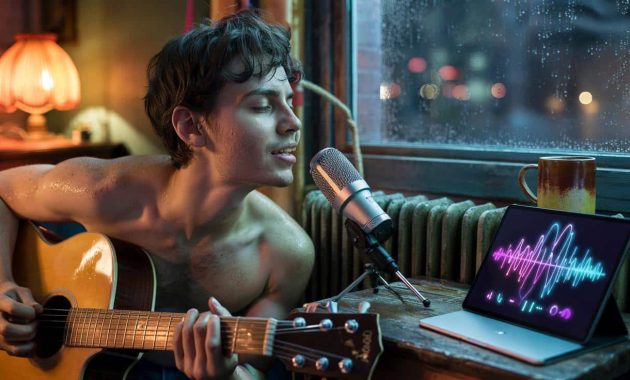
One is a pristine AI render, spotless and glossy, the chorus gripping like a handshake that won’t let go. The other is a late-night demo recorded in a flat that hums with the neighbour’s boiler, the vocal cracking on a high note you’d normally delete. We sit quietly, tea going cold, as the radiator ticks in time. The polished one sounds bigger. The messy one makes us both grin. He looks at me and shrugs. Which one is true? He hits spacebar again. The room answers before I do. Something deeper is doing the listening.
Beyond the sound: what your body knows before your ears decide
Ask a crowd why a song feels human and many will point to voice, groove, melody. All true, but incomplete. What moves us isn’t only the sound—it’s the trace of a person making it, the risk of a take, the room bleeding in. Our brains lean towards stories before they accept facts. Put a heartbeat beneath a loop and it often rings hollow. Put a squeak of a chair before a chorus and you lean in. **It’s what happens around the song.** That faint wobble of time tells us someone was there.
We’ve all had that moment when a busker, mic taped to a broomstick, makes a street corner feel like a chapel. A year ago, an AI “Drake” and “Weeknd” duet racked up millions of plays before it vanished from platforms, slick and uncanny. Meanwhile, a tiny live clip from a Manchester bar—just a voice and a beat-up guitar—shot through group chats for days. The difference wasn’t pitch accuracy. It was context. One had a whisper of transgression and novelty; the other had a room, a night, people clinking glasses and missing lines. The ear hears frequencies. The brain hears life.
Neuroscientists talk about expectations and prediction. Your brain is constantly guessing the next snare, the note, the breath. When a human performer tugs ahead or falls behind by a hair, the brain gets a spark—surprise without confusion. That micro-timing is hard to fake, because it’s not random; it’s tethered to attention, effort, and fatigue. AI can simulate swing, but swing isn’t a numerical offset. It’s a social pulse. You and I sway together, then diverge. Meaning blooms in that tiny gap. That’s why a perfect copy often feels colder than a flawed original. The copy nails the surface. The original carries a day.
How to make AI music feel more human (without faking it)
Start with something that cannot be downloaded: a reason. Before you prompt, write one line on why this piece exists today. Then capture a single human artefact to anchor the track—a voice note, a found footstep, the hiss of your flat at 02:13. Build around that relic. Humanise rhythm by recording one take of handclaps, not five quantised layers. Nudge tempo with micro-drift across sections, not random jitter. A useful rule: keep timing variation within 1–3% and tie it to phrasing, not to bars. The point isn’t mess. It’s consequence.
Common mistake: over-explaining humanity through plugins. You don’t need eight vinyl crackle layers. You need a choice that cost you something. Maybe you keep the cracked note that tells the story. Maybe you mute the safest chorus. Let’s be honest: no one really does that every day. It stings. Yet that sting reads as real, even when the rest is machine-sculpted. Another trap is Franken-referencing—stacking 12 chart hits until your song has no face. Pick one spine. Make the rest argue with it. Leave silence where a tutorial would say “fill”. Silence is proof of trust.
People also ask where to put the “imperfection”. Think less about flaws and more about **evidence**. Who touched this sound? When did they stop? Print answers into the file itself. Freeze a decision early and live with it for a week. That friction will leak into your phrasing and your edits, even with AI on drums and keys. *Music is not a spreadsheet.* It’s a diary entry sung out loud on a deadline.
“The humanity isn’t in the plugin you choose. It’s in the options you leave on the table,” a London producer told me last week. “Commit early. Risk a small thing. People hear that.”
- Leave proof of life: count-in, breath, room tone, one squeak.
- Vary chorus 2: change one chord colour or shorten a bar.
- Automate micro-swells on the master by hand, not by preset.
- Print one stem as mono; pan with intent, not symmetry.
- Risk something small: a lyric that names a street, a specific Tuesday, a cheap mic.
The shocking part: the human bit lives outside the file
We keep hoping a perfect audio file will feel human on its own. It rarely does. Feeling comes from the web around it—how you release it, who frames it, which room breathes it back. Post an AI ballad with a short note about the friend you wrote it for and the night you almost didn’t. Play a clip live once before dropping it online. Let a visual show the rough edges your mix hides. The paradox is sharp: the more you acknowledge the machine, the more your small human choices glow. That’s not a cheat. That’s culture doing its job. The song is the spark. The meaning is the air.
➡️ Valentine’s Day : 58% believe kindness to animals predicts loyalty in relationships
➡️ Air Force Fighter Jets Intercept 2 Aircraft That Violated Airspace Near Mar-A-Lago
| Point clé | Détail | Intérêt pour le lecteur |
|---|---|---|
| Context over waveform | Meaning comes from story, timing, and setting, not just sound quality | Makes your AI tracks resonate beyond novelty |
| Evidence beats imperfection | Embed traces of real decisions and moments into the audio | Creates believable presence without gimmicks |
| Design the release | Frame the music with the right moment, note, and room | Turns plays into connection and conversation |
FAQ :
- Can AI music ever truly feel human?Yes, when the listener perceives intention, risk, and context. The file helps, the frame completes it.
- Do I need to add mistakes to get “human” vibe?No. Add evidence of choices: breaths, tempo drift tied to phrasing, small arrangement changes.
- Will audiences care if I disclose AI use?Many will, if you also share why the song exists. Openness plus purpose tends to build trust.
- What about legal and ethical issues?Use licensed models and your own data where possible. Avoid cloning living artists’ likeness without consent.
- How do I test if a track feels alive?Play it quietly on a phone in a busy room. If conversation pauses at the chorus, you’ve got a pulse.