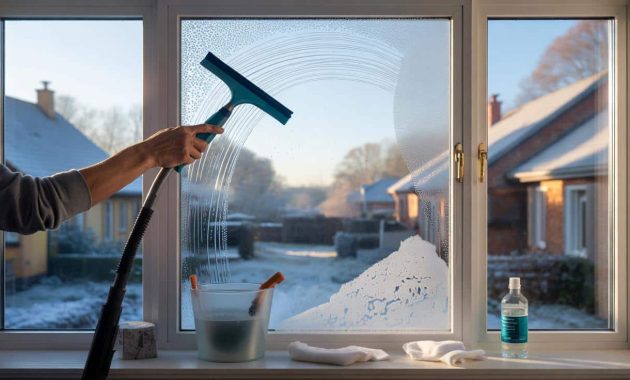
Winter windows tell on us.
Across the country, kettles boil, radiators tick on and panes fog white before the first coffee is poured. The good news is that professionals don’t battle this with magic sprays or endless scrubbing. They rely on a few smart tweaks to how you clean, warm and ventilate your windows so they stay clearer for longer, even on the coldest days.
Why winter makes every streak and smudge look worse
Winter isn’t just about dirtier windows; it actively changes how cleaning behaves on glass and frames. Cold glass makes warm water evaporate too fast, leaving behind soap residue and limescale trails.
Low, sharp sunlight does the rest. That thin January beam slides across the pane and highlights every leftover droplet and wipe mark you missed in December.
Cold glass, hard water and strong sun combine into the perfect streak factory unless you change how you clean.
There’s also the issue of frames. Many people spritz the glass straight away, then panic when pale streaks appear minutes later. What’s really happening is that dusty tracks, loose uPVC chalk or flaking paint are being dragged from frame to pane with every swipe.
Humidity finishes the job. Steamy showers, boiling pans and drying laundry push indoor moisture to 60 or 70 per cent. Once the air cools in the evening, that vapour lands on the coldest surface it can find: the window.
Frame-first: the pro shortcut to fewer streaks
Professional cleaners talk about “frame discipline”. It sounds fussy. It’s not. It just flips your order of attack.
Clean the bits you don’t look at first
Start with the unglamorous parts:
- Run a soft-brush vacuum along the window tracks and drainage holes.
- For uPVC, use warm water with a tiny dot of washing-up liquid and a microfibre cloth.
- For painted timber, use barely damp cloths and a gentle soap, then dry the wood straight away.
- For aluminium, keep it mild and avoid harsh powders and heavy abrasives.
Once the frames are clean, buff them dry. That extra minute stops grey streaks transferring onto the glass and undoing all your hard work.
➡️ 9 parenting attitudes that create unhappy children, according to psychology
➡️ Scientists Identified a New Blood Group After a 50-Year Mystery : ScienceAlert
➡️ This everyday home item is driving damp and mould this winter (and the fix is surprisingly simple)
➡️ Venom-proof frogs snatch and swallow live “murder hornets” in Japan
➡️ How to remove mould from your washing machine drawer – and stop it coming back
➡️ With spice from the kitchen: How to drive mice and rats away in winter
Clean frames mean your first swipe on the glass is actually cleaning, not dragging grime across a cold pane.
The winter glass recipe: cooler water, lighter soap
Most people reach for very hot water and lots of detergent. That works on greasy pans. On winter glass, it backfires.
The mix professionals keep coming back to
- Cool or lukewarm water in a small bucket.
- One tiny drop of washing-up liquid, not a squeeze.
- A splash of distilled or deionised water if you live in a hard-water area.
- On near-freezing days, a capful of isopropyl alcohol to stop the mix glazing on the glass.
Use a good-quality squeegee around 30–35cm wide. Work in smooth S-shaped strokes from top to bottom, wiping the rubber blade on a cloth between each pass so it doesn’t drag droplets back up the pane.
Finish with a dry microfibre cloth around the edges and corners. That detail work is what stops “mysterious” drips appearing half an hour later.
Frame first, light soap, cool water, sharp rubber, edges last: that simple sequence is what separates pro-looking results from cloudy glass.
Common mistakes that quietly ruin the shine
- Paper towels: leave lint and fibres that cling to static on cold glass.
- Direct winter sun: speeds up evaporation and bakes streaks in before you can squeegee.
- Too much detergent: leaves a thin film that only shows when the afternoon light hits.
- Old squeegee rubber: tiny nicks in the blade create the same line of streaks every time.
For stubborn fingerprints or cooking film, use a 50:50 mix of white vinegar and distilled water as a spot treatment, then rinse with your normal solution so that the smell and acidity don’t sit on seals and frames.
Condensation: why your windows “sweat” every morning
Condensation is just physics playing out in your living room. Warm, moist air touches a cold surface, cools down, and drops water. Bedrooms and kitchens get hit worst because breathing, sleeping, cooking and washing all load the air with moisture.
When indoor humidity climbs past roughly 60 per cent on a cold night, your windows turn into the bathroom mirror after a long shower.
Three things matter: how much moisture is produced, how fast it leaves, and how cold the glass gets. You can’t stop breathing or boiling pasta, so you focus on the other two.
Everyday habits that quietly cut condensation
- Crack trickle vents and open windows for a five-minute “burst” twice a day.
- Keep a steady, low background heat around 18–19°C instead of sharp evening blasts.
- Cook with pan lids on and run extractor fans for at least 10–15 minutes after finishing.
- Run bathroom fans until the mirror is totally clear, not just while you shower.
- Dry laundry in one room with a dehumidifier if possible, doors closed.
A cheap digital hygrometer on a shelf can show you when humidity is creeping too high. Aim for 40–55 per cent most of the time. You’ll feel more comfortable and the glass will stay drier.
Quick fixes when the window is already dripping
Some mornings, the damage is done. The sill is wet, the frame is beading, and you’re in a rush.
Use a window vac or a dedicated microfibre cloth to pull the water off the glass and out of the lower seals. Leaving it to dry on its own encourages black mould to form around the rubber and in the corners.
Check the drainage slots — the little holes along the bottom of many frames. If they’re blocked with dirt or cobwebs, trapped water will sit against the frame and stain it, or start to smell musty.
Fast removal of morning moisture protects seals and paint, and cuts that damp, cold feeling in the room.
If condensation keeps returning, look at furniture placement. Beds and wardrobes pushed against external walls create icy patches and stale pockets of air. Pull them a hand’s width away from the wall so air can move and the surface warms slightly.
For older single-glazed or very cold windows, seasonal secondary glazing film can lift glass temperature just enough to tip you away from the dew point. It’s not glamorous, but the shift in comfort is often bigger than people expect.
Anti-fog tricks pros quietly use
On bathroom glass and mirrors, cleaners sometimes create a near-invisible film that slows fogging. You can do a softer version at home.
- Put a tiny dot of washing-up liquid on a damp cloth.
- Buff it across the glass until it vanishes.
- Polish again with a dry microfibre to remove any visible smear.
Shaving foam rubbed on and polished off works on mirrors too, though keep it away from wood and porous stone. For bedroom windows that mist every night, a small dehumidifier on a timer can make a bigger difference than another blast of heating, and often for less money.
A quick reference for your next cleaning session
| Step | What to do | Why it helps |
|---|---|---|
| 1. Frames | Vacuum tracks, wash gently, dry and buff | Stops residue dragging onto the glass |
| 2. Mix | Cool water, tiny soap, splash of distilled water | Reduces film and mineral streaks |
| 3. Squeegee | S-strokes, wipe blade between passes | Gives a smooth, professional-looking finish |
| 4. Edges | Dry microfibre around seals and corners | Prevents late-appearing drips and runs |
| 5. Moisture | Ventilate briefly, use fans, manage laundry | Cuts condensation and mould risk |
What “dew point” and “hard water” actually mean for your windows
Weather forecasts talk about dew point all the time. In your home, it’s the temperature at which the moisture in your indoor air turns into liquid water on surfaces. When the glass drops below that temperature, condensation forms. Raise the glass temperature a little, or lower the moisture in the air, and the problem eases.
Hard water is tap water with a lot of dissolved minerals like calcium and magnesium. When it dries on glass, those minerals stay behind as milky spots and faint vertical streaks. Distilled or deionised water has had those minerals removed, which is why professionals lean on it for smear-free finishes, especially in hard-water regions.
Real-life winter window scenarios
Take a small city flat with no outdoor drying space. The occupant dries clothes on radiators, skips using the noisy bathroom fan at night, and only opens windows at weekends. Humidity climbs all week, bedroom glass is wet every morning, and black spots appear along the sill by February. By shifting laundry to one room with a compact dehumidifier and running the fan for 15 minutes after each shower, the window stops dripping and the mould stops spreading.
In a suburban semi, a family keeps the heating low all day, then cranks it up for a few hours in the evening. The glass goes from chilled to warm and back again in a cycle. By nudging the thermostat to a steady 18–19°C and adding a basic secondary glazing film in the coldest rooms, the windows sit closer to room temperature. Condensation drops and the rooms feel more comfortable without using far more energy.
Small, consistent tweaks to heat, ventilation and cleaning sequence beat occasional deep cleans that ignore how winter actually behaves.
The aim isn’t perfect panes, crystal clear every second of the season. It’s a routine that you can keep up on tired weekdays: quick frame wipe, smart mix, sharp blade, a few minutes of fresh air. Do that, and those rare slices of winter sun will hit your glass and show you the sky, not last night’s steam.