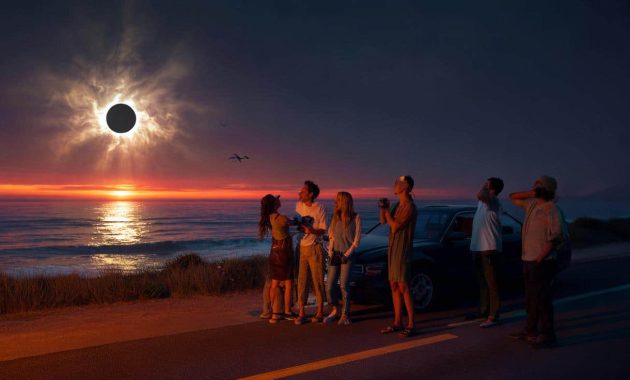
On a quiet coastal road in Mexico, a group of friends pulls over without really knowing why. The afternoon light looks… wrong. Shadows sharpen, the air cools a little, birds start circling as if they’ve lost their script. Someone checks their phone and whispers: “Imagine if this lasted for seven minutes.” Nobody answers. For a second, everyone just listens to the strange silence that arrives when the Sun begins to hide.
Then the light returns, fast and brutal, and life restarts as if nothing happened. Yet one idea hangs in the air, heavier than the heat.
What would it feel like if day turned into night for what, by our human standards, counts as an eternity?
When the Sun disappears… and stays gone
Astronomers already have a date circled in red: a total solar eclipse expected to be the longest of the 21st century. We’re talking about a phase of totality stretching beyond seven minutes, edging toward the theoretical limits of what Earth and the Moon can produce. That’s unusually long for our era.
Most people who have seen a total eclipse say it’s over in a breath. One minute you’re screaming, the next it’s daylight again. This time, the world will stay dark long enough for you to actually realize what’s happening.
Think back to 2009. A total solar eclipse passed over India, China and the Pacific, with a maximum totality of around 6 minutes and 39 seconds. Streets emptied, factories stopped, and in some villages people banged pots to “wake up” the Sun. Even veteran eclipse chasers came back shaken, saying their sense of time had melted.
The upcoming record eclipse pushes the needle further. Observatories are planning experiments they usually can’t fit into the tiny window of normal totality. Weather services will track the sudden drop in temperature. Airline companies are already thinking about “eclipse flights” at premium prices, because some people will pay a lot to sit in a sky that goes dark at noon.
Scientifically, this long blackout is a perfect storm of geometry. The Moon will be near perigee, the closest point in its orbit, which makes its apparent disk slightly larger. Earth will be near aphelion, when the Sun appears a bit smaller. Add the right path across the planet, with the shadow cutting almost perpendicularly across the equator, and the result is stunning: a shadow that lingers.
Astronomers love this, because more time in totality means better data on the Sun’s corona, that fragile halo we usually can’t see. For them, seven minutes of night in the middle of the day is not just spectacular. It’s a gold mine.
How to live through seven minutes of “impossible night”
The way to experience a record-breaking eclipse isn’t just about looking up. It starts months, sometimes years, before, with a decision most people postpone: where do I want to be when the sky does something my brain won’t fully understand? Seasoned eclipse chasers study maps, climate data, and typical cloud cover like travel agents on caffeine. Then they pick a spot on the path of totality and treat it like a pilgrimage.
If you’re tempted, the method is surprisingly simple. Choose a city on the shadow’s path, arrive at least a day early, and keep one backup location within a few hours’ drive in case of clouds.
There’s a quieter part, too: the emotional preparation. Lots of people imagine they’ll calmly admire the scene, take photos, maybe post a live story. Then the Moon bites into the Sun, the light turns a weird metallic gray, and all those plans evaporate. Some cry, some laugh helplessly, some forget they even brought a camera.
Let’s be honest: nobody really does this every single day. If you feel nervous or silly about planning your life around a seven‑minute shadow, you’re not alone. That mix of childlike excitement and slight dread is part of the experience.
For many scientists, this long eclipse is more than a curiosity. “It’s like someone gives us a slow‑motion replay of one of the rarest shows in the Solar System,” says one solar physicist. “We get to breathe during totality, instead of sprinting through our measurements.”
- Before the eclipse – Choose your spot on the path of totality, book early, and test your eclipse glasses at home.
- During partial phases – Use certified filters only, protect your eyes, and enjoy the changing light on the ground and on people’s faces.
- During totality – Drop the gear for a moment, look around, listen to the silence, and notice the horizon glowing like a 360° sunset.
- For kids and first‑timers – Explain that the Sun is not “dying”; have a simple script ready to avoid panic and keep the wonder.
- After the shadow passes – Write down what you felt, not just what you saw. Those few minutes warp memory in unexpected ways.
A long shadow that stretches into our future
When scientists talk about this longest eclipse of the century, the conversation always drifts beyond numbers. Yes, it’s a record. Yes, the physics is beautiful. Yet what sticks is something more basic: the raw shock of seeing our dependable Sun switch off for so long that our instincts start to itch. We’ve all been there, that moment when nature suddenly behaves differently and you realize how small your daily worries actually are.
*One brief, artificial night in the middle of the day can rearrange your sense of time for years.*
| Key point | Detail | Value for the reader |
|---|---|---|
| Record‑length totality | Eclipse expected to last over seven minutes in some locations | Helps you decide if this is a “once in a lifetime” trip worth organizing |
| Unique scientific window | Extended view of the solar corona and atmospheric effects | Gives meaning to the event beyond the spectacle in the sky |
| Preparation matters | Location, timing, and emotional readiness shape the experience | Turns you from passive spectator into an active witness of the event |
FAQ:
- Question 1Why will this solar eclipse be the longest of the century?
- Question 2Where on Earth will the longest totality be visible?
- Question 3Is watching a total solar eclipse dangerous for my eyes?
- Question 4How often do such long eclipses occur?
- Question 5Can weather or clouds “cancel” the experience?