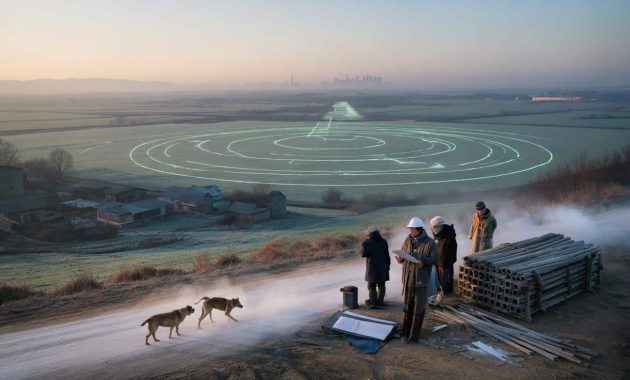
On a cold, hazy morning west of Beijing, the plain outside the capital looks like any other stretch of rural China. Low houses. Frost on the fields. A couple of stray dogs trotting along a dirt road. Somewhere under those fields, engineers once imagined burying a perfect circle dozens of kilometers wide — a giant underground loop that would fling particles close to the speed of light and, maybe, crack open new secrets of the universe.
Today, the fields are quiet. The grand model diagrams are rolled up. Budgets have been frozen, teams reassigned, and China’s most ambitious physics dream has been quietly placed on pause.
A machine that was supposed to outshine Europe’s CERN is now a symbol of something else.
When the universe collides with the budget
For a decade, the idea seemed irresistible: China would build the world’s largest particle accelerator, a machine bigger and more powerful than CERN’s Large Hadron Collider on the French-Swiss border. Physicists called it the Circular Electron Positron Collider (CEPC). The ring would stretch roughly 100 kilometers, more than three times the size of CERN’s collider, and cement China’s status as the new powerhouse of “big science.”
Beijing liked the symbolism. A project digging deep into the universe’s smallest particles, while projecting the country’s scientific stature across the planet. It looked like a space race, but underground.
The plan was simple on paper and wild in reality. First stage: build the CEPC to study the Higgs boson in extraordinary detail, turning China into the global hub for high‑energy physics. Then, in a later phase, reuse the same tunnel to host an even more powerful proton collider. Numbers flew: costs in the tens of billions of dollars, timelines stretching to the 2040s, thousands of researchers moving to a new “science city” built around the ring.
On conference slides, the 100‑kilometer loop glowed like a neon bracelet. Officials posed with scale models. Symposia ended with confident slogans about “leading the next generation of particle physics.” Nobody wanted to talk too loudly about who would actually pay every last yuan.
Reality caught up. China’s economy is slowing, local governments are drowning in debt, and Beijing has stepped on the brakes for flashy mega‑projects that don’t translate directly into factories, chips, or satellites. A multibillion‑dollar tunnel full of magnets and detectors suddenly had to compete with AI chips, 5G networks, electric cars, quantum labs, and a military modernization drive.
In that new hierarchy, the CEPC slipped from “must-have” to “nice, but not now.” The race with Europe turned into a pause button. And in big science, a pause can quietly mean “not this decade.”
How you build (and stall) a machine that smashes atoms
Building a particle collider is part moonshot, part construction nightmare. You don’t just pick an empty field and start digging. You need a region stable enough to host a perfect circle, far from earthquakes, far from dense cities, but still close enough to infrastructure and talent. Chinese teams scouted several provinces, pitched local leaders with glossy brochures, and dreamed up campuses with labs, apartments, cafes and schools for scientists’ families.
➡️ This new heater works at –22°C and uses far less energy
➡️ Princess Catherine’s Run for Rose Delights Everyone sparks massive online frenzy
➡️ At 50 and beyond, “underestimating total ownership costs is the most common mistake”
➡️ Goodbye to happiness : the age when it falters, according to science
Behind the scenes, committees in Beijing weighed geological surveys against budget spreadsheets. One approving stamp could have launched the biggest excavation in physics history. That stamp never came.
Instead, the global competition tightened. In Europe, CERN pushed forward with its own vision: the Future Circular Collider (FCC), another 100‑kilometer ring designed to follow the LHC. Japan flirted with a different machine, the International Linear Collider. Every region tried to show it was serious, but the numbers were brutal.
Estimates for the CEPC’s full program, including the later proton collider, floated into the 30–40 billion dollar range when you counted everything: civil engineering, power lines, cryogenic systems, detectors, long‑term operation. For a country juggling job market fears, a housing slump and tech sanctions, that price tag suddenly felt like a luxury toy. *Even in China, some dreams hit a ceiling made of hard cash.*
There’s a plain truth that physicists hate and finance officials love: particle colliders don’t generate obvious profits. They generate knowledge, and prestige, and sometimes spin‑off technologies years down the line. But you can’t flip a switch and sell Higgs boson data on the open market.
Beijing has shifted towards projects that scream “strategic” in bolder letters. Semiconductor fabrication plants. National AI platforms. Hypersonic test facilities. Deep‑sea drilling. These are the projects that slot neatly into industrial policy and military planning. In that crowd, a collider looks… abstract. Let’s be honest: nobody really does this every single day, weighing dark matter mysteries against GDP targets and youth unemployment. Yet that’s the kind of choice being made in very real, very closed meeting rooms.
What this pause really says about China, Europe, and the future of “big science”
When a project like the CEPC is slowed or frozen, the immediate instinct is to say: “China is giving up on basic science.” That’s too simple. The country is still pouring money into telescopes, fusion experiments, supercomputers, and space missions. What’s changing is how tightly those efforts are tied to national strategy, competition with the US, and short‑to‑medium term returns.
Think of it less as a retreat and more as a ruthless prioritization exercise, the kind that quietly reshapes a scientific generation.
For young Chinese scientists who trained in Europe or at CERN itself, the pause hits more personally. Many of them came home because they believed in this dream: designing detectors from scratch, leading international collaborations on Chinese soil, raising their kids in those planned “science towns.” Some are now drifting back to Europe or the US. Others are staying, but shifting to fields that feel safer: quantum computing, medical imaging, data science.
We’ve all been there, that moment when the thing you spent years preparing for is pushed just out of reach. You don’t quit science. You just tilt your career 20 degrees and hope the wind changes.
Meanwhile, Europe is watching with complicated emotions. On the one hand, Beijing’s hesitation eases the pressure on CERN and its member states. The FCC still faces fierce budget debates, but the specter of being “overtaken by China” is less sharp. On the other hand, physics as a whole loses something when there is only one serious path forward for the next big collider.
“Big colliders were always about more than nations,” one European physicist told me. “They’re about building a machine so difficult, so expensive, that the only sane answer is: let’s do it together. When countries step back into their corners, we all get smaller.”
- China’s pause buys time for Europe and Japan to firm up their own collider strategies.
- Talent flows may shift back toward CERN, strengthening its role but reducing global diversity.
- International collaboration becomes harder when geopolitics trumps curiosity-driven projects.
- Public appetite for huge, abstract science budgets could shrink everywhere, not just in Beijing.
- The next collider might emerge later, leaner, and only if several regions share the bill.
So what happens when the biggest machine never gets built?
The honest answer is: the universe doesn’t care. The Higgs field keeps humming, dark matter still floats invisibly through your living room, and high‑energy particles from distant galaxies continue to crash into our atmosphere every second. What changes is how quickly — or slowly — we get to understand any of it.
A delayed collider means a slower drip of discoveries, more reliance on clever smaller experiments, and a world where the cutting edge of physics feels a little less like a moon landing and a little more like quiet tinkering in labs you never hear about. Some people will say that’s fine, even healthy. Others will feel that we’ve lost a bit of our collective nerve.
| Key point | Detail | Value for the reader |
|---|---|---|
| China paused its mega‑collider plan | Beijing has not formally cancelled the CEPC, but funding and political backing have stalled amid economic pressures. | Helps you read past the headlines and understand this as a strategic slowdown, not just a sudden U‑turn. |
| Big science now competes with “useful” tech | Colliders face budget rivalry from AI, chips, defense, and infrastructure in China, Europe, and beyond. | Gives context for future news about budgets, cuts, or fights over research priorities in your own country. |
| Global physics is at a crossroads | With China on pause and Europe undecided, the next generation of colliders may hinge on new international deals. | Invites you to reflect on what kind of science — and what kind of future ambition — societies are willing to pay for. |
FAQ:
- Question 1So is China’s giant particle accelerator officially cancelled?
- Question 2Why would China freeze such a prestigious science project now?
- Question 3What’s the difference between China’s CEPC and CERN’s collider in Europe?
- Question 4Does this mean Europe automatically “wins” the race for the next big collider?
- Question 5Will we still learn new things about the universe without these mega‑machines?