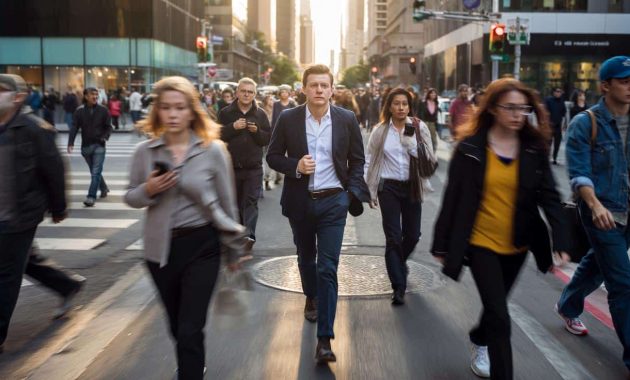
It often starts on a city sidewalk. You’re strolling at your usual pace, coffee in hand, when someone brushes past you with that clipped, decisive stride. Bag close to the body, eyes fixed ahead, almost vibrating with purpose. You watch them disappear at the next crossing, already two traffic lights ahead in what feels like seconds.
You tell yourself they’re just late. A meeting. A train. Kids to pick up. Yet you notice the same thing in parks, in airports, in supermarkets. Different ages, different outfits, same “I’m going somewhere” energy stamped into the way their feet hit the ground.
Behavioral scientists have been watching them too.
And they’re starting to see a pattern.
The strange personality fingerprint hidden in your walking speed
Researchers have a very unromantic term for it: “habitual walking speed.” They literally time how long it takes people to walk a set distance, or track it with wearables. No music, no race, no running for the bus. Just your natural cruise mode when nobody’s rushing you.
Across multiple studies, the same thing keeps popping up. People who walk faster than average don’t just move differently. They tend to think, feel, and react differently too.
Step after step, you can almost read their personality in the rhythm of their feet.
One large study from the UK Biobank, tracking more than 400,000 adults, found that faster walkers tended to score higher on measures linked to conscientiousness and goal orientation. They also showed better long-term health outcomes and even lower mortality risk. That’s a lot of information hiding in a simple walk.
Other projects, including work from universities in the U.S. and Europe, used personality questionnaires along with gait analysis. Over and over, quick walkers were more likely to say things like “I like to get things done,” “I often feel pressed for time,” or “I hate waiting around.”
On the street, you can see it in real time. These are the people weaving gracefully through a crowd without bumping anyone, already scanning for gaps three meters ahead.
Scientists suggest that walking speed is like a physical echo of your inner tempo. People who are more driven, competitive, or high on conscientiousness tend to move faster, as if their brain is always half a second ahead of their body. Their stride mirrors their mental pace.
➡️ Human Centered AI Begins With Inclusive Workforce Strategies
➡️ Innovation Is Stronger When Talent Barriers Are Removed
➡️ Bananas stay fresh for 2 weeks without going brown if kept with 1 household item
➡️ You would die in space in 15 seconds:You would die in space in 15 seconds.
There’s also a social layer. Faster walkers often grew up in environments where time was tight, pressure was normal, or city life trained them to move quickly. So it’s both personality and context, layered together in muscle memory.
*Your feet remember the life you’ve lived.*
And they replay it every time you cross the street.
What your own walking pace might be quietly saying about you
If you’re curious, behavioral scientists use a simple method: measure the time it takes you to walk 20 meters at your usual pace, not trying to go fast or slow. Divide distance by time, and you get your natural walking speed in meters per second. About 1.2–1.4 m/s is considered “average” for adults.
You don’t need lab gear. A hallway, a smartphone timer, and a rough distance are enough to get a feel for it. Walk once like you normally would, then again as if you’re slightly stressed, and notice the gap.
That little difference between “normal you” and “rushed you” says a lot.
Here’s a familiar scene: someone who always walks quickly… until they’re on holiday. Day one, they’re still overtaking people on the boardwalk. By day three, their shoulders finally drop, and you see the pace soften, just a bit.
Researchers note that chronic fast walkers often report feeling “on the clock” even when there is no real deadline. It’s as if their body never got the memo that they can slow down. This doesn’t mean they’re unhappy. They often love being efficient. Yet a sudden injury, a forced break, or a long train delay can leave them unusually irritated, because slowness clashes with their identity.
We’ve all been there, that moment when the crowd in front of us feels like a human wall.
From a psychological angle, faster walking is consistently linked to traits like **goal orientation**, **higher self-discipline**, and a tendency toward impatience. That doesn’t automatically mean “better” or “worse.” It just means “wired differently.”
Slow or moderate walkers, for their part, are more likely to score higher on traits like agreeableness or openness to experience. They stop to look at a storefront. They actually read the poster at the bus stop. Their body language says, “I’m not racing anybody.”
Let’s be honest: nobody really does this every single day, but noticing your own pace versus others can reveal how you handle time, pressure, and space in the world. Your gait becomes a kind of moving inkblot test.
Can you change your walking speed… and should you?
If you’re wondering whether you “should” walk faster, scientists are surprisingly pragmatic. Some health researchers encourage a brisker pace for physical benefits: better cardiovascular fitness, improved mood, sharper focus. They’ll often suggest building small “fast-walk bursts” into daily life.
That might look like walking one or two blocks slightly faster than usual, then returning to your natural pace. Or using a song with a quicker beat and quietly matching your steps to it. Your walking speed becomes a dial you can tweak, depending on whether you need energy, clarity, or calm.
The point isn’t to become a machine. It’s to expand your range.
A common trap is judging yourself harshly. Slow walkers can feel “lazy” in a culture that glorifies hustle. Fast walkers can feel “too intense” when friends tease them about “speed walking through life.” Both stories miss the nuance that scientists keep repeating: walking speed is a clue, not a verdict.
If you tend to rush, one gentle experiment is to intentionally walk slower once a day, especially in safe, low-pressure settings. Notice the discomfort. Do you feel exposed? Bored? Guilty? There’s useful information hiding in that friction.
If you’re usually slow, try one short errand at a brisker stride and observe how your mind responds. You’re not fixing yourself. You’re learning your settings.
Behavioral psychologist Dr. Karen Pine once summed it up simply: “The way we walk reflects how we move through life. Change one, and you can sometimes nudge the other.”
- Micro-test your paceOnce this week, time a 5-minute walk at your natural speed, then a 5-minute walk slightly faster. Compare how your mood and focus shift.
- Use “anchor zones”Pick places where you give yourself permission to slow down: the park, your street at night, the walk to get coffee.
- Respect contextCity centers train quicker walkers, rural paths train slower ones. Your pace is not just you, it’s your environment talking.
- Watch your self-talkSwap “I’m too slow/too intense” for “My default pace is X, and I can adjust when I want.”
- Notice your bodyFast walkers: check your shoulders and jaw. Slow walkers: check your energy after a slightly brisker walk.
The next time someone overtakes you on the sidewalk
There’s a strange kind of intimacy in observing how strangers walk. The teenager drifting with headphones on, the parent pushing a stroller like a rally car, the retired couple keeping a steady, almost meditative rhythm. Once you’ve read the research, each of them looks a little different.
You start to see walking speed as a language. Fast walkers spelling out urgency, drive, sometimes anxiety. Slower walkers spelling out presence, caution, sometimes fatigue. You might recognize yourself in both, depending on the day, the street, the season of your life.
The science doesn’t ask you to judge. It just invites you to notice. Notice when you speed up before you’re actually late. Notice when you slow down because some part of you wants the day to last a little longer. And maybe, the next time someone flies past you, you won’t just think “Wow, they’re in a rush.”
You’ll wonder what story their feet are trying to tell.
| Key point | Detail | Value for the reader |
|---|---|---|
| Walking speed reflects personality traits | Faster walkers often score higher on conscientiousness, time urgency, and goal orientation | Helps you read your own habits and others’ behavior with more clarity |
| Environment shapes your pace | City life, job demands, and upbringing subtly train your natural stride over years | Reduces self-blame and adds context to why you move the way you do |
| You can consciously adjust your pace | Short, intentional experiments with walking faster or slower shift mood and awareness | Gives you a low-effort tool to influence stress, focus, and energy in daily life |
FAQ:
- Question 1Does walking fast mean I’m automatically healthier and more successful?
- Question 2Can my walking speed really reveal my personality to strangers?
- Question 3Is it bad if I naturally walk very slowly?
- Question 4Can I train myself to become a faster walker if I want the health benefits?
- Question 5Why does my walking pace change so much between workdays and holidays?