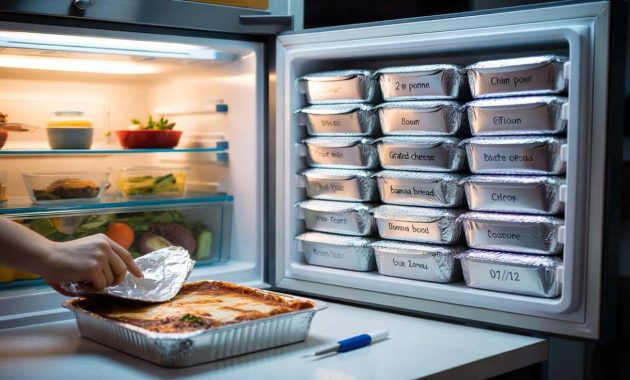
Sunday night, fridge light on, you stand there with a tray of half-eaten lasagna and that familiar mix of guilt and laziness. Toss it? Freeze it? You reach for a random plastic box, then give up trying to find the matching lid buried in the back of the drawer. Fifteen seconds later, you’re balling up a piece of aluminum foil, wrapping it around the dish with the vague hope you’ll “deal with it later.”
Now imagine that same piece of foil quietly saving you money, time, and freezer space.
In a lot of kitchens, that’s exactly what’s starting to happen.
Why aluminum foil is quietly taking over our freezers
Open the freezer of almost any family home and you’ll see the same scene: bags slumped in corners, open boxes of frozen pizza, a mystery tub coated in frost. Somewhere in the middle is that forgotten portion of soup you swore you’d eat “next week.” The freezer is supposed to be the hero of the kitchen, yet it often turns into a cold graveyard.
Aluminum foil is changing that dynamic in a surprisingly simple way.
Over the past year, food bloggers, TikTok parents and zero-waste fans have been sharing the same low-tech trick: swapping bulky plastic containers for tightly wrapped, labeled foil packets. A mom in Lyon posted a short video showing her chaotic freezer “before,” then a neat grid of flat foil parcels “after,” each one scribbled with black marker: “Chili – 2 portions,” “Grated cheese,” “Banana bread slices.” The clip hit hundreds of thousands of views in a weekend.
People weren’t impressed by something shiny and new. They were impressed by something they already had in a kitchen drawer.
There’s a simple reason this little pivot is spreading. Foil is flexible, cheap, and it hugs food closely, which means less air, fewer ice crystals and better taste when things thaw. It can be shaped to fit the last awkward corner of your drawer when every container seems too big or too small. **For a lot of households, it’s the first time the freezer starts feeling organized instead of random.**
And when freezing feels easy, you suddenly waste a lot less food.
The foil-freezer method that actually fits into real life
The basic gesture is simple. Instead of hunting for a box, you tear off a generous sheet of aluminum foil, place your food in the center, and wrap it tight like an envelope. Press out as much air as you can with your hands. Fold the edges twice so nothing leaks, then flatten the package slightly so it can stack well.
➡️ A 2,500-year-old shipwreck off Sicily offers a rare, direct window into ancient Mediterranean trade
➡️ Psychology shows why some people feel safer solving problems than enjoying peaceful moments
➡️ Moya, the robot that almost walks like us: 92% accuracy and already giving people goosebumps
➡️ The psychological reason why overthinking intensifies at night, according to cognitive research
➡️ Legendary rock band retires after 50 years “the hit everyone knows”
➡️ The daily habits that quietly increase physical strain
Last move: grab a marker and write what’s inside and the date, right on the foil.
This little method works especially well for “problem” foods that usually end up wasted. Half a baguette from last night’s dinner, sliced and wrapped in foil, comes out of the freezer almost as good as fresh after a quick oven blast. Cooked rice spread in a thin layer and wrapped in foil thaws in minutes. Leftover grated cheese? Wrapped in a compact brick, it doesn’t sprawl across the whole shelf.
Let’s be honest: nobody really does this every single day. But doing it twice a week already changes the way your freezer looks, and how often you end up ordering takeaway “because there’s nothing to eat.”
The main mistake people make with foil in the freezer is treating it like magic and ignoring a few common-sense limits. Foil alone is not ideal for very wet or acidic foods, which can react with the metal over long periods. Those juicy tomato sauces or lemony marinades are happier if you slide them into a small freezer bag or dish first, and then wrap the whole thing in foil for stacking and protection.
*The good news is you don’t need fancy gear or a perfect system, you just need to know which battles foil can win for you.*
This simple foil trick helped us go from “freezer chaos” to three tidy shelves of ready meals. I don’t feel guilty opening the door anymore, because I actually know what’s in there. — Claire, 38, two kids, Paris suburb
- Wrap food tightly, pressing out excess air before closing the foil.
- Label every packet with content and date, even if you “think you’ll remember.”
- Use foil for solid or semi-solid foods: bread, cooked meat, casseroles, grated cheese, patties.
- Combine foil + inner container (bag or dish) for very saucy or acidic recipes.
- Stack foil packets flat, like books on a shelf, to spot everything at a glance.
Beyond the hack: what a tidy freezer quietly changes
At first glance, wrapping leftovers in foil feels like a tiny, almost boring gesture. Yet those small, boring gestures are often the ones that reshape everyday life. A freezer full of flat, labeled packets doesn’t just look pleasing in a photo. It also means fewer “What’s for dinner?” arguments at 7:30 p.m., fewer bags of freezer-burned mystery stew, and a quieter sense of control in a room that often feels like permanent improvisation.
Some readers say this habit made them more relaxed about cooking big batches, because they finally trusted the freezing part.
Others talk about the strange emotional relief of opening the freezer and seeing clear words instead of shapeless frost: soup, curry, peaches, bread. Just ordinary food, but food they know they’ll actually eat. **In a time when food prices keep climbing, that’s no small thing.** You may still have the occasional frozen disaster, the packet that gets lost in the back until next year. That’s life.
What sticks is the feeling that your freezer is on your side again. A quiet ally, lined in foil.
| Key point | Detail | Value for the reader |
|---|---|---|
| Use foil for smart freezing | Wrap foods tightly in flat, labeled foil packets | Saves space, cuts waste, makes meals easier to plan |
| Know foil’s limits | Avoid prolonged contact with very wet or acidic foods | Protects taste and safety of frozen dishes |
| Build a simple routine | Wrap leftovers in foil two or three nights a week | Gradually transforms a messy freezer into a useful “meal library” |
FAQ:
- Can you put aluminum foil directly in the freezer?Yes, aluminum foil can go straight into the freezer. It handles low temperatures very well and helps protect food from air and freezer burn when wrapped tightly.
- Is it safe to freeze all types of food in foil?Foil works best with solid foods: bread, cooked meat, casseroles, pizza slices, grated cheese. For acidic or very liquid foods like tomato sauces, citrus dishes or stews, use a bag or container inside the foil layer.
- How long can food wrapped in foil stay in the freezer?For best taste, most homemade meals and leftovers wrapped in foil are fine for around 2–3 months. After that, the food is often still safe, but texture and flavor start to fade.
- Does foil prevent freezer burn completely?It really helps, because it limits contact with air. For maximum protection, wrap food tightly, press out air, and consider a double layer of foil for longer storage.
- Can I reuse aluminum foil after freezing food?If the foil is clean and not torn, you can gently smooth it out and reuse it for freezing or for other kitchen tasks. If it’s greasy or full of holes, it’s better to recycle it instead.