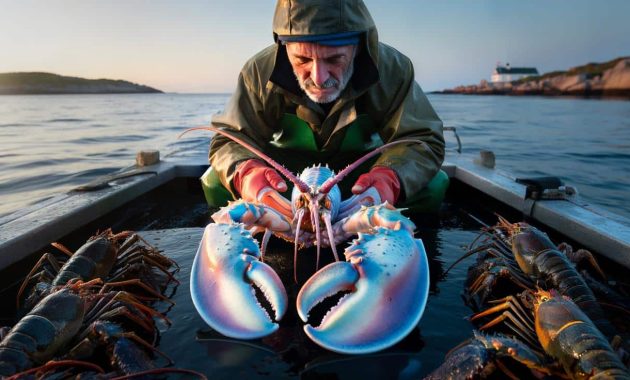
Late this summer, an American lobsterman pulled up a trap expecting the usual mottled brown catch. Instead, a lobster the colour of cloudy blue sherbet was waiting inside, shimmering like a toy dropped from a child’s bedroom into the North Atlantic. What happened next turned a potential dinner into a living scientific exhibit.
A blue surprise off New Hampshire
On 31 July 2024, New Hampshire fisherman Joseph Kramer was hauling his gear when he spotted something off. One lobster in his trap looked wrong – or, depending on your taste, spectacularly right.
Instead of the normal dark brown shell, this lobster glowed with a pale blue, almost pastel sheen. The effect reminded locals of carnival sweets, and the creature quickly earned the nickname “cotton candy lobster”.
Scientists estimate blue “cotton candy” and albino lobsters appear at roughly one in 100 million individuals.
Kramer realised he had not just an oddity, but a statistical marvel. Instead of selling it, he called the Seacoast Science Center, a public aquarium and marine education facility in Rye, New Hampshire. The centre accepted the animal, adding it to their exhibits and research collections rather than to a restaurant menu.
Why this lobster is one in 100 million
The cotton candy lobster is not a separate species. It is the same American lobster found on menus across New England. The difference lies in a rare genetic mutation that changes how pigments appear in its shell.
How lobster colours usually work
Most people think of live lobsters as dull brown and cooked lobsters as bright red. That brown shell, though, hides a complex chemistry.
- Normal lobsters carry a mix of red, yellow and blue pigments.
- Proteins in the shell bind these pigments in different ways.
- Light hitting the shell bounces back as the familiar muddy brown.
When a lobster is boiled, those proteins break down. The blue and yellow elements vanish from view, leaving only the red pigment, astaxanthin, which is why dinner-plate lobsters turn scarlet.
Occasionally, mutations affect how much of each pigment is produced or how it’s arranged in the shell. That is when things get visually interesting.
➡️ Rage builds against ChatGPT: +775% bad reviews and record uninstalls in a few days
➡️ Psychology explains why emotional comfort doesn’t always come from solutions
➡️ Nivea: “I’m a dermatologist and I studied the blue cream’s formula, here’s my honest take”
➡️ Look ten years younger with one dye job: hair colors that rejuvenate your look
➡️ Is eating meat-free actually healthy? A centuries-old diet debate returns
From red to albino: how rare is rare?
Marine biologists have tracked unusual lobster colours for decades. Current estimates suggest:
- Red lobsters: about 1 in 10 million
- Orange, yellow or two-toned lobsters: between 1 in 30 million and 1 in 50 million
- Cotton candy blue and true albino lobsters: around 1 in 100 million
This New Hampshire specimen sits in the rarest known colour category for lobsters, at the extreme end of a long probability curve.
To put that in perspective, a New England lobsterman hauling thousands of traps for an entire career might never see one. Many never do.
From trap to tank: a life spared
For the cotton candy lobster, the mutation turned from a liability in the wild into a ticket to safety on shore.
In the ocean, standing out can be deadly. Predators such as cod, monkfish and larger lobsters hunt partly by sight. A pale blue crustacean on a dark seabed is easier to spot than a camouflaged brown neighbour.
Scientists at the Seacoast Science Center point out that the animal likely survived this long through a mix of luck and habitat. Rocky crevices and kelp forests may have helped it stay hidden until Kramer’s trap appeared.
At the aquarium, the lobster now serves as a live teaching tool about genetics, probability and conservation for visiting school groups.
The centre plans to keep the animal in a controlled tank where visitors can observe it up close. Educators already use the story to start conversations about how random genetic changes shape the way animals look and live.
Not the first cotton candy lobster, but still extraordinary
This is not the first time a cotton candy lobster has reached the headlines. In 2018, Canadian fisherman Robinson Russell hauled up a similarly pastel-toned specimen off the coast of New Brunswick. Photos of that lobster quickly spread online, turning it into a minor internet celebrity.
Side-by-side comparisons show clear differences. Russell’s 2018 lobster appeared much paler, almost white with hints of blue and pink. The New Hampshire 2024 lobster carries a stronger bluish tone. Both likely involve disruptions in how pigments bind, yet not in exactly the same way.
Russell’s luck did not end with one catch. In the following years, he reported two more lobsters with unusual colour patterns, including striking calico and bright orange individuals. Such repeated finds suggest that in pockets of the Atlantic, certain rare genes may be slightly more common, even though the overall odds remain extremely low.
Why scientists care about a pretty crustacean
At first glance, a pastel-blue lobster looks like a curiosity for tourists. For researchers, it offers more than a photo opportunity.
- It helps track genetic diversity in heavily fished populations.
- It offers clues about how pigment pathways evolved in crustaceans.
- It gives educators a real, relatable example of mutation and probability.
Every unusual lobster that ends up in a lab or aquarium can be photographed, measured and, occasionally, sampled for genetic testing. Over time, this builds a picture of how often certain mutations occur and whether they cluster in specific regions.
Colour mutations act like tiny flags, marking places where the lobster gene pool holds hidden variation.
That variation matters when oceans warm and ecosystems shift. Populations with more genetic variety tend to handle change better. While a blue shell does not directly improve survival, the mechanisms behind these mutations may link to broader traits, such as growth rate or resistance to disease.
What “one in 100 million” really means
Odds like one in 100 million can feel abstract. For a rough sense of scale, North American fisheries land tens of millions of lobsters each year. Even across an entire decade, the total catch still falls short of 100 million individuals.
That means a cotton candy lobster might only appear once or twice in an entire generation of fishing, spread over thousands of boats from Canada to the northeastern United States. Many of those rare individuals likely end up in processing plants, never noticed before cooking turns them red like any other.
This makes the New Hampshire specimen not just rare in nature, but rare as a documented, still-living example.
What to do if you ever catch a strange-looking lobster
For commercial fishers, an unusually coloured lobster represents a small but real opportunity beyond its market price.
- Photograph the animal clearly from several angles.
- Note the date and approximate location of the catch.
- Contact a local aquarium, marine lab or fisheries department.
- Keep the lobster alive in a tank or cool storage if possible.
Some institutions offer to take these animals in for display or research. At the very least, verified photos and records help scientists refine their estimates of how often these mutations appear.
For recreational visitors to aquariums, rare-coloured lobsters can be a starting point for learning about less visible issues: fishing pressure, habitat protection and changing ocean temperatures along the North Atlantic coast.
From curiosity to classroom: how children learn from a blue lobster
Teachers often struggle to make genetics feel concrete. A cotton candy lobster in a nearby tank changes that instantly. Children can see that mutation does not always mean “monster” or “science fiction”, but can simply mean “different colour”.
Educators at centres like Seacoast use such animals to explain basic terms:
- Mutation: a random change in DNA that can alter traits, such as colour.
- Trait: a feature of a living thing, like shell pattern or claw size.
- Variation: differences between individuals in the same species.
From there, classes can simulate probabilities with dice or cards, contrasting the one-in-6 chance of rolling a certain number with the one-in-100-million chance of catching a blue lobster. That simple comparison helps students grasp why this single animal, sitting quietly in a tank, has caused such a stir from New Hampshire to scientific news sites worldwide.