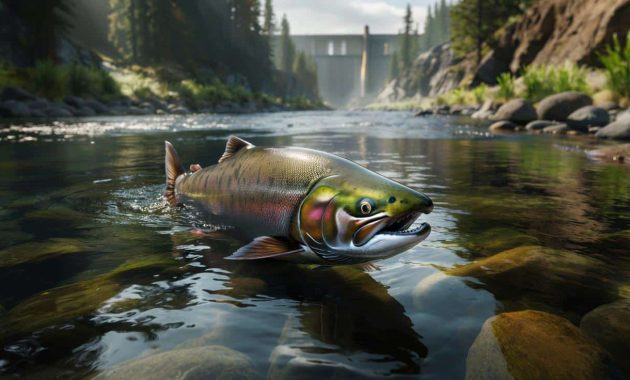
For local tribes, biologists and dam operators, that river has long symbolised loss. This summer, it suddenly became a sign that nature can still surprise us.
A royal visitor where none was expected
On a stretch of the McCloud River, upstream of California’s vast Shasta Dam, conservation staff checking monitoring equipment recently spotted something they had only read about in historical accounts: a wild Chinook salmon, also known as king salmon, back in waters it had been blocked from for a century.
The fish, Oncorhynchus tshawytscha, is one of the Pacific’s largest and most iconic salmon. In California, its populations have crashed so hard that many runs are now classed as endangered by the National Oceanic and Atmospheric Administration (NOAA).
For the first time in roughly 100 years, a Chinook salmon has completed its journey home to the McCloud River without human assistance.
For decades, experts assumed this river run was gone for good. The construction of Shasta Dam in the 1930s severed migration routes between the Pacific Ocean and the McCloud’s icy tributaries. On top of that came drought, warming water and heavy human use of the Sacramento River system.
Why Chinook salmon nearly vanished from California’s rivers
Chinook salmon are anadromous fish. They hatch in freshwater, migrate downstream as juveniles to the sea, grow to adulthood in the Pacific, then return to their natal rivers to spawn and die. This life cycle relies on a long, unbroken corridor of cool, oxygen-rich water.
In California, that corridor has been systematically disrupted:
- Dams cut off upstream spawning grounds and slow river flow.
- Drought shrinks rivers and increases water temperature.
- Water withdrawals for agriculture and cities reduce cold-water flows.
- Climate change drives hotter summers and more extreme dry spells.
Shasta Dam sits just downstream of the McCloud River. When it was completed, it flooded large areas to create Lake Shasta and blocked salmon from travelling upstream. The cold spring-fed reaches of the McCloud, once prime spawning territory, became inaccessible to wild fish.
The blows kept coming. During the severe California droughts of the 2010s, river temperatures in the Sacramento system rose dramatically. Studies later suggested that around 98% of Chinook eggs and young fish in some runs perished in overheated water. Biologists warned that an entire generation had been lost, pushing the species closer to collapse.
➡️ The pantry trick that keeps onions firm and fresh for nearly a month
➡️ Why you should always wash second-hand clothes before wearing them
➡️ Kiwi Recognised By The European Union And The UK As The Only Fruit Proven To Improve Bowel Transit
➡️ Psychology explains why emotional neutrality can feel unsatisfying
➡️ A giraffe with a strange neck in South Africa baffles scientists’ understanding
➡️ Psychology explains why emotional comfort doesn’t always come from solutions
For a fish that spends most of its life in the ocean, survival still hinges on a few fragile months in the river.
An unlikely alliance to bring a salmon back
Faced with those grim numbers, a coalition began to form around the idea of restoring king salmon to their ancestral waters. It brought together federal agencies and Indigenous knowledge holders whose relationship with the McCloud stretches back thousands of years.
The core partners include:
| Partner | Role in the project |
|---|---|
| NOAA Fisheries | Science, population monitoring and legal protection under federal law |
| US Fish and Wildlife Service | Hatchery work, habitat projects and logistics |
| Winnemem Wintu Tribe | Cultural leadership, traditional ecological knowledge and advocacy for the McCloud |
For the Winnemem Wintu, the salmon is not just a species but a relative. Tribal leaders tell stories of the fish as a guide and provider. The loss of salmon from the McCloud has been experienced as both ecological and cultural erasure.
How the reintroduction experiment worked
In recent years, the alliance launched a meticulous attempt to reconnect salmon with the McCloud, even while the physical dam remained in place. The basic idea was to manually bridge the broken migration route for at least part of the journey.
The method was surprisingly hands-on:
- Collect Chinook eggs and fertilise them under controlled conditions.
- Incubate the eggs in chilled, flowing McCloud River water upstream of Shasta Dam.
- Raise the hatched juveniles there until they were strong enough to handle transport.
- Truck the young salmon downstream around the dam and release them into the Sacramento River.
- Let them swim out to sea and hope they survived to adulthood.
The long-term aim was that some of those fish, once mature, would imprint on the chemical signature of their natal waters and attempt to return to the McCloud. Yet almost nobody dared to assume that such a full homecoming was realistic, given the many hurdles along the way.
The “escapees” that rewrote the script
The recent sighting suggests a twist in the story. Conservation staff now believe that during transport, a small number of juvenile Chinook may have slipped out of holding tanks or release sites earlier in the process, entering river channels that allowed them to orient back towards the McCloud instead of downstream only.
Those young fish would have then completed the classic Chinook journey on their own: drifting and swimming to the Pacific, feeding for years in the open ocean, and finally turning back across hundreds of kilometres to spawn where they first smelled running water.
An accidental escape during a hatchery truck run may have produced the first “self-returning” McCloud Chinook in living memory.
For scientists, this is more than a feel-good moment. It shows that the species’ instinctive homing abilities remain intact, and that even heavily managed populations still respond to cues from their native habitat.
Why this single fish matters
One salmon does not rescue a population. Yet the symbolic weight is considerable, especially in a state grappling with water shortages and competing demands from farms, cities and wildlife.
The McCloud return offers several key signals:
- Cold-water habitat above major dams still has biological value.
- Salmon restoration can work alongside existing infrastructure, at least in part.
- Indigenous-led efforts can reshape scientific priorities and timelines.
- Small experimental projects can deliver outsized ecological surprises.
What this means for California’s rivers and beyond
California agencies are under growing pressure to balance hydropower, irrigation and species protection. Success on the McCloud could influence debates over fish passage solutions at large dams, ranging from trap-and-haul schemes to costly fish ladders and even dam removal in some basins.
Other river systems in the US Pacific Northwest, as well as in New Zealand and Japan where Chinook have been introduced, are watching these experiments closely. If salmon can again complete their full life cycle in fragmented watersheds, even with some human help, management strategies may shift from pure triage to cautious rebuild.
Key terms that help make sense of the story
Several technical concepts sit in the background of this apparent comeback. Understanding them sheds light on why one returning fish can change an entire conversation.
Anadromous: This describes species that live primarily in the sea but breed in freshwater. The reverse pattern, where fish live in rivers and breed in the ocean, is called catadromous, as seen in European eels. Anadromous life cycles expose fish to risks in both marine and river environments, which makes them highly sensitive to human impacts.
Imprinting: Young salmon memorise the chemical and sensory profile of their natal river. Years later, they use this imprint as a map to navigate back from the open ocean. Dams, polluted tributaries and altered flows scramble those signals, reducing the chance that adults will find suitable spawning sites.
Possible futures for the McCloud salmon
Managers are now debating how to turn a one-off event into a trend. Several scenarios are on the table:
- Continue current egg incubation and trucking, while improving survival rates.
- Test new release points that give more juveniles a chance to “escape” into wild routes safely.
- Install more sophisticated monitoring gear to track tagged fish over multiple years.
- Negotiate water releases from Shasta Dam to keep downstream temperatures low during key spawning months.
There are risks. If river flows stay low and summers get hotter, adults returning to spawn may meet water that is simply too warm. That can cause stress, disease or mass mortality events. On the other hand, building up small, resilient pockets of salmon in cold-water refuges like the McCloud could act as a buffer against climate shocks elsewhere in the basin.
For anglers and local communities, a self-sustaining Chinook run remains a distant prospect, not a near-term reality. Yet the presence of even a single wild fish hints that decades of restoration work are beginning to shift the odds.