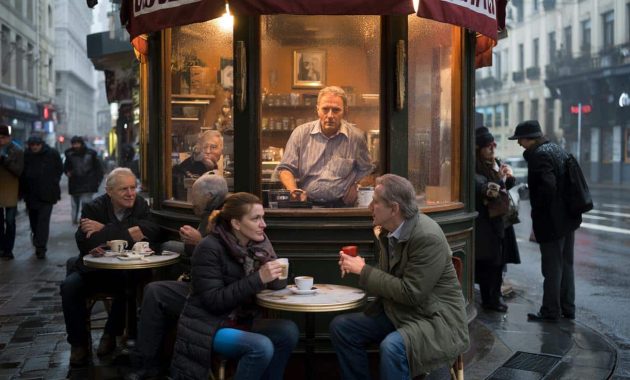
The handwritten sign appeared on a rainy Tuesday, taped slightly crooked on the café’s fogged-up window: “No laptops. No strollers. No sportswear. Conversation only.” Inside, the owner – mid‑50s, tired eyes, perfect espresso – kept repeating the same line to confused regulars: “I’m saving this place from turning into a co‑working zoo.”
Outside, a young woman in a puffer jacket balanced a MacBook, an oat flat white and a look that said, “Wait, what?” A dad with a baby in a stroller read the sign twice, pivoted on the spot and walked away. A pair of retired neighbors, though, nodded approvingly and stepped inside like they were entering a private club.
On one street corner, three visions of the city collided over the price of a cappuccino.
The question is who gets to stay when nostalgia becomes a house rule.
When a coffee breaks up with laptops
The first thing you notice is the silence of keyboards.
The café, once a sea of glowing Apple logos and noise‑cancelling headphones, suddenly sounds different. Chairs scrape. Spoons clink. Two strangers at the bar actually, amazingly, talk about the weather and then keep going.
The owner, let’s call him Marco, moves slower now, chatting as he wipes the counter. He says he was sick of serving “office workers who rented a table for one coffee and eight hours of Wi‑Fi.” To him, the ban isn’t about kicking people out. It’s about reclaiming an atmosphere he swears existed “before everything turned into a screen.”
Ask the people who used this place like a second home and you get a different story.
Lina, a 27‑year‑old copywriter, used to spend three afternoons a week here between client calls. “I’d buy two coffees, a sandwich, then another drink before leaving,” she says, standing on the pavement, laptop closed under her arm. “Now I’m apparently the problem?”
A student nearby scrolls through his phone searching “café with sockets nearby” with the kind of urgency usually reserved for lost wallets. Young parents trade tips about stroller‑friendly places that don’t glare at them when the baby cries.
➡️ China Begins Returning Boeing Aircraft to US
➡️ How to make your heating warm up fast: Engineer shares a simple trick
➡️ Germany and France choose two sharply different paths for their armies, especially on tank warfare
One policy shift, and suddenly a whole invisible community is pushed back onto the sidewalk.
Marco sees himself as defending something bigger than his daily takings.
He talks about “third places” – those semi‑public spots that aren’t home or work but feel like both. He points to the old men at the back table, arguing about football. “That,” he says, “is what a café is for.”
Yet the line between defending culture and deciding who belongs blurs fast. When “no laptops” pairs with “no strollers” and “no leggings”, it starts to sound less like a love letter to conversation and more like a dress code for a private lounge. Let’s be honest: nostalgia gets dangerous the second it turns into a filter for who looks like the “right kind” of local.
The fine art of gatekeeping with a smile
There’s a world of difference between “No laptops” and “We keep some tables free for conversation, please limit laptop use to 90 minutes.”
Policy can nudge behavior without slamming the door. Timed sessions, laptop‑free zones, slower evenings reserved for talk, clear signals on the menu – all of these shape the mood while still welcoming remote workers, parents, and students as part of the café’s ecosystem.
The real craft is in the details: small tables near power outlets for solo workers, larger ones deliberately away from sockets for groups, music kept low enough that people can talk without shouting but not so low that silence feels awkward. One sign can exclude; a handful of gentle, thought‑through limits can invite different kinds of people to share the same room.
Where it often goes wrong is when frustration makes the rules personal.
A tired owner, fed up with people nursing a single espresso for four hours, suddenly aims their anger at an entire generation. The ban isn’t “no extended laptop sessions”; it becomes “no laptops, no strollers, no yoga pants, no noise, no… life.”
That’s when regulars stop feeling like guests and start feeling like suspects. Parents sense judgment for daring to exist with children in public. Students feel like temporary intruders in a city they already can’t afford. Remote workers think, “So I bring money here, but I’m somehow less real than the guy reading a paper?” *Nobody wants to drink coffee where they also have to defend their right to sit down.*
“Cafés have always been gatekept,” a sociologist friend told me. “It’s just that now the gate is about lifestyle, not class on paper. The laptop ban is never just about laptops. It’s a subtle way of saying: this space isn’t for your version of city life.”
- Watch the language
“Authentic people only” or “real conversations” sound innocent, yet they imply some customers are fake or less worthy. - Define behavior, not identity
Banning noise is different from banning children. Setting time limits is different from banning students or remote workers. - Be transparent about money
If the issue is people camping for hours, say so. Many will accept a two‑hour policy if it’s framed as survival, not snobbery. - Create options, not walls
A small laptop‑friendly corner, an evening “no screen” window, or weekend stroller hours keep the café mixed instead of monolithic. - Listen when people push back
If you hear that your rules feel classist, ageist, or anti‑parent, that’s not an attack. It’s free feedback on who your space is quietly pushing out.
Who gets a seat in tomorrow’s city?
Walk down any gentrifying street and you can feel the tension under the scent of freshly ground beans.
On one side, small business owners drowning in rent hikes and delivery apps, desperate for loyal, paying customers who don’t treat them like an office with better coffee. On the other, people whose work, family life, or budgets force them to live half their lives in shared spaces – with their laptops, their kids, their backpacks and their headphones.
The café suddenly becomes a micro‑parliament deciding who is “the right kind” of urban citizen. Is Marco a brave defender of slow talk and local culture? Or is he using rose‑tinted memories of “how things used to be” as a polite way to sort bodies into worthy and unworthy?
Maybe the real question isn’t laptops vs. conversation at all. Maybe it’s this: when public life moves indoors because streets feel expensive or unsafe, every chair with a plug becomes political. And each of us, cup in hand, has to decide what kind of city we’re quietly voting for with where we sit, who we tolerate at the next table, and whether we mistake our comfort for some universal idea of “authentic.”
| Key point | Detail | Value for the reader |
|---|---|---|
| Policies shape who belongs | Laptop, stroller and clothing bans send strong signals about which lifestyles are welcome | Helps you notice when “ambience” rules are actually quiet exclusion |
| Behavior beats identity | Rules focused on time limits or noise work better than bans on people or tools | Offers a fairer template if you run or choose spaces to spend time in |
| Nostalgia can be a weapon | Appeals to “real conversation” and “old‑school cafés” often hide class and generational tensions | Gives you language to question who is being left out in the name of authenticity |
FAQ:
- Question 1Is a café owner legally allowed to ban laptops, strollers, or certain clothing?
- Question 2Why do some owners feel so strongly against remote workers and students?
- Question 3Is wanting a “conversation space” always elitist?
- Question 4What can customers do if they feel excluded by these policies?
- Question 5How could a café balance atmosphere, profit, and inclusion more fairly?