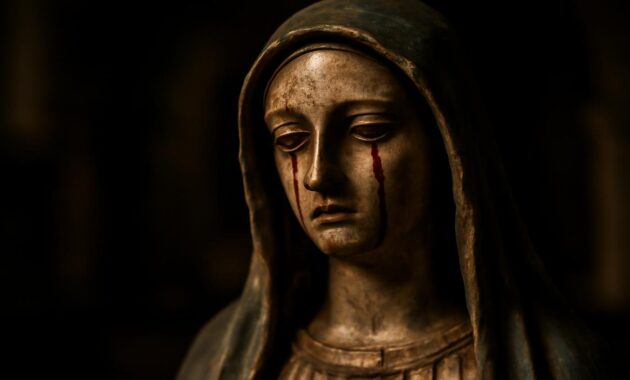
The first time anyone noticed the tears, the church was almost empty. It was a Tuesday afternoon in late autumn, the kind of day when light slants low and shadows lengthen. A parishioner, kneeling in a back pew, thought she glimpsed a glistening on the cheek of the statue of the Virgin Mary. At first, she dismissed it as a trick of the fading daylight. But then she saw another tear form, tremble, and slowly descend the carved face.
Within minutes, word had spread through the small town. People hurried to the church, a few still carrying grocery bags or briefcases, their faces alight with wonder and confusion. By the time the local priest arrived, a sizable crowd had gathered, all eyes fixed on the weeping Madonna.
What unfolded in the following weeks and months would captivate the global media and baffle scientists, theologians, and the faithful alike. The mystery of the Virgin Mary’s bloody tears had only just begun.

The First Tear
In the days after the initial sighting, the statue continued to weep at irregular intervals. Sometimes the tears would flow steadily for hours; other times, only a single bead of moisture would appear and then vanish. Analyses by the church confirmed the tears were indeed human blood, not water or some other liquid.
Crowds flocked to the small parish church, swelling to hundreds on weekends. Pilgrims came from across the country, even the world, hoping to witness the miracle. Many reported experiencing visions, hearing voices, or feeling a profound spiritual connection in the presence of the weeping statue.
The local bishop was unsure how to respond. On one hand, he was deeply moved by the phenomenon and did not want to dismiss it as mere trickery. On the other, he was wary of fueling mass hysteria or exploiting the faithful’s religious fervor. After consulting with Vatican authorities, he decided to allow continued access to the church, but prohibited any commercial activity or organized pilgrimages.

The World Arrives at the Church Door
As the story of the weeping Madonna spread, it ignited a global media frenzy. News crews from around the world descended on the small town, broadcasting live reports and interviewing bewildered locals. Social media buzzed with speculation, skepticism, and heated debates about the meaning and origins of the tears.
Some hailed it as a divine sign, a miraculous portent of great significance. Others dismissed it as an elaborate hoax or the result of natural causes. Scientists scrambled to obtain samples of the blood for analysis, while theologians argued over the theological implications.
Despite the chaos, the church remained a site of profound solemnity and reverence. Pilgrims continued to arrive, undeterred by the media circus. They came to pray, to weep, and to seek solace in the presence of the weeping Madonna.

The Science Steps In
As the phenomenon persisted for months, the local bishop reluctantly agreed to allow a team of independent scientists to conduct a comprehensive investigation. This decision was not without controversy, as some in the church feared it would profane the sacred nature of the event.
The scientists employed the latest forensic techniques, subjecting samples of the tears to DNA analysis, spectroscopy, and other advanced tests. Their findings were both intriguing and perplexing. The blood was indeed human, but its genetic makeup did not match that of any known individual.
Moreover, the blood appeared to contain anomalies that defied easy explanation. Certain proteins and chemical markers were present in quantities far exceeding normal human levels. The researchers were baffled, unable to determine the blood’s precise origin or significance.

What the DNA Revealed
The most startling revelation came when the scientists compared the DNA of the tears to samples taken from the statue itself. To their astonishment, the genetic profiles were an exact match – the blood appeared to be emanating directly from the carved stone of the Virgin Mary.
This discovery only deepened the mystery. How could human blood be flowing from an inanimate object? Was it possible that the statue itself was the source, or was the blood being supernaturally generated in some way?
The scientific team presented their findings to the church authorities, who were both fascinated and deeply troubled by the implications. They knew that the public release of such information could ignite a firestorm of controversy and undermine the faith of millions of believers around the world.
The Strange Comfort of Unanswered Questions
In the end, the church decided to withhold the full scope of the scientific findings from the public. While acknowledging the phenomenon of the weeping Madonna, they emphasized the spiritual significance rather than the technical details.
This decision was met with both praise and criticism. Some faithful saw it as a necessary protection of sacred mysteries, while others accused the church of obfuscation and deception.
For the parishioners and locals, the weeping Madonna remained a source of wonder and solace, a reminder of the power of faith in the face of inexplicable events. The crowds continued to visit, drawn by the sense of the divine, even as the global media spotlight eventually dimmed.

Between Miracle and Mechanism
“This is a profound mystery that challenges our most fundamental assumptions about the nature of reality. Is it a miracle, or is there some natural, perhaps even scientific, explanation? The truth is, we may never know for certain.”
– Dr. Emilia Ramirez, Professor of Religious Studies
The weeping Madonna continues to captivate the imagination of believers and skeptics alike. Some see it as a miraculous sign from the divine, a manifestation of the Virgin Mary’s compassion for a troubled world. Others remain convinced that there must be a rational, scientific explanation – even if it remains elusive.

For the church, the matter is a delicate balancing act. They must respect the faith of their flock while also grappling with the unsettling scientific findings. It is a tightrope walk between the realms of the spiritual and the material, between the realms of faith and reason.
Living with the Unfinished Story
As the years have passed, the weeping Madonna has become a part of the town’s identity, a source of both wonder and consternation. Pilgrims still visit, though in smaller numbers, drawn by the enduring mystery.
The church continues to monitor the statue, collecting samples and documenting any changes. But the scientific community has largely moved on, unable to make further progress in unraveling the enigma.

In the end, the story of the Virgin Mary’s bloody tears may remain unresolved, a testament to the limits of human understanding and the power of the unknown to captivate the human spirit. For some, this is a source of frustration; for others, it is a profound invitation to grapple with the mysteries of faith and the natural world.
| Key Dates in the Weeping Madonna Phenomenon | Event |
|---|---|
| Late Autumn | First sighting of tears on the Virgin Mary statue in a small town church |
| Following Weeks and Months | Tears continue to appear irregularly, drawing crowds of pilgrims and media attention |
| Early Investigation | Church authorities confirm the tears are human blood, not water or other liquid |
| Independent Scientific Study | DNA analysis reveals the blood is of unknown origin, with anomalies that defy explanation |
| Continued Monitoring | The church keeps the statue under observation, but the scientific community has largely moved on |
| Expert Opinions on the Weeping Madonna | Perspective |
|---|---|
| Dr. Emilia Ramirez, Professor of Religious Studies | “This is a profound mystery that challenges our most fundamental assumptions about the nature of reality. Is it a miracle, or is there some natural, perhaps even scientific, explanation? The truth is, we may never know for certain.” |
| Father Thomas Gonzalez, Parish Priest | “The weeping of our Blessed Mother is a sign of her deep compassion for the suffering of the world. It is a call for us to turn to her in our hour of need and to seek the comfort and guidance of our heavenly intercessor.” |
| Dr. Natalia Petrov, Forensic Scientist | “The DNA results are truly perplexing. We’ve never encountered anything like this before. The blood appears to be human, yet its origins defy all scientific explanation. It’s as if it’s coming from the statue itself, which is simply not possible.” |
The story of the Virgin Mary’s weeping statue is a profound and unsettling mystery, a collision of faith and science that has left the world captivated and confounded. In the end, perhaps the true wonder lies not in the search for answers, but in the humbling realization that some questions may forever remain unanswered.
What is the weeping Madonna phenomenon?
The weeping Madonna phenomenon refers to a statue of the Virgin Mary in a small town church that began to spontaneously weep human blood. The tears were first noticed by a parishioner and then drew crowds of pilgrims and media attention.
How long has the weeping Madonna been happening?
The weeping first began in late autumn and continued for months, with the tears appearing at irregular intervals. The phenomenon has persisted for several years, though the crowds of pilgrims have diminished over time.
What did the scientific analysis of the tears reveal?
DNA testing confirmed the tears were indeed human blood, but the genetic profile did not match any known individual. The blood also contained anomalies that defied easy explanation. Most startlingly, the blood was found to be an exact match to the DNA of the statue itself.
Why did the church decide to withhold the full scientific findings?
The church authorities were concerned that the release of the full scientific findings, particularly the DNA match to the statue, could undermine the faith of believers and spark widespread controversy. They opted to emphasize the spiritual significance of the weeping Madonna rather than the technical details.
Is there a scientific explanation for the weeping Madonna?
Despite extensive investigation, scientists have been unable to determine a conclusive, rational explanation for the phenomenon. The DNA anomalies and the apparent connection to the statue itself have left the research team baffled, unable to fully reconcile the scientific findings with the miraculous nature of the event.
How have people reacted to the weeping Madonna?
Reactions have been divided, with some hailing it as a divine miracle and others remaining deeply skeptical. The local community has largely embraced the weeping Madonna as a source of wonder and spiritual solace, while the global media attention has waxed and waned over the years.
Will the weeping Madonna mystery ever be solved?
It’s uncertain whether the full truth behind the weeping Madonna will ever be revealed. The church has maintained a cautious approach, and the scientific community has largely moved on, unable to make further progress. The mystery may ultimately remain unresolved, a testament to the limits of human understanding and the enduring power of the unknown to captivate the human spirit.
What is the significance of the weeping Madonna for the church?
For the church, the weeping Madonna represents a delicate balancing act between respecting the faith of their flock and grappling with the unsettling scientific findings. They must navigate the realms of the spiritual and the material, seeking to protect the sacred while also acknowledging the limits of their own knowledge and understanding.