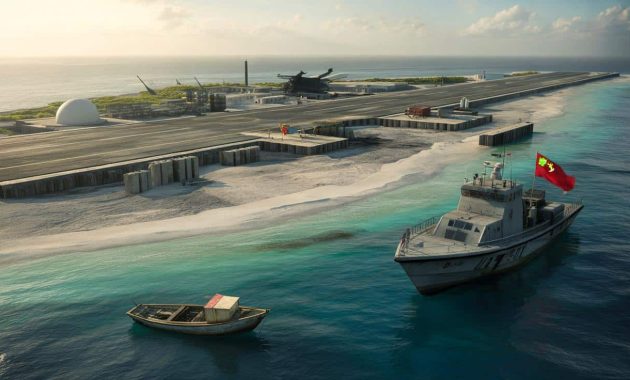
The boat slows as the water turns a bizarre, chalky turquoise. Ahead, where old maps show nothing but submerged reefs, an island suddenly rises from the sea like a mirage made of concrete. There’s a runway long enough for jet fighters, a neat row of radars, the flash of a lighthouse that no fisherman asked for. The air smells of fuel and wet cement rather than salt and coral. Chinese flags snap in the hot South China Sea wind. A patrol boat idles nearby, grey and watchful, as if guarding a secret that is no longer a secret at all.
Once, this was just a shallow patch of ocean, home to fish, clams, and the occasional rusted ship anchor. Now it’s a military outpost bristling with antennas and anti-aircraft guns. Somewhere under all that concrete, a living reef is buried, suffocating in silence.
From the sky, it looks permanent. Almost inevitable.
The quiet transformation of reefs into fortresses
The story begins in places that barely existed on the surface. Low-tide elevations, submerged reefs, and sandbars that only fishermen knew by memory. For decades, these features were lines on maritime charts, not destinations. Then Chinese dredgers appeared, hulking silhouettes on the horizon, churning day and night. Sand roared through steel pipes, piling up where there had only been waves. Concrete mixing ships followed, pouring foundations into shallow turquoise water. *Bit by bit, transient reefs turned into something solid, hard, and unmistakably man-made.*
From a distance, you’d think someone was building a coastal city that got lost at sea.
Take Fiery Cross Reef, once a barely-there speck in the Spratly Islands. A few decades ago, it was a hazard to navigation, somewhere sailors avoided in typhoons. Today it holds a 3,000-meter runway, hardened shelters for fighter jets, missile platforms, fuel depots, and housing for hundreds of personnel. Satellite images show radar domes like white beads planted along the perimeter, watchful eyes scanning sky and sea.
Chinese state media framed the project as improving navigation safety and supporting “peaceful” operations. Fishermen, meanwhile, describe being waved away, their traditional grounds now guarded by armed coast guard ships. One reef after another, the map has been rewritten in concrete.
Strategically, the logic is brutally simple. Whoever holds fixed bases in the middle of the South China Sea can project power far beyond their coastline. Airstrips on man-made islands let aircraft refuel and loiter. Missile batteries extend a defensive bubble over key shipping lanes. Radar and sonar stations turn distant waters into a monitored backyard. **Concrete becomes sovereignty made visible**, especially in disputed zones where legal claims are murky and distant.
Once an airfield and harbor sit on top of what used to be coral, the conversation shifts. It’s no longer about abstract lines on a map. It’s about whether anyone is really ready to contest something that looks, from up close, like a permanent base.
How you turn a reef into an island, step by heavy step
The process begins with a dredger anchoring near a reef that might barely peek above the waves. Giant suction pipes plunge down, biting into the seabed and sucking up sand, crushed coral, and shell. The slurry is pumped onto the reef and spread out, forming a growing mound that slowly rises above sea level. Bulldozers and excavators, brought in on barges, rumble across this raw, shifting surface, pushing earth into shape. Once there’s dry ground, concrete arrives — in blocks, in piles, in a never-ending grey ribbon.
➡️ Goodbye to the angled bob : the “anti-ageing” cut that restores volume to thinning hair after 55
➡️ “At 63, I misunderstood my morning stiffness”: what my body needed instead
➡️ A polar vortex disruption is on the way, and its magnitude is almost unheard of in February
Foundations are poured, seawalls are cast, then the straight lines of human geometry replace the curves of a living reef.
From 2013 to 2016, analysts estimate China created more than 3,000 hectares of new land across seven reefs in the Spratly Islands alone. That’s roughly the size of a small city, dropped into one of the world’s richest marine ecosystems. Mischief Reef grew a runway and piers. Subi and Fiery Cross gained extensive harbors and long airstrips. Each project followed a similar script: dredge, dump, flatten, pour. Fishermen in the Philippines and Vietnam watched the horizon change year after year, like a slow-motion time-lapse.
There are now concrete helipads where sea turtles once nested, and breakwaters where waves used to break freely on coral heads.
Ecologically, the damage is staggering. Dredging smothers coral in sediment, disrupts fish breeding grounds, and kicks up plumes that can drift for kilometers. Once concrete settles, natural reef functions — shelter, feeding, storm buffering — vanish beneath an artificial platform. **You can’t pour millions of tons of concrete onto a living reef and expect the sea to shrug.** Beijing argues that it has built seawalls to reduce erosion and sometimes mentions “ecological restoration,” but marine biologists point out that a few transplanted corals on a pier do not replace an entire reef system.
The plain truth: once a reef becomes a fortress, the old ecosystem doesn’t come back in any meaningful way.
What this means for the region, and for the rest of us
For coastal neighbors like the Philippines, Vietnam, and Malaysia, these artificial islands are more than geopolitics on a map. They’re daily reality. Coast guard captains report being shadowed by Chinese vessels as they approach their own claimed waters. Filipino supply boats heading to their tiny outpost on Second Thomas Shoal now pass within range of Chinese bases built on nearby reefs. Simple trips to fish or resupply can turn into tense stand-offs, with water cannons, dangerous maneuvers, and blinding lasers.
The new islands don’t just change who has the bigger gun. They change who dares to show up at all.
For many people watching from afar, it can feel abstract — just another news story about rocks and flags. Then an oil tanker is diverted, or a navy conducts a “freedom of navigation” patrol, or footage surfaces of rusting hulls being bumped by larger, newer vessels. The South China Sea carries about a third of global maritime trade. If navigation becomes more controlled, more militarized, or more contested, the ripple effects reach fuel prices, consumer goods, even the stability of supply chains half a world away.
We’ve all been there, that moment when a distant dispute suddenly hits your everyday life through a price spike or a delayed shipment, and you realize the map isn’t as far away as it looked.
“On paper, these are just man-made features,” a Southeast Asian security analyst told me. “In practice, they are unsinkable aircraft carriers. Once you have them, you can set the rhythm of everyone else’s moves.”
- New islands, new rulesArtificial bases give China a permanent presence deep in disputed waters, changing who feels at home — or unwelcome — there.
- Environmental loss with no rewind buttonBuried reefs mean lost fisheries, storm buffers, and biodiversity that coastal communities relied on for generations.
- Militarization of everyday sea lanesWhat used to be fishing routes and commercial corridors now sit under watchtowers, radar domes, and missile ranges.
- Legal grey zonesUnder international law, many of these features weren’t islands to begin with, raising tough questions about what rights they really generate.
- Growing risk of miscalculationMore bases, more patrols, more close encounters — and more chances that a small incident spirals out of control.
Where the concrete ends and the questions begin
The strange thing about these man-made islands is how ordinary they look once built. There are basketball courts for off-duty soldiers. Solar panels glint on roofs. Antennas poke at the sky like any remote telecom tower. From the viewport of a passing plane, you might mistake one for a tiny resort with its own airstrip. Yet underneath those straight lines sits the memory of a reef that can no longer breathe. And beyond the horizon is a ring of countries forced to recalculate their every move.
Let’s be honest: nobody really tracks each new radar dome or jet shelter unless they’re paid to. Most of us catch fragments on social media — a satellite photo here, a viral video there — and move on with our day.
Still, there’s something quietly unsettling about the idea that pouring enough concrete, for long enough, can turn a disputed patch of sea into a quasi-permanent fact on the ground. It raises questions about how power shapes the planet, literally, and who gets to say what a coastline is. Can legal rulings compete with dredgers? Do protests and diplomatic notes matter when the runway is already laid and the harbor already dug?
These aren’t just questions for the South China Sea. They echo in Arctic sea lanes, in disappearing islands, in any place where climate and ambition are redrawing the edges of the map.
What happens next will likely unfold in slow motion — small incidents, new construction, quiet negotiations, the occasional crisis that makes headlines for a week and then fades. Yet each new layer of concrete poured onto shallow waters sets a precedent that’s hard to roll back. The reefs buried under the bases will stay buried. The military outposts will stay on the map. And the rest of us are left to decide how we feel about a world where the seafloor itself is fair game for whoever has the biggest dredger and the longest vision of control.
| Key point | Detail | Value for the reader |
|---|---|---|
| Concrete as strategy | Massive land reclamation has turned reefs into fortified bases with runways, radars, and missiles. | Helps you grasp how physical construction shifts power at sea. |
| Environmental cost | Dredging and building have devastated coral ecosystems and local fisheries. | Shows the hidden price paid by oceans and coastal communities. |
| Global ripple effects | Militarized islands sit astride key trade routes and contested maritime borders. | Connects distant island-building to everyday economic and political stability. |
FAQ:
- Question 1Are these artificial islands legally considered Chinese territory?
- Question 2How much concrete and material has China used to build these outposts?
- Question 3Do other countries also build artificial islands in the South China Sea?
- Question 4Can the damaged coral reefs ever fully recover if the bases are removed?
- Question 5Why should people outside Asia care about concrete on distant reefs?