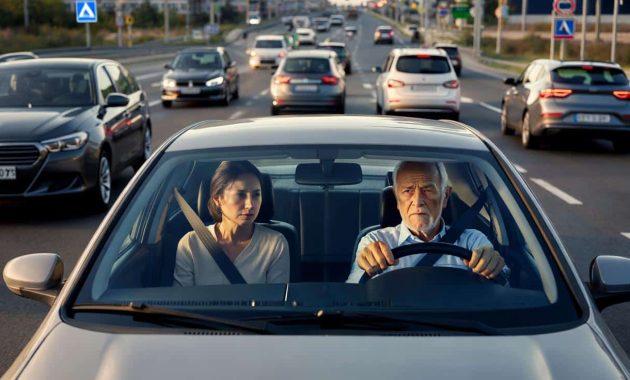
The scene is almost cliché, yet painfully real. A silver hatchback hesitates at a roundabout, indicator blinking in every direction, while a line of drivers behind tap their fingers on the steering wheel. At the wheel, an elderly man squints, looking for an opening that feels safe enough. In the passenger seat, his daughter whispers, “Dad, maybe it’s time we talk about driving.”
On the radio, a commentator talks about “age limits” and “road safety”. Someone says 65, another insists on 75. The debate sounds brutal when you’re watching a parent trying to park straight.
Because behind the number on the birthday cake, there is a driving licence, a daily freedom, and a question that nobody really wants to answer.
So, is there a real age limit for driving?
Let’s clear up the rumor straight away. No, the Highway Code has not set a magic cut-off at 65, or at 75, or at any other birthday. In most countries, **there is simply no fixed maximum age to drive**. What really counts on paper is not the number of candles, but the medical and practical ability to handle a vehicle safely.
That sounds neat in theory. On the road, it’s messier. One 80-year-old can reverse into a tight spot like a pro, while a 45-year-old fiddles with the GPS and drifts between lanes. The law is forced to walk a tightrope between freedom and protection.
Take the example of Marie, 78, who still drives every day to do her shopping, visit friends, and volunteer twice a week. Her eyesight is corrected, her reflexes are a bit slower, but she plans ahead, respects distances, and avoids night driving. Her doctor has not raised any red flag, and her last license check went through without a problem.
Two streets away, Paul is 62. No one would call him “old”. Yet he is constantly on his phone, often exceeds the speed limit, and once ran a red light he simply didn’t see. On the insurance records, he has more accidents than Marie. On paper, he is “young enough”. On the road, he is the one raising concerns.
Age, on its own, really doesn’t tell the whole story.
That’s why the real “age limit” is less a number than a combination of thresholds. Past a certain age, some countries require more frequent medical checks, eyesight tests, or license renewals every three or five years. These stages act like filters, not guillotines. They are supposed to catch the warning signs: slower reaction time, reduced vision, memory gaps, difficulty handling complex traffic situations.
Behind these rules, there’s a simple logic: adapt the follow-up to the reality of aging without stamping a “too old to drive” label on everyone past 70. Laws try to follow biology, not the calendar. And biology doesn’t read birth certificates.
➡️ 4 phrases to end a conversation intelligently
➡️ The overlooked bathroom vent setting experts say reduces mold by more than 40%
➡️ This “easy” plant is taking over French gardens – and it’s not always good news
➡️ What you see is not a ship : at 385 metres long, Havfarm is the world’s largest offshore salmon farm
➡️ Why office friendships are ruining productivity and saving your sanity at the same time
➡️ “I recovered $1,200 a year by cancelling things I no longer used”
What really decides if someone is “too old” to be at the wheel?
The Highway Code mostly answers that question with one word: fitness. Not fitness in the gym sense, but the ability to drive without putting yourself or others at risk. This includes eyesight, hearing, reflexes, concentration, and how well you process traffic information. Some countries let doctors report if they think a patient should be re-evaluated, while others rely on regular medical certificates after 70 or so.
In practice, the “real limit” comes when a professional – sometimes combined with a driving test – estimates that the person can no longer handle unexpected situations on the road. That’s the invisible line no one wants to cross, but that the law cannot ignore.
Families often see the signs before the authorities do. A new scratch on the bumper that “came from nowhere”. Getting lost on a route that used to be automatic. Avoiding night driving, long distances, or high-speed roads because “it’s too stressful now”. One day, a neighbor quietly mentions a near-miss at a junction.
We’ve all been there, that moment when a parent stalls three times in front of a busy intersection and laughs it off, but you feel the knot in your stomach. You start offering lifts a bit more often, “to help”, not quite ready to say the real words out loud. Those small stories say more than any birthday date.
On the medical side, several risk factors are well known: neurodegenerative diseases, some forms of diabetes, untreated sleep apnea, strong sedatives, or repeated small strokes. These conditions can affect judgment, attention, or reaction time. *The plain truth is that aging multiplies these risks, but doesn’t guarantee them.* That’s why many experts defend a regular, personalized evaluation instead of a brutal universal age ban.
The Highway Code, in its latest adaptations, tends to go in that direction. Rather than saying “no more driving after X years”, it encourages or imposes stepped checks: every 5 years past 70, every 2 or 3 years past 80, for example. The goal is simple: catch the problem early, before the tragic accident that was “bound to happen one day”.
How to know when it’s time to slow down… or stop?
There is a very concrete method that road safety specialists often suggest. Take a recent, realistic trip with the older driver, as a passenger. Not a quiet Sunday ride on an empty road, but their real daily route: supermarket, doctor, town center. Don’t intervene unless necessary. Observe. Does the person anticipate? Do they react calmly to unexpected situations? Are they overwhelmed by roundabouts, lane changes, heavy traffic?
Back home, write down, coldly, anything that worried you: delayed braking, confusion with pedals, missing signs, hesitation in intersections. This “field test” often says more than a theoretical opinion on their age.
What hurts most is not the license, it’s what it represents: autonomy, pride, the right to say “I’ll come when I want”. When you start this conversation, talk about safety, not about “being old”. Avoid phrases like “You’re dangerous” and focus on precise facts: “Yesterday you didn’t see the pedestrian”, “You confused the accelerator and the brake at the car park”.
Let’s be honest: nobody really does this every single day. We postpone the discussion, we hope that things will somehow fix themselves, we cross our fingers. Yet the earlier the dialogue starts, the more you can plan alternatives: shared cars, organized lifts, taxi budgets, adapted schedules. That way, stopping doesn’t feel like exile.
“As a doctor, I’ve seen 55-year-olds who should have stopped driving years ago, and 85-year-olds who handle the wheel better than many younger people,” confides a geriatrician. “The real emergency is to stop reducing people to their age and start really looking at how they drive.”
- Warning signs to watch on the road
- Frequent near-misses, even without actual accidents
- New fear of driving at night, on highways, or in cities
- Difficulty following directions or reading signs in time
- Confusion between pedals, or very late reactions to traffic lights
- Steps you can take
- Book an eyesight and hearing test
- Ask the doctor about medication and alertness
- Suggest a refresher driving lesson with an instructor
- Gradually limit the most stressful trips instead of cutting everything overnight
The real age limit might be less about years, more about courage
In the end, the Highway Code does set a limit, but it’s more subtle than a big red cross on the 75th birthday. The rulebook says: you can drive as long as you are capable, physically and mentally, of doing so safely. Past a certain age, some countries tighten the net of checks and renewals. The true battle happens elsewhere, in lounges, kitchens, and passenger seats, where families negotiate the transition between independence and protection.
The number that really counts is sometimes not the driver’s age, but the age at which we dare to talk about it. Those who prepare this moment early, without drama, often live it better. They adjust routes, times, vehicles. They involve doctors, instructors, neighbors. They invent shared solutions instead of dramatic bans.
The question is not “At what age should we stop driving?” but “How do we stay honest about our capacities, and how do we help our loved ones do the same?” That’s where the real limit hides: in our ability to look reality in the eye, even when it hurts a little, for the sake of everyone on the road.
| Key point | Detail | Value for the reader |
|---|---|---|
| No fixed legal age limit | Most Highway Codes don’t ban driving at 65 or 75, they rely on medical fitness and regular checks | Reassures older drivers while clarifying that age alone doesn’t decide |
| Warning signs matter more than birthdays | Near-misses, confusion at intersections, and new fears on the road are key indicators | Helps families know when to start the conversation about driving |
| Progressive adaptation works best | Shorter trips, avoiding nights, medical follow-up, and refresher lessons soften the transition | Offers concrete options before considering a full stop to driving |
FAQ:
- Is there an official age when the license is automatically withdrawn?In most countries, no. The license can be withdrawn after a medical opinion, repeated offenses, or a failed test, but not simply because of reaching a certain age.
- Do seniors have to pass a new driving test after 70?It depends on the jurisdiction. Some places require regular medical certificates or theoretical checks, others can ask for a practical test in doubtful cases.
- My parent is offended when I talk about their driving. What can I do?Start with concern, not accusation. Describe specific situations you witnessed, propose a medical check “to be reassured”, and offer help in organizing alternatives.
- Are older drivers really more dangerous than younger ones?Statistics often show more severe consequences for older drivers involved in crashes, but younger drivers tend to have more risky behavior. The risk profile is different, not simply “worse” or “better”.
- Can a doctor tell someone to stop driving?Yes, in many countries doctors can recommend suspending or limiting driving. Some regions even allow or oblige them to report serious medical risks to the authorities.