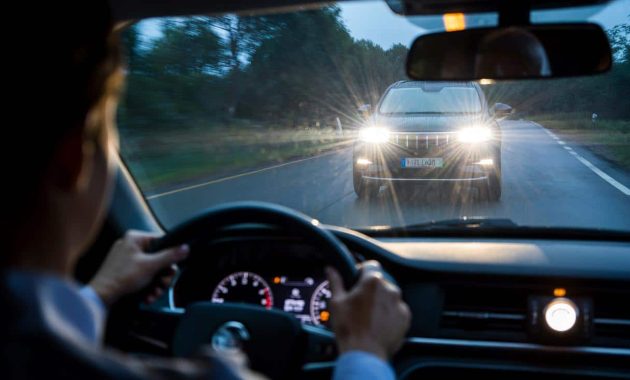
At night on a narrow country road, you don’t need a PhD to feel it. A modern SUV with brand-new LED headlights appears in your mirror, and suddenly your cabin fills with cold blue-white light. The rearview mirror turns into a glowing rectangle. Your eyes tense, your neck tightens, and the instinct is simple: “I’m being blinded.”
You lower your gaze a little, grip the steering wheel a bit too hard. There’s this strange contrast: your modest halogen beams licking the asphalt ahead, and behind you, a portable stadium floodlight getting closer.
Researchers have just put numbers on this feeling that every driver already knows.
The verdict is uncomfortable.
LED headlights: when “seeing better” means someone else sees less
On paper, LED headlights are a dream. Whiter light, more powerful, lower energy consumption, longer life. For carmakers, they tick every box on the spec sheet and every line in the marketing brochure.
Out on the road, the story feels very different once you’re on the receiving end. Especially when the oncoming car sits higher than yours, or when its lights are just a bit misaligned. The beam doesn’t just light the road. It enters your eyes, your brain, your nerves.
The new study that’s been making the rounds simply confirms what many drivers mutter under their breath at night. LED headlights are stronger, often too strong, and the human eye doesn’t negotiate with physics.
The researchers (from several European traffic-safety labs) did something quite simple. They placed real drivers in real conditions, sometimes on test tracks, sometimes using detailed simulations, then measured everything: brightness, glare, reaction times, pupil size. Not just from the car that “benefits” from the LEDs, but from all the others facing that light.
They compared classic halogen, xenon, and the latest LED beams. The numbers are clear. The measured luminous intensity of some LED headlights can be several times higher than old halogen setups, especially in the most sensitive angles for the human eye.
Yet when you read the conclusion, it almost sounds like a shrug: the science finally caught up with what people have been complaining about for years.
What the study shows, and what drivers feel, is a gap between regulation and reality. On a technical sheet, the headlights are “within the law”. The beam cut-off lines are respected, the lux levels are measured in a lab, the certification stamps are all there.
➡️ 12 things flight attendants notice about you the moment you board
➡️ This plant that can stop mold is becoming the ideal natural solution for bathrooms and damp rooms
➡️ US special forces could give their Skyraider II aircraft a long-range strike punch
➡️ Space sovereignty: can France still keep up with SpaceX and China?
Out in a real street, with loaded trunks, worn suspensions, aftermarket kits, wet roads and dirty windshields, things slide. The same LED that looked fine in a controlled environment becomes a white wall for the person coming the other way. *The standard doesn’t see what your retina sees.*
That’s the plain truth sentence nobody likes to read: the system protects the product better than it protects your tired eyes at 11:30 pm on a rainy Tuesday.
What you can actually do, when you’re not the one designing headlights
There is one small, low-tech gesture that changes a lot: adjust your own headlights. Not once when you buy the car. Regularly. At least check them. On a flat surface, a few meters from a wall or garage door, at night.
Turn on low beams, mark the height of the light cutoff with tape, then compare left and right. If one side is too high, or both seem to be pointing at the sky, adjust using the little wheels or screws usually hidden near the headlight housing. It takes ten minutes, not an afternoon.
You won’t fix the SUV behind you, but you’ll stop contributing to the silent nightly arms race.
The other tool is already in your cabin, often forgotten: the dashboard dial that lowers headlight aim depending on passenger or trunk load. Most drivers leave it on “0” forever, even when the car is full of luggage and kids, back end sagging, front pointing upward like a lighthouse.
Let’s be honest: nobody really does this every single day. We rush, we’re late, we just want to get home. Yet that tiny wheel sometimes makes the difference between “nice clear beam on the road” and “why is everyone flashing me?”.
You can also slightly tilt your interior mirror in “night” position earlier than you think you need to, and glance at the right edge of the road instead of staring straight into the oncoming white blaze. It won’t solve everything, but your eyes will thank you.
The study’s authors are cautious in their wording, yet between the lines the message is sharp.
“LED technology is not the enemy. Misuse, misadjustment and regulatory lag are,” one of the researchers explains. “We optimized performance for the driver who owns the car, not for the ten other drivers who share the same stretch of asphalt.”
To turn that into something useful, keep a small mental checklist in mind:
- Have my headlights been checked since the last service or big pothole hit?
- Is my beam too white and high because I installed aftermarket LEDs in old housings?
- Do I lower my aim when the car is loaded?
- Do I use fog lights only when there’s actual fog or heavy rain?
- Do I get my vision tested if night driving suddenly feels much harder?
Small, unheroic habits. Yet those are the ones that quietly change the glare game.
The quiet war of light on the road isn’t going away
What this new wave of research underlines is something uncomfortable: road safety isn’t just about seatbelts, airbags and speed cameras. It’s about light. About what we see, what we don’t, and what blinds us without leaving a scratch on the car.
LEDs will not disappear. If anything, they’ll become smarter, more adaptive, more connected to cameras and sensors that cut the beam around other cars. That’s the optimistic scenario. The less flattering one is already on sale in some online stores: cheap, ultra-bright conversion kits stuffed into old reflectors never designed for this power.
Between those two extremes, there’s us. The everyday drivers who squint at night, who complain in low voices, who arrive home with a faint headache they blame on “a long day” rather than on two hours of aggressive light. Maybe this study won’t change laws overnight. It does offer something else though: the relief of knowing that when you feel attacked by lights on the road, you’re not imagining it. You were right all along.
| Key point | Detail | Value for the reader |
|---|---|---|
| LED glare is real | Studies confirm higher intensity and more disruptive angles compared to halogen | Validates your night-driving discomfort and encourages you to act |
| Adjustment matters | Simple headlight aiming and correct load settings reduce blinding others | Gives you a practical, low-cost way to improve safety for everyone |
| Your habits count | Responsible use of aftermarket LEDs, fog lights and mirrors limits glare | Helps you stay safer and less exhausted behind the wheel at night |
FAQ:
- Are LED headlights actually legal if they blind me this much?Yes, most OEM LED headlights are legal because they pass lab tests, but real-world factors like car load, poor adjustment or retrofitted bulbs can turn a “legal” light into serious glare for others.
- Do LED headlights really help the driver of the car that has them?Often yes: they offer better visibility, sharper cutoffs and a broader beam, especially on unlit roads, even though that extra performance can be exhausting for oncoming traffic.
- Is it safe to put LED bulbs in old halogen headlight housings?Generally no, because the optics were designed for a filament, not an LED chip, so the beam can scatter and create a lot more glare, even if it looks “brighter” from the driver’s seat.
- What can I do if I’m often dazzled by oncoming cars?Look slightly to the right line or shoulder instead of straight into the lights, use the night setting on your mirrors, clean your windshield regularly and have your eyes checked for increased light sensitivity.
- Will future headlights solve this glare problem?Adaptive matrix LEDs can reduce glare by “cutting out” other vehicles from the beam, and as they become more widespread and better regulated, they should help balance visibility with comfort for everyone.