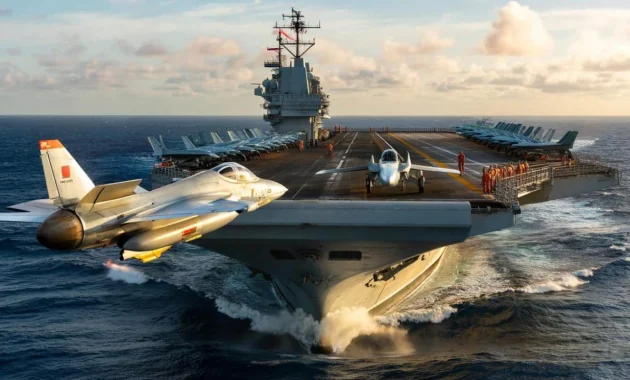
Picture this: you’re standing on the deck of a massive warship, watching jets launch into the sky not with the roar of steam, but with the silent precision of electromagnetic power. The aircraft don’t struggle up a ramp—they’re catapulted forward like arrows from a bow.
This isn’t science fiction. This is happening right now aboard China’s newest supercarrier, and it’s changing everything we thought we knew about naval power in the Pacific.
The Fujian aircraft carrier represents more than just another ship in China’s growing fleet. It’s a technological leap that puts Beijing in an exclusive club of nations capable of projecting serious naval power across the globe.

China Just Joined an Elite Two-Nation Club
The Fujian aircraft carrier has successfully completed its most crucial test: launching and recovering fighter jets using electromagnetic catapults. This milestone puts China alongside the United States as the only countries operating this advanced launch technology at sea.
“The electromagnetic catapult system represents a fundamental shift in how carrier aviation works,” explains naval analyst Sarah Chen. “It’s like upgrading from a manual transmission to a computer-controlled system—everything becomes more precise and powerful.”
Unlike China’s previous carriers, the Liaoning and Shandong, which use ski-jump ramps for takeoffs, the Fujian employs the same CATOBAR system found on American supercarriers. This means Chinese pilots can now launch heavier aircraft carrying more fuel and weapons.

The difference is dramatic. Where ski-jump carriers limit aircraft to whatever they can lift under their own power, catapult systems can launch planes at their maximum weight capacity. Think of it as the difference between running up a hill versus being shot from a cannon.
The Game-Changing Aircraft Flying From Fujian’s Deck
Recent footage from China’s People’s Liberation Army Navy reveals three aircraft that signal Beijing’s serious intentions for carrier operations:
| Aircraft | Role | Significance |
|---|---|---|
| J-35 Stealth Fighter | Air Superiority | First stealth aircraft on Chinese carriers |
| J-15T Fighter | Multi-role Combat | Enhanced version with greater payload |
| KJ-600 Early Warning | Radar Detection | Extends radar coverage by hundreds of miles |
The J-35 stealth fighter deserves special attention. This aircraft gives China its first low-observable fighter capability from a carrier deck, potentially neutralizing one of America’s key advantages in naval aviation.

“Having stealth fighters on carriers completely changes the tactical equation,” notes former Navy pilot Commander Mike Rodriguez. “Suddenly, a Chinese carrier group can threaten targets that were previously considered safe.”
The KJ-600 early warning aircraft might be even more significant. This plane acts like the carrier’s eyes and ears, detecting enemy aircraft and ships far beyond the horizon. Previous Chinese carriers couldn’t operate fixed-wing early warning aircraft due to their ski-jump configuration.
- Extended radar detection range up to 400 miles
- Real-time coordination of multiple fighter squadrons
- Enhanced missile targeting for fleet defense
- Improved situational awareness for carrier operations
Why Electromagnetic Beats Steam Every Time
The Fujian’s electromagnetic catapults aren’t just different from steam systems—they’re better in almost every way. Steam catapults, used on older American carriers, work like giant pressure cookers, building up steam pressure to launch aircraft.

Electromagnetic systems use magnetic fields to accelerate aircraft down the deck. This provides several crucial advantages that make the technology worth the enormous development costs.
The precision control means pilots experience smoother launches with less stress on their aircraft. Steam catapults deliver a sudden jolt followed by acceleration, while electromagnetic systems provide steady, controlled force from start to finish.
“It’s the difference between being hit by a sledgehammer and being pushed by a hydraulic press,” explains aerospace engineer Dr. Lisa Park. “The electromagnetic system is much gentler on both pilot and aircraft.”

Energy efficiency also matters on a warship where every watt counts. Electromagnetic catapults can be precisely tuned for different aircraft weights, using only the energy needed for each launch. Steam systems waste enormous amounts of energy heating water and maintaining pressure.
What This Means for Naval Balance in the Pacific
The successful operation of the Fujian aircraft carrier fundamentally alters the military balance in the western Pacific. China now possesses a carrier capable of conducting sustained operations far from its coastline.
For Taiwan, this development represents a new level of pressure. The Fujian can station itself beyond the range of most land-based missiles while still projecting airpower over the Taiwan Strait.

“A CATOBAR carrier gives China options it never had before,” warns strategic analyst Robert Kim. “They can now threaten areas that were previously out of reach.”
American naval planners are taking notice. The Pentagon has already begun adjusting carrier deployment schedules in response to China’s growing naval capabilities. The days when a single American carrier group could dominate an entire region may be ending.
Regional allies like Japan, South Korea, and Australia are also reassessing their defense strategies. The presence of a modern Chinese supercarrier changes calculations about everything from trade route security to alliance commitments.

Economic implications extend beyond military concerns. Major shipping companies are already factoring potential conflict scenarios into their route planning. Insurance rates for vessels transiting disputed waters have increased as tensions rise.
The Technology Race Heating Up
China’s success with electromagnetic catapults puts additional pressure on other naval powers to accelerate their own carrier programs. India, currently building its second indigenous carrier, is reportedly considering electromagnetic systems for future vessels.
The United Kingdom and France, both operating smaller carriers, face difficult decisions about upgrading their capabilities. Neither country currently possesses electromagnetic launch technology, potentially leaving their carriers at a disadvantage in any future conflict.

“We’re witnessing the emergence of a true peer competitor in carrier aviation,” observes naval historian Dr. James Mitchell. “The monopoly on advanced carrier operations is officially over.”
The implications stretch beyond military applications. Electromagnetic launch technology has potential civilian uses in space launch systems and cargo operations. Countries mastering this technology gain advantages across multiple sectors.
FAQs
How many aircraft can the Fujian aircraft carrier hold?
The Fujian can carry approximately 70-80 aircraft, similar in capacity to American Ford-class carriers.
When will the Fujian become fully operational?
The carrier is expected to achieve full operational capability within the next 1-2 years after completing sea trials and crew training.
How does electromagnetic catapult technology work?
It uses powerful magnetic fields to accelerate aircraft down the flight deck, providing smooth, controlled launches without steam or hydraulic systems.
Can the Fujian launch nuclear-capable aircraft?
While technically possible, China maintains a no-first-use nuclear policy and hasn’t confirmed nuclear weapons deployment on carriers.
How many electromagnetic catapults does the Fujian have?
The ship features three electromagnetic catapult systems, allowing rapid sequential aircraft launches during combat operations.
What makes this different from China’s other carriers?
Unlike the Liaoning and Shandong, which use ski-jump takeoffs, the Fujian uses catapults that can launch heavier, more capable aircraft with full fuel and weapons loads.