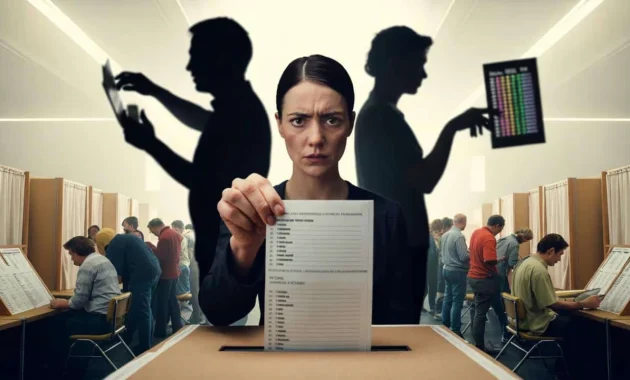
Sarah stared at the ballot in the small voting booth, her hand hovering over three different names. She’d driven to the community center with one candidate firmly in mind—the progressive who matched her values perfectly. But now, with the curtain drawn and the marker in her hand, doubt crept in like cold air through a crack.
“What if my vote doesn’t matter?” she whispered to herself, thinking about the polls she’d obsessed over for weeks. Her ideal candidate was trailing by double digits. Meanwhile, the moderate she could tolerate was neck-and-neck with someone she absolutely couldn’t stomach winning.
Sarah filled in the bubble next to the moderate’s name, folded her ballot, and walked out feeling like she’d just lied to herself. She wasn’t alone in that feeling.

The chess game hiding inside democracy
Strategic voting has quietly become the shadow operating system of modern elections. It’s the practice of casting your ballot not for the candidate you most want to win, but for the one you think has the best chance of beating the candidate you most want to lose.
This isn’t about being uninformed or making mistakes. It’s calculated, deliberate, and increasingly common across democracies worldwide.
“We’re seeing voters become amateur political strategists,” says Dr. Maria Rodriguez, a political scientist at Georgetown University. “They’re not just expressing preferences anymore—they’re trying to engineer outcomes.”

The phenomenon shows up everywhere from French presidential runoffs to British constituencies where tactical voting can swing entire seats. In the U.S., primary elections have become laboratories for strategic behavior, with voters sometimes crossing party lines or abandoning preferred candidates to influence the general election landscape.
The strategic voting playbook: how it works
Strategic voting operates on several different levels, each with its own logic and consequences:
- Defensive voting: Choosing a viable candidate to block your least favorite option
- Tactical switching: Abandoning your preferred candidate when they can’t win
- Coalition building: Supporting candidates who can attract broader coalitions
- Primary manipulation: Voting in opposite party primaries to weaken their field
The mathematics can get complex, but the emotional calculus is simple: the fear of your worst-case scenario outweighs the hope for your best-case scenario.

| Voting Strategy | Motivation | Risk |
|---|---|---|
| Vote for ideal candidate | Express true preference | May help opposition win |
| Vote strategically | Prevent worst outcome | Undermine authentic choice |
| Vote for “electability” | Pick probable winner | Self-fulfilling prophecy |
Dr. James Mitchell, who studies voting behavior at Oxford, explains it simply: “People have learned that sincere voting and smart voting aren’t always the same thing. The question is whether that makes democracy more practical or less honest.”
When lying to your ballot becomes normal
The rise of strategic voting reflects deeper changes in how people think about democracy itself. Voters increasingly see elections not as opportunities for expression but as damage control exercises.
Consider what happened in the 2017 French presidential election. Millions of left-wing voters who despised Emmanuel Macron’s centrist policies cast ballots for him anyway to prevent Marine Le Pen’s far-right victory. They called it “voting with a clothespin on your nose.”

Similar patterns emerged in recent UK elections, where anti-Conservative voters coordinated online to identify which opposition candidate had the best chance in each constituency, regardless of party affiliation.
“The tragedy is that strategic voting often works,” notes political analyst Rebecca Chen. “But it creates a system where authenticity becomes a luxury most voters feel they can’t afford.”
The psychological toll is real. Voters report feelings of betrayal—of their values, their preferred candidates, and themselves. They walk away from polling stations wondering if they just participated in democracy or gamed it.
The democracy disruption nobody talks about
Strategic voting creates ripple effects that reshape entire political landscapes:
- Candidate quality: Mediocre but “electable” candidates gain advantages over principled ones
- Policy positions: Politicians moderate their views to attract strategic voters
- Campaign dynamics: Races become about viability rather than vision
- Voter engagement: People become cynical about authentic political participation
The most insidious effect might be how it changes what candidates think they need to be. Instead of inspiring movements, they focus on seeming like safe choices. Instead of bold positions, they offer calculated moderation.
Primary elections particularly suffer from this dynamic. Candidates who energize their base often lose to those who poll better against the opposing party’s likely nominee—even when that opposing nominee hasn’t been chosen yet.

“We’re optimizing for electability based on hypothetical matchups,” warns Dr. Rodriguez. “That’s not democracy—that’s elaborate guesswork with ballots.”
The honest argument for strategic dishonesty
But defenders of strategic voting make compelling points. They argue it’s actually the most responsible way to participate in flawed electoral systems.
When you’re stuck with winner-take-all elections, first-past-the-post voting, or electoral colleges that distort popular will, strategic voting becomes a rational response to irrational systems.

“If the rules force you to choose between expressing yourself and achieving your goals, choosing your goals isn’t dishonest—it’s adaptive,” argues political theorist Dr. Kenneth Walsh.
Strategic voters often see themselves as the adults in the room, making hard choices while others indulge in idealistic gestures. They point to examples where strategic coordination prevented extremist victories or preserved democratic norms.
The future of voting with your brain, not your heart
Technology is making strategic voting more sophisticated. Apps and websites now help voters identify the most tactically effective choice in their specific district. Social media enables real-time coordination of strategic campaigns.

Some countries are responding by changing their electoral systems. Ranked-choice voting, approval voting, and proportional representation all promise to reduce the pressure for strategic behavior by better reflecting voter preferences.
But in places stuck with traditional systems, strategic voting seems destined to grow. Voters are becoming more educated about electoral mechanics and more willing to subordinate personal preferences to strategic objectives.
The question isn’t whether strategic voting will continue—it will. The question is whether democracies can maintain legitimacy when increasing numbers of citizens routinely vote against their conscience to serve their calculations.
As one longtime poll worker put it: “I’ve watched people walk into these booths for thirty years. They used to look determined. Now they look like they’re solving math problems they hate.”
FAQs
What exactly is strategic voting?
Strategic voting is when you cast your ballot for someone other than your preferred candidate, usually to prevent your least-favorite candidate from winning.
Is strategic voting legal?
Yes, strategic voting is completely legal. Voters have the right to cast their ballots for any eligible candidate for any reason.
Does strategic voting actually work?
Sometimes yes, sometimes no. It can prevent unwanted outcomes, but it can also backfire if too many people make the same calculations or if predictions are wrong.
Why don’t we just change the voting system?
Electoral system reform is difficult because it requires those in power to change the rules that put them there. Many alternatives exist but face political obstacles.
Is strategic voting destroying democracy?
That’s debated. Some see it as voters adapting intelligently to flawed systems, while others worry it undermines authentic democratic expression.
How common is strategic voting?
Studies suggest 10-25% of voters engage in some form of strategic voting, with higher rates in competitive races and certain electoral systems.