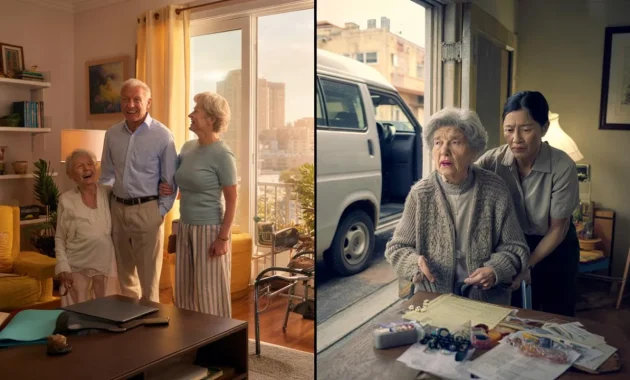
Sarah stares at the stack of bills on her kitchen table, her coffee growing cold. The nursing home wants $6,000 a month for her father’s care. Her mortgage is $2,800. Her daughter’s college tuition is due next month. At 52, she never imagined she’d be choosing between her father’s dignity and her family’s financial survival.
Down the street, her neighbor Margaret hosts book club meetings in her paid-off home, planning Mediterranean cruises with her retirement fund. Both women are navigating the same aging boom, but they’re living in completely different worlds.
This is the uncomfortable truth about our longevity revolution: it’s creating winners and losers in ways we never expected.

The aging boom nobody planned for
The aging boom is reshaping society faster than we can adapt. People aren’t just living longer—they’re living decades longer than previous generations ever imagined. In 1950, the average American lived to 68. Today, that number has jumped to nearly 79, with many people reaching their 90s and beyond.
But here’s what nobody talks about: our systems were built for shorter lives. Pensions calculated on 10-15 years of retirement, not 25-30. Families expected to care for parents for a few years, not decades. Healthcare designed for acute illness, not chronic management of multiple conditions over time.
“We’re seeing the collision between medical advances and economic reality,” says Dr. Patricia Chen, who studies family caregiving patterns. “People are living longer, but not necessarily healthier, and someone has to pay for those extra years.”

The numbers tell a stark story. In Japan, nearly 30% of the population is over 65. Europe isn’t far behind. The U.S. will see its senior population nearly double by 2030. Yet most Western pension systems were designed when life expectancy was 15-20 years shorter.
The brutal math of modern aging
Let’s break down what the aging boom actually costs families and society:
| Expense Category | Average Annual Cost | Duration | Total Impact |
|---|---|---|---|
| Nursing Home Care | $108,405 | 2-3 years average | $216,810-$325,215 |
| Home Health Aide | $61,776 | 5-8 years average | $308,880-$494,208 |
| Family Caregiver Lost Wages | $1,986 per month | 4.5 years average | $107,244 |
| Medical Expenses (chronic conditions) | $18,424 | 10-15 years | $184,240-$276,360 |
These aren’t just numbers on a spreadsheet. Each figure represents families making impossible choices:

- Adult children leaving careers to become caregivers
- Retirement savings drained in 2-3 years of care costs
- Marriages strained by financial and emotional pressure
- Grandchildren seeing college funds redirected to grandparent care
- Middle-class families forced into poverty by medical expenses
“I quit my job to take care of my mother, and now I’m 58 with no retirement savings myself,” explains Maria Rodriguez, whose story echoes thousands of others. “I’m going to be the burden on my kids next.”
When families fracture under pressure
The aging boom is creating family dynamics nobody prepared for. Adult children find themselves parenting their parents while still raising their own kids—the so-called “sandwich generation” that’s being squeezed from both sides.
But it’s not affecting everyone equally. Wealthy families hire professional caregivers and move parents to luxury senior communities. Working-class families rotate care duties, sacrifice careers, and watch their financial stability crumble.

This economic divide is creating a new form of class warfare around aging. Who gets to grow old with dignity? Who becomes a “burden” on family resources? The questions sound harsh, but they’re being whispered in family conversations across the country.
“We’re seeing families torn apart by these decisions,” notes social worker Jennifer Walsh. “Siblings stop speaking when one can’t contribute financially to parent care. Marriages end when one spouse prioritizes their parent over their own family’s needs.”
The stigma of being “useless old” becomes very real when families are stretched to breaking points. Elderly parents sense the tension, the whispered conversations about costs, the delayed responses to requests for help.

The class war nobody wants to admit
The aging boom has exposed uncomfortable truths about who deserves comfort in old age. If you’re wealthy, longevity looks like freedom—time to travel, pursue hobbies, enjoy grandchildren. If you’re poor or middle-class, those extra years can feel like a penalty nobody budgeted for.
Consider two scenarios playing out simultaneously:
Wealthy retirees are extending their lives with expensive treatments, concierge medicine, and luxury care facilities. They’re not burdens—they’re customers with purchasing power.

Meanwhile, working-class seniors exhaust their modest savings quickly, rely on overwhelmed family members, and face waiting lists for basic care services. They become statistics in discussions about “unsustainable” aging costs.
“The irony is that the same medical advances that create longevity also create inequality,” observes economist Dr. Robert Kim. “Life extension becomes a luxury good, not a human right.”
Public policy struggles to keep up. Medicare covers acute care but not long-term support. Medicaid requires families to impoverish themselves before providing help. Private insurance treats aging as an uninsurable risk.

The result is a growing sense that society is splitting elderly people into categories: the “deserving” wealthy who can afford their longevity, and the “burdensome” poor who cannot.
What happens next
The aging boom isn’t slowing down. If anything, it’s accelerating. Medical advances keep extending lives, but economic systems aren’t adapting fast enough to support those extra years meaningfully.
Some countries are experimenting with solutions. Germany has mandatory long-term care insurance. Singapore requires children to financially support elderly parents. Nordic countries integrate aging support into universal healthcare.

But in many places, families are left to figure it out alone, creating a lottery system where your birth family’s financial situation determines your aging experience.
The conversation about aging needs to change. Instead of celebrating longevity as an automatic good, we need honest discussions about who pays for it, how families can be supported, and what growing old with dignity actually means in practical terms.
Otherwise, the aging boom risks becoming exactly what many fear: a generational burden that divides families and society along lines of economic class, leaving the “useless old” to navigate their final years in a system that views them as a problem to be managed rather than people to be valued.
FAQs
What is the aging boom?
The aging boom refers to the rapid increase in elderly populations worldwide as people live longer than ever before, creating unprecedented social and economic challenges.
How much does long-term care actually cost?
Nursing home care averages over $108,000 annually, while home health aides cost around $62,000 per year, often lasting multiple years and quickly exhausting retirement savings.
Who is most affected by aging care costs?
Middle-class families are hit hardest—too wealthy to qualify for government assistance but not wealthy enough to afford quality care without financial devastation.
Is the aging boom the same everywhere?
No, countries like Japan and Germany face more severe aging challenges, while some developing nations still have younger populations, but most developed countries are experiencing similar pressures.
What can families do to prepare for aging care costs?
Start planning early with long-term care insurance, family conversations about expectations, and understanding local resources, though options remain limited for most families.
Will the aging boom get worse?
Yes, the number of people over 65 will continue growing rapidly through 2030, while the working-age population supporting them remains relatively stable, intensifying the economic pressures.