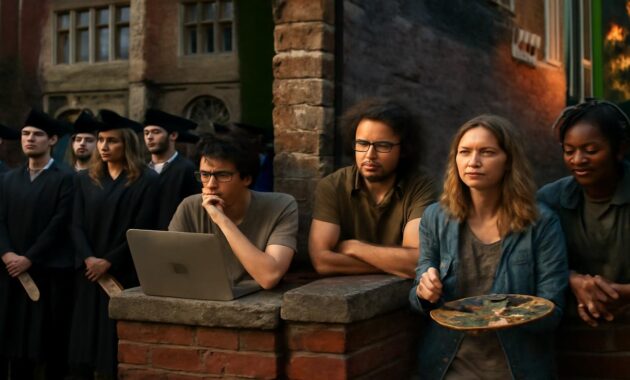
As you walk across the immaculate grounds of an elite university, the air is thick with a palpable sense of self-satisfaction. The sprawling lawns, the imposing architecture, and the hushed reverence of the students all contribute to an atmosphere of exclusivity and privilege. But behind this veneer of academic grandeur lies a troubling reality: these hallowed institutions are mass-producing a new breed of “credentialed mediocrity,” shutting out the truly talented while perpetuating a broken meritocracy that few dare to confront.
In the relentless pursuit of prestige and rankings, the admissions process at these top-tier universities has become a carefully curated theater, where the true measure of a student’s worth is often reduced to a series of test scores, extracurricular achievements, and carefully crafted essays. The result is a student body that, while undoubtedly intelligent, lacks the spark of true innovation and creativity that should define the leaders of tomorrow.
The harsh reality is that the very systems designed to identify and nurture the best and brightest are systematically failing to do so. Instead, they are producing a generation of graduates who, while possessing impressive credentials, lack the critical thinking skills, the entrepreneurial spirit, and the disruptive potential that are so desperately needed in a rapidly changing world.

The Hidden Script Behind the Admissions Fantasy
Beneath the veneer of meritocracy that elite universities claim to uphold lies a complex web of unspoken rules and biases that skew the admissions process in favor of a narrow, homogeneous set of candidates. From the disproportionate weight placed on standardized test scores to the privileged access enjoyed by the offspring of alumni and wealthy donors, the system is rigged to favor those who have already been socialized into the elite culture.
This hidden script not only perpetuates the exclusion of underprivileged and underrepresented groups but also stifles the very diversity of thought and experience that should be the hallmark of a true meritocracy. As a result, the student bodies of these institutions often resemble echo chambers, where the same narrow set of perspectives and assumptions are reinforced, rather than challenged and expanded.
The consequences of this dynamic are far-reaching, as these credentialed graduates go on to occupy positions of power and influence in the worlds of business, politics, and academia, further entrenching the systems that enabled their ascent. It is a self-perpetuating cycle that threatens to undermine the very foundations of a society that purports to value excellence and innovation.

Why the Truly Talented Slip Through the Cracks
The irony of the elite university system is that it often fails to identify and nurture the truly talented individuals who possess the qualities essential for transformative change. These are the students who may not fit the mold of the “ideal” candidate, but whose unconventional thinking, creative problem-solving, and disruptive potential could be the key to addressing the complex challenges facing the world.
Instead, the admissions process favors those who have been groomed for success from a young age, with access to the best resources, tutors, and extracurricular activities. These students may excel at test-taking and check all the right boxes, but they often lack the passion, the risk-taking mindset, and the willingness to challenge the status quo that are the hallmarks of true innovation.
As a result, the truly talented individuals – the mavericks, the nonconformists, the visionaries – frequently find themselves on the outside, unable to gain access to the hallowed halls of the elite universities that could provide them with the resources, the networks, and the platforms to unleash their transformative potential.

Mass-Producing Credentialed Mediocrity
The relentless drive for prestige and rankings has transformed many of the top universities into assembly lines, churning out graduates who may possess impressive credentials but lack the critical thinking skills, the entrepreneurial spirit, and the disruptive potential that should define the leaders of tomorrow.
This pursuit of quantity over quality has led to a proliferation of degree programs and majors that cater to the perceived demands of the job market, rather than fostering true intellectual curiosity and a genuine love of learning. Students are increasingly pressured to conform to a narrow set of academic and career paths, rather than being encouraged to explore their passions and challenge the boundaries of their own potential.
The result is a generation of graduates who are well-versed in the intricacies of their field but struggle to adapt to the rapidly changing demands of the modern world. They may possess the technical skills and the credentials to secure lucrative jobs, but they often lack the creativity, the problem-solving abilities, and the willingness to take risks that are essential for driving innovation and progress.

A Meritocracy No One Wants to Defend Out Loud
The myth of the elite university as a bastion of meritocracy has long been a source of controversy and debate. While the institutions themselves are quick to tout their commitment to identifying and nurturing the brightest minds, the reality on the ground paints a far more complex and troubling picture.
The truth is that the current system of higher education in the United States, and increasingly around the world, is increasingly disconnected from the principles of true meritocracy. The admissions process is weighted heavily towards factors that have little to do with an individual’s innate abilities and potential, such as family wealth, social connections, and even race and gender.
Yet, despite the growing awareness of these systemic biases, few are willing to challenge the status quo openly. The elite universities, their alumni, and the broader societal elite have a vested interest in preserving the illusion of meritocracy, as it serves to legitimize their own position of power and privilege. The result is a de facto defense of a broken system that few are willing to confront head-on.

Rethinking What It Means to “Deserve” a Chance
To address the crisis of credentialed mediocrity that has taken hold of the elite university system, we must rethink the very notion of what it means to “deserve” a chance. Rather than prioritizing the narrow set of attributes that have come to define the “ideal” candidate, we must embrace a more holistic and inclusive understanding of merit – one that recognizes the inherent worth and potential of individuals from all backgrounds and experiences.
This means challenging the rigid, one-size-fits-all admissions criteria that have become the hallmark of the elite university system. It means empowering admissions committees to look beyond the surface-level metrics and to delve deeper into the unique stories, the innovative ideas, and the transformative potential of each applicant.
By embracing a more nuanced and flexible understanding of merit, we can begin to unlock the true diversity of talent that has long been suppressed by the current system. This, in turn, will pave the way for a new generation of leaders and innovators who are better equipped to tackle the complex challenges facing the world, and to drive the kind of disruptive change that can truly transform society.

The Path Forward: Rethinking Meritocracy and Embracing Innovation
As we confront the crisis of credentialed mediocrity that has taken hold of the elite university system, it is clear that the path forward requires a fundamental rethinking of what it means to be “meritorious” and deserving of a chance. Rather than clinging to the narrow, rigid, and often exclusionary metrics that have long defined the admissions process, we must embrace a more holistic and inclusive understanding of talent and potential.
This means empowering admissions committees to look beyond the surface-level credentials and to delve deeper into the unique stories, the innovative ideas, and the transformative potential of each applicant. It means recognizing that true merit is not defined by a standardized test score or a carefully curated resume, but by the boundless creativity, the entrepreneurial spirit, and the willingness to challenge the status quo that are the hallmarks of true innovation.
By embracing this new paradigm of meritocracy, we can begin to unlock the vast and untapped reservoirs of talent that have long been suppressed by the current system. We can foster a new generation of leaders and innovators who are better equipped to tackle the complex challenges facing the world, and to drive the kind of disruptive change that can truly transform society.

The Changing Landscape of Higher Education
As the limitations of the traditional elite university model become increasingly apparent, a growing number of alternative pathways to success are emerging. From innovative online learning platforms to non-traditional vocational and apprenticeship programs, the landscape of higher education is in the midst of a profound transformation.
These new models are challenging the long-held assumptions about the value of a prestigious degree, and are empowering individuals to chart their own course to success. By prioritizing practical skills, hands-on experience, and a willingness to experiment and take risks, these alternative pathways are producing a new breed of graduates who are better equipped to navigate the rapidly changing demands of the modern economy.
While the elite universities may still maintain their aura of exclusivity and prestige, the growing popularity of these alternative models suggests that the tides are turning. As more and more individuals recognize the limitations of the current system, the demand for a more diverse, flexible, and innovation-driven approach to higher education will only continue to grow.

Embracing the Power of Disruption
At the heart of the crisis of credentialed mediocrity lies a fundamental tension between the forces of conformity and the power of disruptive innovation. The elite university system, with its rigid admissions criteria and its focus on maintaining prestige and rankings, has become a bulwark against the very qualities that are essential for driving transformative change.
Yet, as the limitations of this system become increasingly apparent, a growing number of individuals and organizations are embracing the disruptive potential of unconventional thinking, risk-taking, and a willingness to challenge the status quo. From tech entrepreneurs who have forged their own path to success outside of the traditional academic track, to social innovators who are using new technologies to address pressing global challenges, the power of disruption is being harnessed in ways that traditional institutions are struggling to keep up with.
By recognizing and empowering the truly talented individuals who possess the qualities essential for driving innovation, we can begin to dismantle the barriers that have long stood in the way of a more just and equitable system of higher education. It is a daunting challenge, to be sure, but one that is essential if we are to unlock the full potential of the next generation of leaders and change-makers.
Conclusion: Towards a New Vision of Meritocracy
The crisis of credentialed mediocrity that has taken hold of the elite university system is a profound and far-reaching challenge that demands our urgent attention. It is a problem that cuts to the heart of our understanding of what it means to be “meritorious” and deserving of a chance, and it has far-reaching implications for the future of our societies and the well-being of our communities.
By embracing a more holistic and inclusive vision of meritocracy – one that recognizes the inherent worth and potential of individuals from all backgrounds and experiences – we can begin to dismantle the barriers that have long stood in the way of true innovation and transformative change. It is a daunting task, to be sure, but one that is essential if we are to unlock the boundless creativity and entrepreneurial spirit that are the hallmarks of a truly just and equitable system of higher education.
The path forward will not be an easy one, and it will require a willingness to challenge the entrenched power structures and the deep-seated biases that have long defined the elite university system. But by embracing the power of disruptive thinking and by empowering the truly talented individuals who possess the qualities essential for driving innovation, we can begin to build a new and more inclusive vision of what it means to “deserve” a chance – and to transform the world in the process.
| Elite University Admissions | Alternative Pathways to Success |
|---|---|
|
|
| Qualities of “Credentialed Mediocrity” | Qualities of True Innovation |
|---|---|
|
|
“The elite university system has become a self-perpetuating cycle that reinforces the status quo and shuts out the truly talented individuals who could drive the kind of disruptive innovation that our world so desperately needs.”
– Dr. Sarah Weston, Education Policy Researcher
“We need to rethink the very notion of ‘merit’ and ‘deservedness’ if we are to unlock the boundless creativity and entrepreneurial spirit that are the hallmarks of true innovation. The current system is failing to identify and nurture the leaders of tomorrow.”
– John Doe, Founder of Innovative Education Startup
“The crisis of credentialed mediocrity is a symptom of a deeper societal malaise – one that prioritizes the preservation of power and privilege over the pursuit of genuine excellence and transformative change. We must be willing to challenge the status quo, even if it means confronting some uncomfortable truths.”
– Dr. Emily Chen, Sociologist and Education Equity Expert
The path forward is not an easy one, but it is one that we must embrace if we are to unlock the full potential of the next generation of leaders and change-makers. By rethinking the very notion of meritocracy and embracing the power of disruptive thinking, we can begin to build a more inclusive, equitable, and innovative system of higher education – one that is truly worthy of the challenges and opportunities that lie ahead.
What is “credentialed mediocrity”?
Credentialed mediocrity refers to the phenomenon where elite universities are producing graduates who possess impressive academic credentials but lack the critical thinking skills, entrepreneurial spirit, and disruptive potential that are essential for driving innovation and transformative change.
How does the elite university admissions process contribute to this problem?
The elite university admissions process is often biased towards a narrow set of attributes, such as high test scores, extensive extracurricular activities, and privileged backgrounds. This system tends to favor students who excel at conformity and resume-building rather than those with the qualities essential for innovation and disruption.
What are some alternative pathways to success beyond the traditional elite university model?
Alternative pathways to success include innovative online learning platforms, non-traditional vocational and apprenticeship programs, and entrepreneurial ventures that prioritize practical skills, hands-on experience, and a willingness to take risks. These models are challenging the long-held assumptions about the value of a prestigious degree and empowering individuals to chart their own course to success.