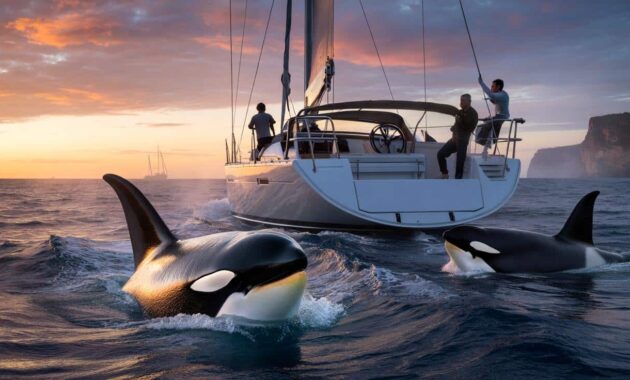
The vast, blue expanse of the ocean has long been a sanctuary for orcas, the majestic killer whales that have captured the imagination of marine biologists and the public alike. But in recent years, this idyllic relationship has been shattered by a series of startling encounters between these apex predators and human vessels, sparking a new and troubling chapter in the ongoing saga of the “orca boat war.”
As reports of orcas aggressively ramming and damaging sailboats, yachts, and even commercial ships have proliferated, the scientific community has been left grappling with a complex and unsettling question: are these incidents the result of human-caused disturbances, or are the whales themselves adapting to a changing world in which they no longer fear the presence of human watercraft?
Orcas on the Attack: A Troubling Trend Emerges
The escalating conflict between orcas and boats first came to light in the summer of 2020, when a spate of incidents off the coast of Spain and Portugal caused significant damage to several vessels. In one particularly harrowing encounter, a sailing yacht was left with a gaping hole in its hull after being repeatedly rammed by a group of orcas.

As more and more reports of these encounters surfaced, marine biologists and conservation groups began to take notice, with some suggesting that the whales were intentionally targeting boats as a response to perceived threats or disturbances in their environment.
However, other experts have argued that the orcas’ behavior may be a result of a more complex adaptation process, in which the whales are learning to see human vessels not as sources of fear, but as potential sources of food or play.
The Science Behind the Orca Boat War
At the heart of the debate lies the question of whether the orcas’ actions are driven by human-caused factors or by the whales’ own evolutionary processes. Some scientists point to the increasing presence of human activity in the oceans, from shipping traffic to recreational boating, as a potential trigger for the orcas’ aggressive behavior.

“These whales are highly intelligent and social creatures, and they may be perceiving certain human activities as threats to their territory or their food sources,” explains Dr. Sarah Crowe, a marine biologist at the University of California, Santa Cruz. “As we encroach further into their habitats, it’s possible that they are becoming more defensive and more willing to engage with our vessels.”
However, other researchers have suggested that the orcas’ behavior may be a result of their own learning and adaptation processes, rather than a direct response to human activity. “Orcas are incredibly adaptable animals, and they may be developing new strategies for interacting with their environment, including the presence of human vessels,” says Dr. Michael Heithaus, a professor of marine biology at Florida International University.
The Orca Boat War Spreads Across the Globe
The orca boat war is not limited to the coasts of Spain and Portugal, as similar incidents have been reported in other parts of the world. In 2021, a series of encounters between orcas and boats were recorded off the coast of Argentina, with one incident causing significant damage to a fishing vessel.

More recently, in 2022, the phenomenon has been observed in the waters around the Canary Islands, where orcas have been seen targeting both recreational and commercial vessels. The incidents have become so widespread that some researchers have begun to refer to it as a global “orca boat war.”
This escalating conflict has raised serious concerns among marine biologists and conservation groups, who fear that the orcas’ behavior could have far-reaching consequences for both the whales and the human vessels they encounter.
The Orcas’ Perspective: Adapting to a Changing World
While the human perspective has dominated much of the discussion surrounding the orca boat war, some scientists are calling for a deeper understanding of the whales’ own experiences and adaptations. “We have to remember that these are highly intelligent and social creatures, and they are responding to a world that is rapidly changing around them,” says Dr. Heithaus.

The professor suggests that the orcas may be developing new strategies for navigating the increasingly crowded and human-dominated ocean environments, including the use of aggressive tactics to deter perceived threats. “It’s possible that they are learning to see our vessels not as sources of fear, but as potential sources of food or play,” he explains.
This shift in perspective could have significant implications for the way we approach the orca boat war, as it suggests that the solution may not lie in simply deterring the whales, but in finding ways to coexist peacefully with these magnificent creatures.
The Path Forward: Balancing Conservation and Coexistence
As the orca boat war continues to unfold, marine biologists and policymakers are grappling with the complex task of finding a balanced approach that protects both the whales and the human vessels that share their ocean home.

Some researchers have proposed the implementation of more stringent regulations on boating and shipping activities in known orca habitats, while others have called for increased research and monitoring to better understand the whales’ behavior and motivations.
Ultimately, the resolution of the orca boat war will require a collaborative effort between scientists, policymakers, and the public to find a way to coexist with these magnificent creatures in a manner that respects their needs and preserves the delicate balance of the marine ecosystem.
The Future of the Orca Boat War: Towards a Peaceful Coexistence
As the orca boat war continues to unfold, marine biologists and conservation groups are working tirelessly to find a way to mitigate the conflict and ensure a peaceful coexistence between these apex predators and the human vessels that share their domain.

While the underlying causes of the orcas’ behavior remain a subject of scientific debate, one thing is clear: the solution to this growing crisis will require a multi-faceted approach that takes into account the needs and perspectives of both the whales and the humans who interact with them.
Whether through the implementation of new regulations, the development of innovative deterrence strategies, or a deeper understanding of the orcas’ own adaptations, the path forward will be a challenging one. But for those who are passionate about preserving the health and vitality of our oceans, the stakes have never been higher.
| Incident Location | Date | Vessel Affected | Reported Damage |
|---|---|---|---|
| Off the coast of Spain | Summer 2020 | Sailing yacht | Gaping hole in the hull |
| Off the coast of Argentina | 2021 | Fishing vessel | Significant damage |
| Canary Islands | 2022 | Multiple vessels (recreational and commercial) | Varying degrees of damage |
“These whales are highly intelligent and social creatures, and they may be perceiving certain human activities as threats to their territory or their food sources. As we encroach further into their habitats, it’s possible that they are becoming more defensive and more willing to engage with our vessels.”
Dr. Sarah Crowe, marine biologist at the University of California, Santa Cruz

“Orcas are incredibly adaptable animals, and they may be developing new strategies for interacting with their environment, including the presence of human vessels.”
Dr. Michael Heithaus, professor of marine biology at Florida International University

“We have to remember that these are highly intelligent and social creatures, and they are responding to a world that is rapidly changing around them.”
Dr. Michael Heithaus, professor of marine biology at Florida International University
Orcas are on the move, and their interactions with human vessels are becoming increasingly complex and concerning. As scientists grapple with the underlying causes of this phenomenon, it’s clear that the path forward will require a delicate balance of conservation, research, and coexistence. The stakes are high, but the potential rewards of finding a peaceful solution are immeasurable.
What is the “orca boat war”?
The “orca boat war” refers to the recent increase in incidents where orcas, or killer whales, have been observed aggressively ramming and damaging various types of vessels, including sailboats, yachts, and commercial ships.
Where has the orca boat war been observed?
The orca boat war has been reported in several regions, including the coasts of Spain, Portugal, Argentina, and the Canary Islands. The phenomenon appears to be a global issue, with similar incidents being recorded in different parts of the world.
What are the possible causes of the orca boat war?
There are two main theories: 1) the orcas are responding to perceived threats or disturbances caused by human activities in their environment, and 2) the orcas are adapting and developing new strategies for interacting with human vessels, which they may see as potential sources of food or play.
What are the potential consequences of the orca boat war?
The orca boat war raises serious concerns for the safety of both the whales and human vessels, as well as the potential impact on the delicate marine ecosystem. Resolving the conflict will require a collaborative effort to find a balanced approach that protects the needs of the orcas and the human activities in their shared ocean environment.
How are scientists and policymakers responding to the orca boat war?
Researchers are calling for increased research and monitoring to better understand the orcas’ behavior and motivations, as well as the implementation of more stringent regulations on boating and shipping activities in known orca habitats. The goal is to find a way to coexist peacefully with these magnificent creatures.
What are the challenges in resolving the orca boat war?
The underlying causes of the orcas’ behavior are complex and subject to scientific debate, making it difficult to devise a single, straightforward solution. Additionally, balancing the needs of the whales and the human activities in the ocean presents a significant challenge that requires a multi-faceted approach.
What is the future outlook for the orca boat war?
The orca boat war is likely to continue, and possibly even escalate, unless effective measures are taken to mitigate the conflict. Ongoing research, policy changes, and a concerted effort to find ways for orcas and humans to coexist peacefully will be crucial in addressing this complex and pressing issue.
How can the public help in resolving the orca boat war?
The public can help by supporting scientific research, advocating for conservation efforts, and being mindful of their own activities in orca habitats. Raising awareness and promoting a better understanding of the orcas’ perspective can also play a crucial role in finding a long-term solution to this emerging conflict.