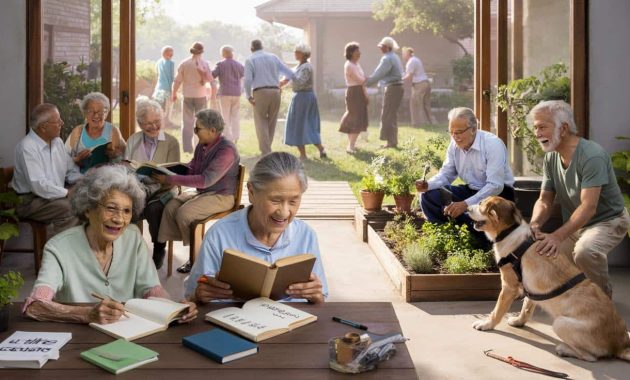
On a Tuesday afternoon, around 4 p.m., the park is strangely quiet. A few dogs pull their owners along the path, a couple of teenagers scroll on a bench, and at the far end, an older man throws crumbs to pigeons and checks his phone every few minutes. No new messages. No calls. Just that familiar notification silence.
We don’t often say it out loud, but this is how loneliness sneaks in: quietly, between two doctor’s appointments and one too many TV reruns.
Psychologists repeat the same warning: loneliness in old age doesn’t “just happen”, it grows when our habits shrink.
The good news is that hobbies can act like social seatbelts.
They don’t only fill time.
They protect us from disappearing from other people’s lives.
1. Group walking: the simplest antidepressant
Ask any psychologist who works with older adults: walking groups are one of the most protective habits against loneliness. You don’t need perfect joints, fancy clothes or a smartwatch. Just a pair of shoes, a meeting point, and a pace that leaves room for talking.
The social magic starts in the small rituals.
The “Hello, you came back!” after someone misses a week. The shared complaint about the hill that feels steeper every month. The short pauses on benches where people end up swapping recipes, pharmacy tips, even family stories.
Step by step, strangers turn into people you’re happy to see again.
In a French study on seniors, researchers found that walking in groups reduced feelings of isolation more than walking alone, even when the distance was the same. The body moved, yes, but the real therapy was the micro-conversations.
➡️ “I used to end days exhausted,” this small habit made them lighter
➡️ If you’re over 60, this type of routine reduces cognitive overload
Take Rosa, 74, widowed. She joined a local “slow walking” club because her daughter insisted. The first time, she stayed at the back, barely spoke, ready to quit. By the fourth session, she arrived early to “help the leader”, which really meant chatting about her grandchildren. Today, she walks less for fitness and more for those two hours where someone laughs at her jokes.
The route changes, the people too, but the feeling of belonging stays.
Psychologically, group walking works on three fronts. The regular meeting creates structure in the week, which reduces that floating sensation many retirees describe. The shared effort, even light, acts like social glue: when we sweat together, we talk more easily. And the environment does some of the work. Trees, sky, fresh air… the brain relaxes, walls drop, words come out more freely.
*Our brains are surprisingly simple: they link faces to places.*
See the same faces enough times on the same path, and loneliness has less room to grow.
The body thinks it’s a walk.
The mind knows it’s a lifeline.
2. Learning something new: a shield against shrinking worlds
One of the strongest predictors of loneliness in old age is having a life that gets smaller every year. Same sofa. Same shows. Same three topics of conversation. Learning something new cuts through that slow shrinking.
Pick almost anything: a language class at the local community center, a basic photography course, beginners’ guitar on Tuesday nights. The content matters less than the feeling of being “a beginner” again. That role comes with built-in excuses to talk: “Can you help me with this chord?”, “How do you say this in Spanish?”, “What settings are you using?”
These small questions are open doors to connection. And older adults who keep asking them tend to stay more mentally alive.
Psychologist-led programs on “lifelong learning” show consistent results. Older participants who join regular classes report fewer depressive symptoms and more frequent social contact than those who don’t. That doesn’t mean they become straight‑A students.
Take André, 69, who signed up for a pottery course.
His bowls are famously crooked. The teacher jokes that they’re “personality bowls”. Yet every Thursday, that studio is his anchor. He has people to tease, a place to go, and a story to tell his neighbors when they ask, “So, what are you up to?”
He’s not trying to become an artist.
He’s just refusing to become invisible.
From a psychological point of view, new learning boosts something precious in older age: self-efficacy, the quiet belief of “I can still do things”. When that belief stays alive, people are more likely to accept invitations, answer calls, even propose outings.
There’s also the identity factor. A retired nurse who becomes “the one in our class who always remembers the grammar rule” gains a new social role. **Roles are loneliness repellents.**
Let’s be honest: nobody really does this every single day.
People skip weeks, get discouraged, come back late. That’s fine. What matters is having at least one place, each week or each month, where your brain and your social life are both engaged in something that didn’t exist in your routine before.
3. Hobbies that connect, not isolate: choosing wisely
Not all hobbies protect against loneliness in the same way. The key is to favor activities that have a built‑in social component. Psychologists often talk about “social hobbies” versus “solitary hobbies in disguise”. Reading is wonderful, reading in a book club is protective. Knitting is calming, knitting in a knit‑and‑chat group is a social net.
A practical method: for every hobby you like, ask, “Is there a version of this that includes other humans?”
Walking → walking group. Gardening → community garden. Music → choir. Cooking → shared cooking class.
The activity stays yours, but the frame opens up. That small tweak can mean the difference between just filling time and actually feeling less alone.
One common trap is falling into hobbies that are technically rich but socially empty. Many older adults proudly say, “I do puzzles, I watch documentaries, I follow YouTube yoga.” These are fine. They stimulate the mind.
Yet when psychologists look closer, the people who feel least lonely usually have at least one hobby that requires another person to notice when they’re missing. That’s the emotional piece most of us secretly crave.
If you’re shy, the first sessions can feel brutal. The names fly by, running jokes seem closed, and you may go home thinking, “This isn’t for me.” That’s where an empathetic mindset helps: you’re not late, you’re just entering a story that started before you. Stay a few weeks, and new chapters will quietly rearrange around you.
“Loneliness in old age is rarely about being physically alone,” explains a clinical psychologist I spoke with. “It’s about not feeling expected anywhere. Hobbies that include others give you a place where your presence, or your absence, actually matters.”
- Choose at least one hobby with a fixed schedule
It creates rhythm in your week and gives others a chance to notice when you’re not there. - Prefer small, recurring groups over one‑off events
Regular faces are easier to bond with than a constant flow of strangers. - Mix one “quiet” hobby with one “social” hobby
This balances recovery time and human contact. - Aim for shared outcomes
Choirs, theater groups, gardening clubs, or craft circles where everyone works toward a show, harvest, or fair strengthen bonds. - Start where the barrier is low
Neighborhood centers, libraries, and churches often host activities that welcome beginners without pressure.
4. Staying open to new rituals as years go by
What psychology keeps showing, across cultures and studies, is that loneliness in old age is not just about who you live with. It’s about whether your days still contain shared rituals. Coffee after choir rehearsal. The wave to the same people at tai chi on Wednesday mornings. The half‑serious argument at the chess club.
Hobbies that prevent loneliness are rarely glamorous. They’re ordinary habits that quietly repeat, week after week, until one day you realize: if you stopped showing up, you’d be missed. That realization can be more powerful than any health tip.
Some people find their anchor in volunteering, helping children read at the library. Others in dance classes, even with sore knees. Others in community gardening, trading tomatoes for stories. The form matters less than the simple fact that something in your schedule connects your private life to a shared space.
Psychologists talk about “social nutrition”: small, regular doses of contact that, over time, protect the brain and the heart just as much as physical exercise protects the body. The ten hobbies that come up again and again in studies are all variations on the same theme: they force you, gently, to be part of something beyond your front door. Group walking. Choirs. Volunteer work. Craft circles. Language classes. Tai chi. Community gardening. Theater groups. Board‑game nights. Book clubs.
None of these demand perfection. They demand presence.
If you’re reading this for yourself, or for a parent, a neighbor, a grandparent, the real question isn’t “Which hobby is best?” The question is, “Which hobby feels just barely possible to start this month?”
Because loneliness doesn’t usually explode in a single moment.
It fades in reverse: one shared activity at a time.
| Key point | Detail | Value for the reader |
|---|---|---|
| Prioritize social versions of hobbies | Choose activities with recurring groups, shared goals, and fixed schedules | Builds a network that notices your presence and absence |
| Start with small, realistic commitments | One new class, club, or group walk per week or month | Makes it easier to begin and stay consistent over time |
| Mix mental, physical, and creative activities | Combine learning, movement, and expression (e.g., language + walking + choir) | Protects against cognitive decline and emotional isolation |
FAQ:
- Is it too late to start new hobbies after 70?Psychological research says no: people in their 70s and 80s still benefit strongly from new activities, both socially and cognitively. The hardest part is the first step, not the age on your ID.
- What if I’m introverted and don’t like big groups?Look for small, predictable settings: a book club of six people, a quiet craft circle, or a weekday walking group with a slow pace. Loneliness prevention doesn’t require being “the life of the party”, just regular, gentle contact.
- How many hobbies do I need to feel less lonely?Studies suggest that even one or two regular social activities per week can significantly reduce feelings of isolation. Quality and consistency matter more than quantity.
- What if I have mobility or health limitations?There are adapted activities: chair yoga, online discussion groups, phone‑based book clubs, or volunteer roles done from home. The key is reliable connection, not physical performance.
- How can family members encourage an older relative without pushing?Offer to go along for the first time, help with practical barriers (transport, registration), and suggest options that match their past interests. Respect their rhythm, but keep proposing gently; repeated, kind invitations often work better than pressure.