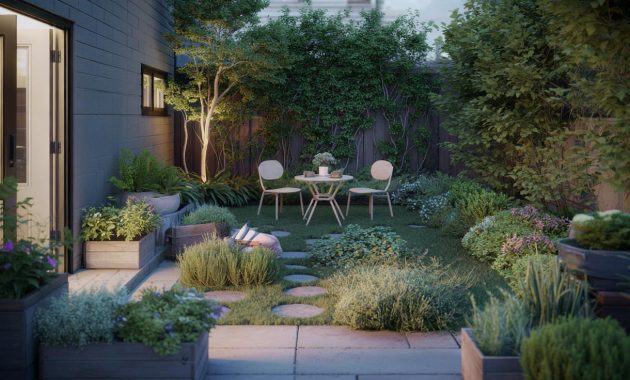
The first time you notice it, you’re standing in your tiny yard, coffee in hand, wondering why it feels… flat. The plants are there, the flowers are technically pretty, the lawn is fairly green. But the space feels like a postcard pressed under glass. No depth, no surprise, nothing that pulls your eye forward or makes you want to walk around and explore.
Then you visit a friend whose garden is barely bigger than yours, and suddenly you’re somewhere else. The path curves. A small tree leans in. The back fence seems mysteriously far away. You’re still in the city, you can hear the traffic faintly, yet it feels like a secret pocket of countryside.
Same surface area. Completely different feeling.
That’s when the penny drops: a beautiful garden is not improvised. It’s calculated.
Why some gardens feel bigger than they are
Stand at the threshold of any truly charming garden and you’ll notice something odd. Your eye doesn’t stop at the fence line. It travels. It follows a curve of brick, gets caught by a tall grass, jumps to a tree at the back, then hooks around to a bench half hidden in the corner.
That journey your gaze takes is not an accident. Gardeners who work in tight city spaces know they’re basically stage designers. They’re playing with layers, with overlaps, with what you see first and what you only notice on your second cup of tea.
The surface area doesn’t change. The perceived space does.
Think of a typical “before” scene. A small rectangle of lawn, one skinny border stuck to the fence, maybe a few potted geraniums, the barbecue sulking in a corner. Standing at the back door, you see everything at once. There’s nothing to discover, so your brain checks out almost immediately.
Now picture the same 40 m² yard divided in three subtle zones. A tiny paved terrace by the house. A small tree and taller planting in the middle. A narrow bench at the very back, half veiled by a trellis with climbing jasmine. Suddenly, your gaze has to travel through space.
You haven’t gained a single square meter. Yet your brain quietly upgrades the place from “patch” to “garden”.
➡️ Do you really know where people live the longest in Europe – and where your region stands?
➡️ Swinging Bob: here’s the perfect haircut for damaged hair this fall, according to a hairdresser.
➡️ Making a “shampoo sandwich” is the best way to wash your hair, according to hairdressers
What’s going on is almost optical sleight of hand. Our eyes read verticals and diagonals, light and shadow, open and closed spaces, long before we label “rose bush” or “hosta”. When everything is the same height and at the same distance, the brain flattens the picture like a photo taken with flash against a white wall.
The moment you bring in layers — low, medium, high — and you gently block some views while revealing others, the scene gains depth. Perspective kicks in: closer things feel larger, distant things seem smaller, and our brain quietly extrapolates “there’s more there than I can see”.
That’s the quiet calculation behind a garden that feels generous, even when your property line says otherwise.
Playing architect in three dimensions
Start with one simple move: stop designing your garden as a flat drawing, start thinking like an architect. Take a piece of paper and, instead of a single lawn, sketch three “layers” from the house to the fence. Near, middle, far. Then imagine what will occupy each tier: low planting in front, medium shrubs or grasses in the middle, something vertical at the back.
In a small space, height is your biggest ally. A single multi-stemmed small tree (like an amelanchier or Japanese maple) instantly makes the background feel further away. A pergola or arch draws the eye up and through.
You’re building a kind of green corridor, even if it’s only six meters long.
Most of us, out of fear of making the space feel cramped, push everything against the boundaries. Furniture against the wall, flowerbeds glued to the fence, nothing in the middle. The paradox is brutal: clearing the center often makes a small garden look smaller, like an empty parking space.
Try the opposite. Float a small bistro table slightly off center. Plant a group of airy grasses or perennials in a soft island bed away from the fence. Lay stepping stones on a slight diagonal rather than straight from door to shed. That tiny shift forces your eye to zigzag, extending the visual journey.
We’ve all been there, that moment when you step into someone’s yard and think, “Wait, how is this place still going?” That’s not luck. That’s choreography.
Behind this lies a simple bit of visual psychology. Our brains love depth cues: overlap, diminishing size, partial obstruction. When a plant partly hides another, when a path disappears behind a group of shrubs, your mind assumes there is “more” beyond. That “more” doesn’t have to be large. It just needs to exist.
This is why a narrow side passage can feel intriguingly spacious if there’s a curve or a turn, while a wider but fully visible rectangle can feel brutally short. The trick is not to show everything from the doorway. *Keep one thing hidden from the first glance.*
You’re not only gardening. You’re curating the pace at which your space is revealed.
Depth, perspective and the illusion of space: hands-on tricks
A very practical starting point: decide on one main view, the “money shot”, usually from your back door or living room window. Stand there and snap a photo with your phone. Then, with a pen, draw three horizontal bands on the photo: foreground, middle ground, background. Ask yourself what will anchor each band.
Foreground: containers, groundcovers, low herbs. Middle ground: a path, a cluster of medium-height perennials, maybe a small raised bed. Background: a vertical accent — trellis, small tree, tall grass, a painted fence. Play with the idea that each band needs a different height and a different texture.
This simple exercise already forces your garden out of the “carpet mode” and into three dimensions.
One of the most common mistakes is planting everything in a neat parade along the edges. It feels logical, almost polite. You don’t want to invade the little space you have. The result is a green frame around a dead center, like a picture with nothing in the middle.
Try overlapping instead. Let a shrub slightly step forward from the back border. Let a taller plant lean into the middle. Use repetition — the same variety of grass or the same pot in three sizes — to guide the eye deeper.
And yes, you will get it “wrong” sometimes. A plant too big, a pot too close, a pathway that feels awkward. That’s part of the game. Let’s be honest: nobody really does this every single day. We tweak when something annoys us.
“Small gardens scare people because every mistake is visible,” a landscape designer in Lyon told me. “But that’s exactly why they’re exciting. One clever line, one well-placed tree, and you’ve changed the whole movie in someone’s head.”
- Use light and darkPlace paler foliage and flowers closer to the house and darker, denser greens toward the back. Dark recedes, light advances, and your border seems to stretch.
- Play with diagonalsRun a path or a row of stepping stones on a slight diagonal rather than straight out. A diagonal automatically reads as longer than a straight line of the same length.
- Break the back fenceSoften that hard boundary with a trellis, climber, or staggered planting. When the edge becomes fuzzy, your brain stops reading it as “the end”.
- Scale your furnitureBulky corner sofas crush a tiny terrace. Choose lighter, visually permeable pieces that allow the eye — and your legs — to move through.
- Create one “borrowed view”Frame a distant tree, rooftop, or skyline through an arch or over a hedge. Even a glimpse of something beyond your property line pushes the mental horizon out.
A garden that thinks bigger than its square meters
When you start looking at your outdoor space like this, something shifts. You stop obsessing over its size and begin to study its lines, its pauses, its shadows. That awkward corner becomes a chance for a hidden chair. The boring fence turns into a backdrop you can paint darker to make plants pop and the boundary melt away.
The illusion of space doesn’t rely on a shopping list of rare plants or an expensive redesign. It’s a series of small, almost invisible decisions you spread over seasons. Move the bench. Plant one taller shrub. Add a curve where there was a straight line. Take away what blocks the view, add what guides it.
Bit by bit, your cramped little yard stops apologizing for itself and starts behaving like a place you want to walk through slowly. It will still measure what it measures. Yet on a warm evening, when the light slides along the path and your eye drifts toward that half-hidden corner, numbers won’t matter very much.
| Key point | Detail | Value for the reader |
|---|---|---|
| Think in layers | Divide the view into foreground, middle ground, and background with different heights and textures | Creates instant depth and a sense of progression in a small yard |
| Guide the eye | Use paths, diagonals, repeated plants, and partial hiding to choreograph what’s seen first | Makes the garden feel larger and more intriguing without adding square meters |
| Soften boundaries | Break the back fence line with climbers, dark paint, and vertical accents | Blurs the sense of where the garden stops, expanding perceived space |
FAQ:
- Question 1How do I create depth if my yard is just a narrow strip?Use the long shape to your advantage. Run a stepping-stone path on a gentle diagonal, break the space into two or three “rooms” with a trellis or an arch, and vary heights along the way: low groundcovers, then medium perennials, then a small tree or tall grass at the far end.
- Question 2Won’t adding more plants make my small garden feel crowded?It can, if everything is the same height or crammed at the front. Focus on vertical layering and airy plants like grasses or open shrubs. They add volume without heaviness and help hide and reveal views instead of forming a solid wall.
- Question 3Can color really change the feeling of space?Yes. Cooler tones (blues, purples, silvery foliage) recede visually, so placing them at the back can stretch the border. Warmer, brighter colors feel closer, so keep them nearer the house for a more spacious perspective.
- Question 4What’s the quickest change to create more perspective?Paint the back fence a darker shade and place one taller element in front of it — a slim tree, trellis, or obelisk with a climber. The contrast between dark background and vertical accent instantly pushes the boundary back.
- Question 5Do I need a professional design to get this right?Not necessarily. Start with photos from your main view, sketch simple bands for near/middle/far, and test one change at a time. Sit with each adjustment for a few weeks. Space is felt, not just drawn, and your own sense of comfort is the best guide.