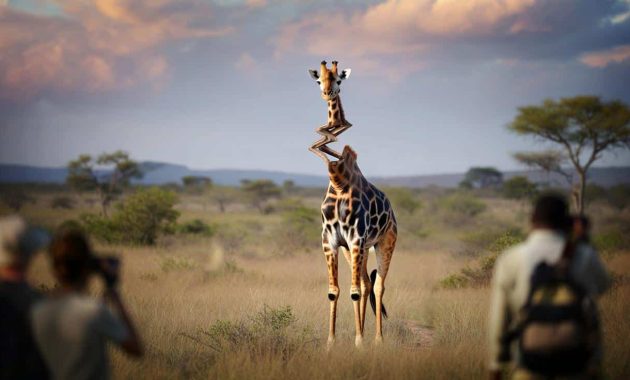
Deep inside South Africa’s Kruger National Park, tourists and scientists are fixated on a giraffe whose neck bends sharply in a zigzag, raising questions about survival, adaptation and how wild animals cope with serious injury.
A giraffe that makes people look twice
The animal was first brought to wider attention when travel blogger Lynn Scott photographed it in early July near a popular tourist route in Kruger. At first glance, visitors thought they were seeing a trick of perspective, or perhaps a tree branch obscuring the animal’s neck.
Then the binoculars came out. The giraffe’s neck was not straight. It curved abruptly, then kinked again, forming a pronounced zigzag that looked almost geometric against the flat horizon of the savannah.
The giraffe’s neck appears to bend in at least two places, giving it a broken, almost folded look that seems incompatible with a life in the wild.
Onlookers reported that the animal moved very little. It stood for long periods, occasionally taking a few laboured steps, as if every movement had to be calculated. Still, it was upright, alert and clearly alive — a living contradiction of what many would assume a giraffe can withstand.
What makes giraffe necks so special
Giraffes are built around their necks. A fully grown individual can reach 5.5 metres in height, with the neck alone making up around two metres of that total. Their famous silhouette is not just for show: a tall neck lets them browse on high acacia leaves that antelopes and zebras can’t touch.
Each giraffe still has only seven neck vertebrae, just like humans do, but each bone can be more than 25 centimetres long. These vertebrae are held together by powerful ligaments and muscles that must support a body mass of up to 1,800 kilograms in big males.
- Average female weight: 800–1,200 kg
- Average male weight: up to 1,800 kg
- Lifespan in the wild: around 25 years
- Gestation: about 15 months, single calf
- Height at birth: nearly 2 metres
Neck length plays into almost everything a giraffe does: feeding, scanning for predators, regulating blood flow to the brain, and even mating rituals. Males fight by “necking” — swinging their heads like sledgehammers into a rival’s body. That combat can fracture bones and dislocate joints.
What could cause such a twisted neck?
Wildlife experts who analysed Scott’s photographs suspect the Kruger giraffe is suffering from a form of severe torticollis. In humans, this condition forces the head to twist or tilt to one side. In a giraffe, the effect can be far more dramatic because of the neck’s length and weight.
➡️ This simple trick helps prevent spills when storing leftovers
➡️ How mindset and money habits are more connected than people realize
➡️ 50 years on: scientists identify a brand-new blood group
➡️ Psychology teams identify three recurring color preferences linked with fragile self-confidence
➡️ How changing your walking pace can influence your mental state
➡️ Bad news : a new rule prohibits mowing lawns between noon and 4 p.m. in 24 departments
Specialists say the abnormal bend could stem from an old fracture, a spinal infection, or a congenital deformity that worsened as the giraffe grew.
A detective story without X‑rays
Without medical imaging, no one can state exactly what happened. Rangers cannot easily immobilise and scan a wild giraffe; sedation itself carries serious risks because of the animal’s size and unique blood pressure system.
Researchers outline several main suspects behind the twisted neck:
- Traumatic injury: A fracture or dislocation from a fall, collision or fight with another giraffe.
- Spinal infection: Disease affecting the vertebrae or spinal cord, leading to structural collapse or muscular spasms.
- Congenital defect: A malformation present from birth, potentially worsened by growth or minor injuries.
- Degenerative disease: Progressive damage to bones, joints or nerves associated with age or nutritional stress.
Cases with mild curvature have been recorded in zoos and wild populations, including a male in Tanzania’s Serengeti noted in 2015 after what appeared to be a brutal necking fight. The Kruger giraffe stands out because the distortion looks especially sharp and pronounced.
Living with a broken line of sight
The central question for biologists is not just what caused the deformity, but how the animal manages to function at all. A giraffe’s daily life involves constant movement between scattered food sources, regular bending to drink and frequent scanning for lions and wild dogs.
A compromised neck could reduce feeding reach, limit mobility and make drinking dangerous, since a giraffe is most vulnerable when its head is down.
Observers have noted that the Kruger giraffe seems hesitant to move and may be relying on nearby trees at a comfortable height, rather than stretching to the highest branches. If it struggles to lower its head, accessing waterholes could also become a challenge, raising the risk of dehydration during the dry season.
Social behaviour might also change. Giraffes often form loose groups that shift throughout the day. An animal in poor condition may lag behind, avoid long walks, or be subtly pushed to the edges of herds as others move on to richer grazing areas.
What scientists hope to learn
For researchers focusing on giraffe conservation, this unusual case is more than a curiosity. It acts like a natural experiment in resilience and adaptation under harsh conditions.
| Research angle | Questions raised |
|---|---|
| Survival | How long can a giraffe live with such a deformity? Does it maintain normal weight and reproduction? |
| Behaviour | Does it avoid certain terrains, predators or social situations? Does it change feeding times? |
| Health | Does the neck cause chronic pain or neurological problems? How does that affect daily activity? |
| Conservation policy | Should park managers intervene in extreme cases, or let natural processes unfold? |
Long-term observation could yield insights into how much physical damage a large mammal can sustain while still functioning in the wild. Those lessons can then inform how zoos and wildlife reserves treat injured animals, especially when resources are limited.
Intervene or step back: a difficult choice for parks
Kruger National Park generally follows a hands-off approach for naturally occurring injuries, allowing predators, disease and accidents to shape populations as they would outside protected areas. Interventions are usually reserved for cases directly linked to human activity, such as snares or road collisions.
This raises ethical questions. Some visitors argue that such a severely deformed animal should be treated or euthanised to prevent suffering. Others say that stepping in would turn wild spaces into managed farms, where only healthy, “perfect” animals persist.
Veterinarians also face technical barriers. An operation on a giraffe’s neck would be exceptionally risky, logistically complex and unlikely to restore the spine to normal function. In that context, detailed monitoring from a distance can provide knowledge with far less disturbance.
How neck anomalies might shape the species’ future
Strange cases like the Kruger giraffe can cast light on broader evolutionary pressures. If most individuals with serious neck defects die young or fail to reproduce, their genes fade from the population over time. That silent filtering can help maintain strong, functional necks as a defining trait.
On the other hand, an animal that survives for years despite a major deformity may reveal built-in safety margins in giraffe anatomy. Strong ligaments, redundant blood supply routes and flexible behaviour might allow them to cope with damage that would cripple other species.
Understanding those buffers does not just matter for wild giraffes. Zoo and reserve managers plan enclosures, enrichment and medical care partly around how much strain the animals’ necks can take, and how quickly they can recover from falls or minor injuries.
Context: what torticollis means outside the savannah
In humans, torticollis can appear in newborn babies, often due to cramped positioning in the womb, or develop after trauma, infections or nerve problems. Treatment might include physiotherapy, collars or in rare cases surgery. Most people with the condition do not face the life-or-death pressures that a wild herbivore does.
Translating that concept to a giraffe shows how anatomy and environment interact. A slight twist of the neck for a person might be uncomfortable yet manageable with medication and support. For a towering animal with blood rushing up a two-metre column to its brain, the same kind of twist can affect vision, balance, feeding and vulnerability to predators all at once.
Cases like the Kruger giraffe remind researchers that wild landscapes are full of hidden medical stories. Each injured animal that keeps going offers a small, living data point on pain tolerance, adaptation and the fine line between survival and collapse in nature.