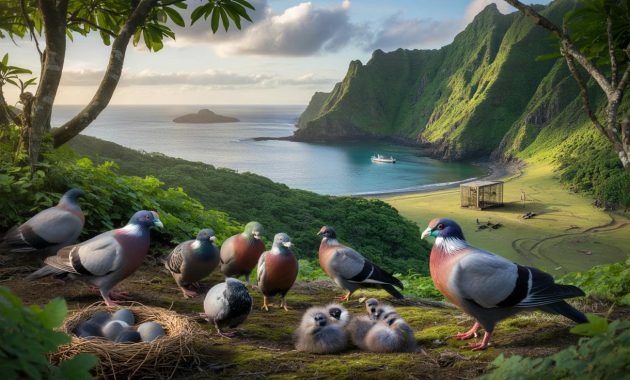
Local authorities thought they were simply easing pressure on native wildlife. Instead, they watched an entire species of bird pull off a comeback that many conservation biologists had written off as nearly impossible.
From ghost bird to comeback story
The Ogasawara Islands, about 1,000 kilometres south of Tokyo, look like a tropical postcard. Dense forests, steep cliffs, turquoise bays. But for decades, this fragile ecosystem hid a brutal imbalance.
Feral cats, introduced by humans, had turned into highly efficient hunters. They targeted nesting seabirds, lizards, and a little-known bird: the red-headed wood pigeon of Ogasawara, a species found nowhere else on Earth.
By the early 2010s, this pigeon hovered on the cliff edge of extinction. Field surveys counted just over a hundred adults. Fewer than ten juveniles appeared in annual checks. Conservationists feared a slow, quiet disappearance.
The turning point came when authorities removed 131 stray and feral cats from the islands, cutting off the main source of predation on nests and fledglings.
Three years later, researchers led by Kyoto University returned with clipboards and mist nets, expecting a modest uptick. Instead, they were stunned.
A population surge that stunned scientists
The numbers looked like a typo at first glance. Adult pigeons had jumped from 111 to 966 individuals. Juveniles had soared from 9 to 189 in the same period.
That is not a gentle recovery curve. It’s a vertical line on a graph – one of the fastest rebounds ever recorded for a vertebrate species that had been so close to vanishing.
- Adult pigeons: 111 → 966 in three years
- Juveniles: 9 → 189
- Primary action: removal of 131 cats
- Main result: survival and breeding success dramatically improved
For biologists used to hard-fought, gradual gains, this was almost unsettlingly rapid. It suggested the pigeons had been held underwater by predation pressure, not by an intrinsic inability to recover.
➡️ What if artificial general intelligence was already here… and we simply failed to notice?
➡️ The overlooked bathroom vent setting experts say reduces mold by more than 40%
➡️ Fast walkers are not healthier they are just more anxious and unstable
➡️ I Always Make This Salmon Terrine For New Year’s Eve — Everyone Loves It And Begs Me For The Recipe
The genetic puzzle: why inbreeding did not crush them
The ecological side of the story is clear: fewer cats, more pigeons. The genetic side is far stranger.
Species reduced to a few dozen or a few hundred individuals usually face two serious problems: inbreeding and genetic drift. Mating between close relatives tends to increase harmful mutations. Over time, genetic variation often collapses, leaving populations fragile and less able to cope with disease or environmental shifts.
Yet genetic analysis of the Ogasawara pigeon showed a level of resilience that defied expectations for such a tiny, isolated population.
Researchers sequenced DNA samples and looked for tell-tale signs of a genetic bottleneck: reduced diversity, long stretches of identical DNA, and accumulation of damaging mutations. They found some warning signals, but not the genetic meltdown many had feared.
How a small population can stay surprisingly robust
Several factors may explain why these pigeons held their ground genetically:
- Historical stability: The species has probably lived in small, stable numbers on these islands for thousands of years, naturally selecting for individuals that tolerate mild inbreeding.
- Strong selection: Predation by cats may have removed weaker individuals, unintentionally favouring birds with more robust genetics.
- Hidden diversity: Even a small population can preserve enough variation in key genes, especially those linked to immunity or reproduction, if declines are relatively recent.
Researchers now view the Ogasawara pigeon as a case where evolutionary history met modern conservation at exactly the right moment. The species was genetically prepared to rebound – it just needed breathing space.
Why removing cats had such a dramatic effect
Cats are not native to the Ogasawara Islands. They arrived on boats, following people, as they have across much of the planet. On these islands, they quickly climbed the food web.
Ground-nesting birds like the Ogasawara pigeon were especially exposed. Eggs and chicks spent hours unattended while adults foraged. A single feral cat could wipe out multiple nests in a season.
Once the cats were removed, almost every part of the pigeon life cycle improved at once: more eggs hatched, more chicks fledged, and more young birds survived their first year.
This multiplier effect explains the sudden population boost. Conservationists did not change the pigeons themselves. They changed the risk level surrounding every nesting attempt.
What the operation looked like on the ground
The cat removal was not a one-night sweep. It unfolded in stages, using different methods:
- Humane trapping of feral and stray cats in key nesting areas
- Collaboration with local residents to prevent new releases or abandonments
- Veterinary checks and rehoming where possible
- Long-term monitoring to detect any return of feral populations
These operations often raise ethical debates. Many conservation programs now combine eradication with strong efforts to care for captured cats, including adoption drives away from sensitive habitats.
What this means for endangered species elsewhere
The Ogasawara case carries a hopeful message for conservation agencies facing long lists of threatened species and limited budgets. It suggests that, in some situations, removing a single key threat can unleash rapid recovery.
This does not apply everywhere. Some species have already lost too much genetic diversity or habitat. Others face multiple overlapping threats such as pollution, climate change, and hunting.
The lesson is less about a miracle and more about timing: if action comes before genetic collapse, even tiny populations can surprise us.
For island ecosystems in particular, this study strengthens the case for targeted control of invasive predators like cats, rats, and mongooses. These species often hit native birds hardest during nesting, exactly where recovery efforts need the most help.
Key concepts behind the science
Several technical terms appear in discussions of this study. A clear grasp of them helps make sense of what happened.
| Term | What it means in plain language |
|---|---|
| Genetic bottleneck | A sharp reduction in population size that cuts down genetic diversity, like squeezing a wide river through a narrow pipe. |
| Inbreeding | Mating between close relatives, which can increase the risk of harmful genetic traits appearing. |
| Genetic drift | Random changes in gene frequencies, especially strong in small populations, where chance can shape evolution. |
| Endemic species | A species that lives naturally in one place only and nowhere else on the planet. |
In the case of the Ogasawara pigeon, a bottleneck clearly happened, but not to the point where inbreeding and drift destroyed the population’s potential to bounce back once the external pressure eased.
Future risks and what could still go wrong
The story is encouraging, but the pigeons are not out of danger. A few years of good numbers do not guarantee long-term security.
Several risks remain on the horizon:
- Reintroduction of cats through pets being abandoned or strays arriving by boat
- New predators, such as rats or snakes, filling the gap left by cats
- Habitat loss from development or tourism pressure on the islands
- Disease outbreaks that could hit a still-limited gene pool
Conservation plans now focus on keeping predator pressure low, protecting nesting forest, and continuing genetic monitoring. If signs of genetic weakness start to appear, managers might even consider carefully controlled translocations between island subpopulations to shuffle genes.
What this tells us about cats, wildlife and difficult choices
Stories like this one sit at the intersection of animal welfare and biodiversity protection. Many people care deeply about cats as companions. At the same time, free-roaming cats kill huge numbers of birds and small mammals every year, especially on islands.
Some practical measures that reduce the need for drastic eradication campaigns later include:
- Keeping pet cats indoors or in secure outdoor enclosures in sensitive areas
- Supporting neutering campaigns to reduce stray populations
- Avoiding releasing unwanted pets in rural or island environments
The Ogasawara pigeon’s comeback shows that when humans take responsibility for the impacts of past introductions, damaged ecosystems can respond quickly. The science behind this case now feeds into planning for other islands facing similar tensions between beloved pets, feral predators and wildlife found nowhere else on Earth.