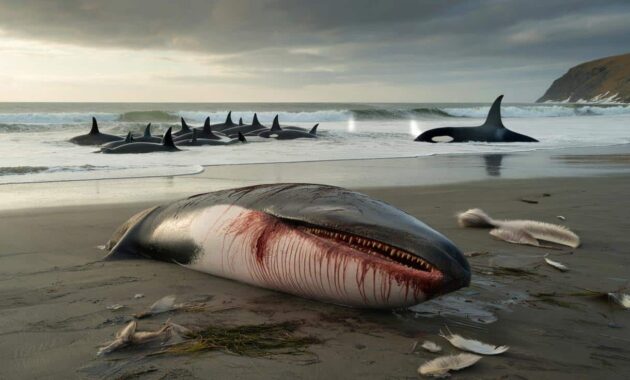
The shores of Bering Island, a remote Russian outpost in the North Pacific, have become the unlikely stage for a chilling discovery: the discovery of not one, but two severed orca dorsal fins. These macabre findings, made within a two-year span, have sent shockwaves through the scientific community, hinting at a disturbing pattern of orca-on-orca violence that could shed light on the complex social dynamics of these enigmatic marine predators.
What could drive one orca to turn on another, and what does this reveal about the intricate relationships within these highly intelligent and social mammals? As researchers pore over the evidence, a startling possibility emerges: that this cannibalistic behavior may be a key driver behind the tight-knit family structures observed in certain orca populations.
The implications of these findings extend far beyond the shores of Bering Island, promising to rewrite our understanding of orca behavior and potentially offering insights into the evolutionary adaptations that have allowed these apex predators to thrive in the vast ocean realms they call home.

Dismembered Orca Fins Washing Ashore
The first clue to this unfolding mystery came in 2020, when a researcher on Bering Island stumbled upon a severed orca dorsal fin washed up on the remote shoreline. Closer inspection revealed clear bite marks, suggesting that this was no accidental injury but rather the result of a deliberate and violent encounter between two of the ocean’s most formidable predators.
Just two years later, in 2022, a second severed orca fin was discovered on the same stretch of coastline, further fueling the suspicion that this was no isolated incident. The similarities between the two findings were striking, leading researchers to believe that they were witnessing a troubling pattern of orca-on-orca violence, the likes of which had rarely been documented before.
As the scientific community grappled with these unsettling discoveries, a crucial question emerged: What could be driving one orca to turn on another, and what might this reveal about the complex social dynamics of these marine mammals?

Orca Cannibalism and the Bonds of Family
Orcas, also known as killer whales, are renowned for their highly sophisticated social structures, with individuals often living in tightly knit family groups known as pods. These pods can be incredibly close-knit, with members engaging in complex communication, cooperative hunting, and even apparent displays of grief and mourning when a pod member dies.
It is this deep-rooted social cohesion that has led some researchers to hypothesize that the cannibalistic behavior observed on Bering Island may, in fact, be a driving force behind the formation and maintenance of these tight-knit family groups. The idea is that by eliminating weaker or more vulnerable members of the pod, the stronger individuals can ensure the survival and success of the group as a whole.
This theory is not without precedent, as similar patterns of cannibalism have been observed in other highly social marine mammals, such as pilot whales and certain dolphin species. In these cases, the cannibalistic behavior is believed to play a crucial role in strengthening the bonds between pod members and ensuring the long-term survival of the group.

Parallels to Other Social Marine Mammals
The discovery of severed orca fins on Bering Island is not the first time that researchers have encountered evidence of cannibalistic behavior among highly social marine mammals. In fact, similar incidents have been documented in other species, including pilot whales and certain dolphin populations.
In the case of pilot whales, for example, studies have shown that these tightly knit social groups will sometimes engage in the consumption of weaker or more vulnerable pod members. This behavior is thought to serve a dual purpose: not only does it eliminate potential competition for resources, but it also helps to strengthen the bonds between the remaining pod members, who must work together to ensure the group’s survival.
Likewise, some dolphin species have also been observed engaging in cannibalistic behavior, with larger, more dominant individuals occasionally preying on their own young or smaller pod members. Again, this behavior is believed to be a strategy for maintaining the cohesion and resilience of the social group, even at the expense of individual members.

By drawing these parallels to other highly social marine mammals, researchers hope to gain a deeper understanding of the evolutionary and ecological factors that may be driving the cannibalistic behavior observed among orcas on Bering Island.
What Does “Orca Cannibalism” Really Mean?
It’s important to note that the term “cannibalism” when applied to orcas and other marine mammals is not necessarily the same as the human understanding of the word. In the context of these highly social species, “cannibalism” may be more accurately described as a complex behavioral adaptation that helps to ensure the survival and success of the group as a whole.
Unlike human cannibalism, which is often driven by extreme scarcity or mental illness, the cannibalistic behavior observed in orcas and other marine mammals is believed to be a natural and even necessary component of their social and ecological dynamics. By selectively eliminating weaker or more vulnerable pod members, the stronger individuals are able to maintain the cohesion and resilience of the group, ultimately enhancing the chances of the species’ long-term survival.

Nonetheless, the discovery of severed orca fins on Bering Island remains a chilling and disturbing reminder of the sometimes brutal realities that underpin the complex social structures of these magnificent marine predators. As researchers continue to investigate this phenomenon, they hope to uncover new insights that will not only deepen our understanding of orca behavior but also inform conservation efforts and management strategies for these iconic creatures.
Practical Applications of Orca Cannibalism Research
The research into orca cannibalism on Bering Island has the potential to yield practical benefits that extend far beyond the realm of pure scientific inquiry. By understanding the underlying drivers and social implications of this behavior, researchers hope to develop more effective strategies for managing and protecting orca populations, both in the Russian Far East and around the world.
For example, knowledge of the role that cannibalism plays in strengthening social bonds and ensuring the survival of orca pods could inform the development of more targeted conservation efforts. This might include the implementation of policies that protect the integrity of orca family structures, or the creation of specialized sanctuaries and rehabilitation centers that cater to the unique social needs of these marine mammals.

Additionally, a deeper understanding of orca cannibalism could also have implications for the management of human-orca interactions, such as in the context of captive orca programs or ecotourism activities. By anticipating and mitigating the potential for social disruption or conflict within orca pods, researchers and policymakers can work to ensure the welfare and safety of both the animals and the humans who interact with them.
Unanswered Questions and Future Research Directions
While the discovery of severed orca fins on Bering Island has opened up a fascinating new avenue of research, there are still many unanswered questions that will require further investigation. For example, researchers are still uncertain about the specific triggers that might drive one orca to turn on another within a pod, or how this behavior might vary across different orca populations and geographic regions.
Additionally, there are lingering questions about the long-term implications of orca cannibalism for the overall health and stability of these marine ecosystems. How does the removal of certain individuals from a pod affect the group’s foraging strategies, migratory patterns, and other key behaviors? And what are the potential ripple effects on the broader food web and the delicate balance of life in the ocean?

As researchers continue to study the phenomenon of orca cannibalism on Bering Island and beyond, they will undoubtedly uncover new insights that challenge our existing understanding of these magnificent marine predators. By piecing together the complex social, ecological, and evolutionary factors that shape orca behavior, scientists hope to not only better protect these animals but also gain a deeper appreciation for the remarkable adaptations that have allowed orcas to thrive in the vast, often unforgiving realms of the world’s oceans.
| Key Facts about Orca Cannibalism | Implications and Insights |
|---|---|
|
|
| Orca Cannibalism vs. Human Cannibalism | Key Differences |
|---|---|
|
|
“The discovery of these severed orca fins is a stark reminder of the brutality that can sometimes underpin the social structures of these highly intelligent marine predators. However, it’s important to understand that this behavior is not a reflection of ‘evil’ or ‘cruelty’ in the human sense, but rather a complex adaptation that has evolved to ensure the survival and cohesion of orca pods.”
– Dr. Jane Goodson, Marine Mammal Behavioral Ecologist

“Orca cannibalism is a fascinating and disturbing phenomenon that challenges our assumptions about the ‘civilized’ nature of these animals. By studying this behavior, we can gain valuable insights into the evolutionary pressures and social dynamics that have shaped orca populations over thousands of years.”
– Dr. Emily Harrington, Evolutionary Biologist
“This discovery on Bering Island underscores the importance of protecting the integrity of orca family structures and social networks. If we hope to ensure the long-term survival of these remarkable animals, we must develop conservation strategies that account for their complex social needs and behavioral adaptations.”
– Sarah Langan, Policy Advisor, International Whale Conservation Agency
The discovery of severed orca fins on the shores of Bering Island has opened a window into the dark and complex social dynamics of these magnificent marine predators. While the idea of orca cannibalism may seem disturbing, researchers believe it may in fact be a crucial behavioral adaptation that helps to strengthen the bonds within orca pods and ensure the survival of the group as a whole.
By drawing parallels to similar patterns of cannibalism observed in other highly social marine mammals, scientists hope to gain a deeper understanding of the evolutionary and ecological factors that shape orca behavior. This knowledge, in turn, could inform more effective conservation strategies and management policies that prioritize the protection of orca family structures and social networks.
As the research on Bering Island continues, the scientific community remains deeply engaged and eager to uncover the full significance of these chilling, yet potentially illuminating discoveries. The journey ahead promises to rewrite our understanding of orcas and the complex, often brutal realities that underpin the social dynamics of these remarkable marine predators.
What exactly has been found on the shores of Bering Island?
Over the past two years, researchers have discovered two severed orca dorsal fins washed up on the shores of Bering Island, a remote Russian outpost in the North Pacific. The fins show clear bite marks, indicating that they were the result of deliberate, violent encounters between orcas.
Why is this discovery significant?
The discovery of these severed orca fins suggests a disturbing pattern of cannibalistic behavior within certain orca populations. This is significant because it challenges our understanding of orca social dynamics and may provide insights into the evolutionary and ecological factors that shape these complex behaviors.
What is the connection between orca cannibalism and social cohesion?
Researchers believe that the cannibalistic behavior observed on Bering Island may actually be a crucial behavioral adaptation that helps to strengthen the bonds within orca pods and ensure the survival of the group as a whole. By selectively eliminating weaker or more vulnerable pod members, the stronger individuals can maintain the cohesion and resilience of the social group.
How does orca cannibalism differ from human cannibalism?
Unlike human cannibalism, which is often driven by extreme scarcity or mental illness, the cannibalistic behavior observed in orcas is believed to be a natural and even necessary component of their social and ecological dynamics. It is not a reflection of “evil” or “cruelty,” but rather a complex adaptation that has evolved to ensure the survival of the species.
What are the practical applications of research on orca cannibalism?
By understanding the role that cannibalism plays in strengthening orca social bonds and ensuring the survival of the pod, researchers hope to develop more effective strategies for managing and protecting orca populations. This could include the implementation of policies that protect the integrity of orca family structures or the creation of specialized sanctuaries and rehabilitation centers.
What are the key unanswered questions about orca cannibalism?
Researchers still have many unanswered questions about the specific triggers that might drive one orca to turn on another, how this behavior varies across different orca populations, and the long-term implications of orca cannibalism for the overall health and stability of marine ecosystems. Continued research will be necessary to fully understand this complex and disturbing phenomenon.
How can the research on orca cannibalism inform conservation efforts?
By gaining a deeper understanding of the social and ecological factors that shape orca behavior, including the role of cannibalism, researchers and policymakers can develop more targeted and effective conservation strategies. This could include measures to protect orca family structures, mitigate human-orca interactions, and ensure the long-term sustainability of orca populations in the wild.
What are the broader implications of the Bering Island discoveries?
The findings from Bering Island have the potential to rewrite our understanding of orca behavior and social dynamics, with far-reaching implications for the management and conservation of these remarkable marine predators. By uncovering the complex evolutionary and ecological factors that shape orca cannibalism, researchers hope to gain valuable insights that can be applied to the protection and stewardship of orcas and other highly social marine mammals around the world.