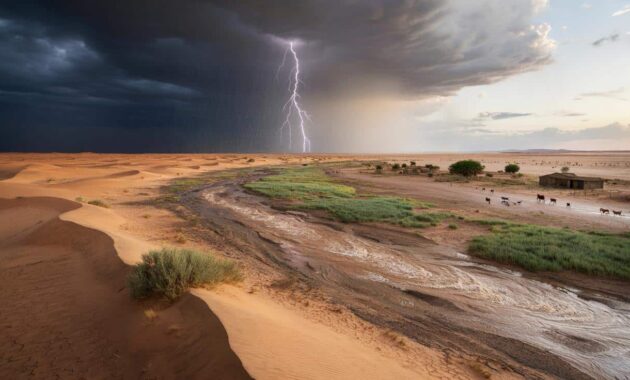
The Sahara Desert, long considered a vast, arid expanse, may soon face a dramatic transformation, according to a new study. Climate projections suggest that excessive rainfall could profoundly alter the face of this iconic desert, with far-reaching consequences for the delicate balance of Africa’s ecosystems and the lives of millions.
This potential shift, driven by complex climate patterns, could herald the arrival of a “green Sahara,” a landscape of lush vegetation, thriving wildlife, and even new water sources. However, this environmental upheaval may also bring a host of challenges, from flash floods to shifting migration patterns, that could test the resilience of the continent’s diverse communities.
As the world grapples with the ongoing effects of climate change, the fate of the Sahara serves as a stark reminder of the interconnectedness of our planet and the urgent need to understand and adapt to these rapidly evolving environmental realities.

Wetter Sahara, Uncertain Future
The latest climate projections suggest that the Sahara may be poised for a dramatic transformation, with the potential for significantly increased rainfall in the coming decades. This shift could lead to the emergence of new oases, the expansion of grasslands, and even the return of once-thriving lakes and rivers.
While a “green Sahara” may sound like a positive development, the reality is more complex. Sudden and excessive rainfall can also bring a host of challenges, from flash floods to soil erosion, that could disrupt the delicate balance of the region’s ecosystems.
Experts warn that this environmental upheaval could have far-reaching consequences for the communities that call the Sahara home, as well as the broader African continent. From changes in agriculture and livestock patterns to the potential for increased climate migration, the impacts of a wetter Sahara could reverberate across the region.

Shifting Winds and Monsoon Timing
The driving force behind the Sahara’s potential transformation lies in the complex interplay of global climate patterns, particularly the behavior of winds and monsoons. As these systems shift in response to climate change, they may push more moisture into the desert, altering the region’s long-established rainfall patterns.
The timing of the monsoon season, often a critical factor in the success of agricultural harvests across Africa, could also be affected by these changes. Shifts in the arrival and duration of the monsoon rains could lead to unpredictable growing seasons and potentially devastating crop failures.
Researchers emphasize that understanding these intricate climate dynamics is crucial to anticipating the future of the Sahara and developing effective adaptation strategies for the region’s communities.

Adapting to a Changing Landscape
The prospect of a wetter Sahara presents both opportunities and challenges for the people and ecosystems of Africa. While the emergence of new oases and fertile areas could provide much-needed resources, the potential for flash floods and other extreme weather events could also disrupt traditional ways of life.
Adapting to these changes will require a multifaceted approach, including investments in infrastructure, agricultural practices, and disaster preparedness. Policymakers and community leaders will need to work closely with scientists and researchers to develop tailored solutions that address the unique needs of each region.
Successful adaptation will also depend on the ability of African nations to collaborate and share knowledge, as the impacts of a transformed Sahara are likely to cross borders and require coordinated regional responses.

Balancing “Too Much” and “Too Little”
The Sahara’s potential transformation highlights the complex and often contradictory nature of climate change’s impacts on Africa. While a wetter Sahara may alleviate some of the region’s long-standing water scarcity issues, it could also exacerbate other challenges, such as the risk of flooding and soil degradation.
As the continent grapples with the dual threats of too much and too little water, policymakers and communities will need to find innovative ways to manage these competing demands. This could involve investments in water infrastructure, the development of drought-resistant crops, and the integration of traditional knowledge with modern scientific approaches.
Ultimately, the ability of Africa to navigate these complex and often contradictory climate challenges will be crucial not only for the well-being of its people but also for the preservation of the continent’s rich biodiversity and the resilience of its ecosystems.

A Profound Shift for the Continent
The potential transformation of the Sahara Desert is not just a local or regional issue – it has the power to reshape the entire African continent. From changes in migration patterns and economic activities to shifts in the distribution of natural resources, the consequences of a wetter Sahara could ripple across the diverse landscapes and communities of Africa.
Experts warn that this environmental upheaval could exacerbate existing social and economic fault lines, potentially leading to increased competition for scarce resources and the potential for conflict. Addressing these challenges will require a coordinated, pan-African approach that prioritizes the needs of vulnerable populations and the preservation of the continent’s delicate ecosystems.
As the world watches the unfolding story of the Sahara, the future of Africa hangs in the balance. The choices made today will not only shape the face of this iconic desert but also determine the resilience and prosperity of the continent as a whole.

Envisioning a New Sahara
Amid the uncertainty and challenges posed by the Sahara’s potential transformation, there are also glimmers of hope and opportunity. Researchers and policymakers are exploring the possibility of harnessing the benefits of a wetter Sahara, from the development of new agricultural techniques to the restoration of once-thriving ecosystems.
The prospect of a “green Sahara” could not only provide much-needed resources for the region’s communities but also contribute to global efforts to mitigate the effects of climate change. By understanding and adapting to these changes, Africa may be able to unlock new pathways for sustainable development and environmental stewardship.
However, realizing this vision will require a concerted effort by governments, international organizations, and local communities to collaborate and invest in the necessary infrastructure, research, and policy frameworks. The stakes are high, but the potential rewards of a transformed Sahara could be transformative for the continent and the world.

| Potential Impacts of a Wetter Sahara | Challenges to Address |
|---|---|
| Emergence of new oases and fertile areas | Increased risk of flash floods and soil erosion |
| Expansion of grasslands and wetlands | Shifts in agricultural and livestock patterns |
| Restoration of once-thriving lakes and rivers | Potential for climate-induced migration |
| Increased availability of water resources | Disruption of traditional ways of life |
“The transformation of the Sahara could be one of the most profound environmental changes we see in Africa in the coming decades. It’s critical that we understand the full scope of the challenges and opportunities this presents for the continent’s people and ecosystems.”
– Dr. Fatima Denton, Director of the UN University Institute for Natural Resources in Africa
“The timing and intensity of the monsoon rains are crucial for the success of agricultural harvests across Africa. Any shifts in these patterns could have devastating consequences for food security and the livelihoods of millions.”

“We need to work closely with local communities to develop adaptation strategies that address their unique needs and vulnerabilities. This will require a collaborative, cross-border approach that draws on both traditional knowledge and modern scientific research.”
– Dr. Amadou Hama Maiga, climate policy expert at the African Development Bank
“The prospect of a ‘green Sahara’ is both exciting and daunting. While it could provide new opportunities for sustainable development, we must also be prepared to manage the risks of flash floods, soil degradation, and other extreme weather events.”
“Adapting to these changes will be a complex and multifaceted challenge, but one that is crucial for the future of the African continent and its people.”
– Dr. Simbisai Zhige, environmental scientist at the University of Cape Town
What is the Sahara Desert, and where is it located?
The Sahara Desert is the world’s largest hot desert, covering an area of about 3.6 million square miles (9.2 million square kilometers) in North Africa. It stretches from the Red Sea in the east to the Atlantic Ocean in the west, and from the Mediterranean Sea in the north to the Sahel region in the south.
How much of Africa does the Sahara Desert cover?
The Sahara Desert covers about 25% of the African continent, making it the largest desert in Africa and the third-largest desert in the world, after Antarctica and the Arctic.
What is the current climate of the Sahara Desert?
The Sahara Desert has a hot, dry climate, with very little rainfall throughout the year. The average annual rainfall is less than 4 inches (100 millimeters), and the region experiences extreme temperatures, with daytime highs often exceeding 120°F (49°C).
How might the climate of the Sahara Desert change in the future?
According to the new study, climate projections suggest that the Sahara Desert may experience significantly increased rainfall in the coming decades, which could lead to the transformation of the region into a “green Sahara” with new oases, grasslands, and even the return of once-thriving lakes and rivers.
What are the potential impacts of a wetter Sahara on Africa?
The transformation of the Sahara could have far-reaching consequences for the African continent, including changes in migration patterns, economic activities, and the distribution of natural resources. It could also exacerbate existing social and economic fault lines, potentially leading to increased competition for scarce resources and the potential for conflict.
How can African countries and communities adapt to a changing Sahara?
Adapting to the changes in the Sahara will require a multifaceted approach, including investments in infrastructure, agricultural practices, and disaster preparedness. Policymakers and community leaders will need to work closely with scientists and researchers to develop tailored solutions that address the unique needs of each region, and to foster collaboration and knowledge-sharing across the African continent.
What role can the international community play in supporting Africa’s adaptation to a transformed Sahara?
The international community can play a crucial role in supporting Africa’s adaptation to a transformed Sahara, through financial and technical assistance, as well as the sharing of best practices and the development of innovative solutions. Collaboration and coordination between African nations and the global community will be essential in addressing the complex challenges posed by the changing Sahara.
What are the potential opportunities presented by a wetter Sahara?
While the transformation of the Sahara presents significant challenges, it also offers potential opportunities, such as the development of new agricultural techniques, the restoration of once-thriving ecosystems, and the increased availability of water resources. By understanding and adapting to these changes, Africa may be able to unlock new pathways for sustainable development and environmental stewardship.
What is the timeline for the Sahara’s potential transformation?
The timeline for the Sahara’s potential transformation is not precisely defined, as it depends on complex climate patterns and global efforts to mitigate and adapt to the effects of climate change. However, the new study suggests that the Sahara may start experiencing significant changes in the coming decades, with the potential for a “green Sahara” to emerge within the next century.