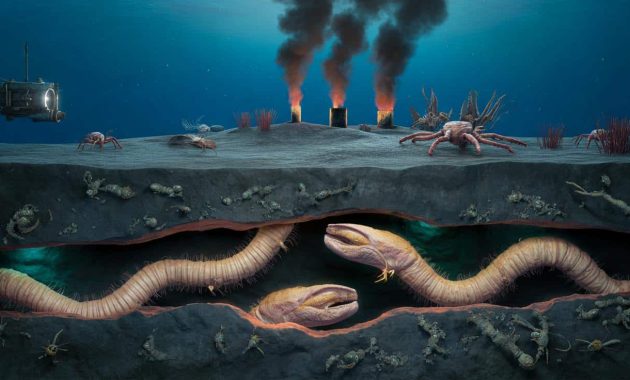
Researchers studying deep-sea hydrothermal vents have stumbled on a hidden habitat, buried under the oceanic crust itself. There, inside hot, fractured rocks, they have identified giant worms and an entire community of animals that no one had actually seen before.
A secret ecosystem beneath the seafloor
For decades, hydrothermal vents have been famous for their “smoking” chimneys and bizarre creatures clinging to the seafloor around them. Giant tubeworms, crabs, shrimps and strange fish crowd around the hot, mineral-rich fluids. Until now, the story seemed to stop at the sediment.
The new work extends that frontier downwards. By drilling and carefully sampling below vents on the deep ocean floor, scientists have revealed a living layer tucked inside the upper crust. This zone lies just under the seabed, threaded by cracks where scorching fluids circulate.
In that dark, pressurised labyrinth, they have found giant worms embedded in the rock, along with a supporting cast of smaller animals and dense communities of microbes.
Hidden under the apparent barrenness of the seafloor sits a “biomass layer” that could reshape how we think about life on Earth.
How giant worms end up inside solid rock
The obvious question is how such large animals reach such an unlikely address. They are not boring through solid stone like underwater moles. Instead, researchers suspect the worms start life somewhere more familiar.
Many vent animals release free-swimming larvae that drift near the seabed, carried by currents. The team suggests that some of these larvae get drawn into the porous crust by the very fluids that power hydrothermal vents.
Hot water, heated by underlying magma, rises through cracks and chimneys. As it moves, it may drag in tiny larvae from surrounding communities. Once inside, those larvae can settle in the fluid-filled fractures, feeding on the rich microbial life that thrives there, and eventually grow into adults.
A dynamic connection between three realms
This idea links three previously distinct habitats:
➡️ What if artificial general intelligence was already here… and we simply failed to notice?
➡️ CES 2026 : A visual revolution is coming for our screens
- the open ocean water, where larvae drift
- the seafloor, where classic vent communities sit
- the subseafloor crust, where this newly revealed animal layer resides
Instead of isolated pockets, the deep ocean looks more like a connected network. Animals and microbes can move gradually between layers, carried by hydrothermal fluids and subtle currents.
The ocean surface, the deep seafloor and the rocks beneath it form a continuous, interacting system, not separate worlds.
The subseafloor “biomass layer” and why it matters
Researchers now suspect that the rock beneath vents holds a significant amount of living matter. This “biomass layer” is packed with bacteria and archaea using chemical reactions as their energy source, plus larger organisms feeding on them.
Hydrothermal fluids deliver hydrogen, methane, sulfides and metals from the hot interior. Microbes use these chemicals the way plants use sunlight, building organic matter from scratch. Larger animals such as worms then feed directly or indirectly on this microbial production.
Although the total mass of this hidden biosphere remains uncertain, it could rival or exceed more visible deep-sea ecosystems. That shifts estimates of how much life Earth supports and where it is located.
| Layer | Main energy source | Typical life forms |
|---|---|---|
| Surface ocean | Sunlight | Phytoplankton, fish, marine mammals |
| Deep seafloor | Falling organic matter, vent chemistry | Crabs, shrimps, tubeworms, sea cucumbers |
| Subseafloor crust | Chemical reactions in hot fluids | Microbes, giant worms, small invertebrates |
Deep-sea mining threatens a habitat we barely know
While researchers try to map this new realm, industrial plans are already pushing closer. Several companies and states are preparing for deep-sea mining in areas rich in metals like cobalt, nickel and rare earth elements. Hydrothermal vent fields and nearby crust are often high-value targets.
Mining proposals usually focus on what is visible: chimneys, metal-rich sediments and nodules. The newly revealed animal layer sits just beneath these structures, exactly where drilling, scraping and fluid changes would hit hardest.
A subseafloor habitat that took millions of years to form could be damaged in a few seasons of industrial activity.
Scientists are urging regulators to slow down the rush. They argue that environmental protections need to consider not just corals and fishes, but the entire vertical column of life, from water above to rock below.
Clues for the search for life beyond Earth
This hidden community also carries unexpected consequences for space science. Several icy moons in the Solar System, such as Jupiter’s Europa, are thought to host global oceans under their frozen crusts. Some models suggest volcanic activity on their seafloors, similar in spirit to Earth’s hydrothermal vents.
NASA’s Europa Clipper mission, now on its way, aims to assess whether that moon could support life. If hydrothermal activity exists there, the processes seen on Earth’s seafloor become a useful comparison.
On our planet, chemical energy from rock-water interactions feeds microbes, which in turn support larger organisms, even in complete darkness. A similar chain could, in principle, appear on Europa or other icy moons, without any need for sunlight.
Finding thriving animals beneath Earth’s seafloor strengthens the idea that rock-hosted life might be common wherever liquid water and volcanism coincide.
Key terms behind the discovery
What scientists mean by “oceanic crust”
The oceanic crust is the solid, outer layer of Earth’s surface beneath the oceans. It forms when magma rises at mid-ocean ridges, cools and cracks into a lattice of basaltic rock. Over time, seawater infiltrates those cracks, reacts with minerals and creates a complex network of hot and cold channels.
This fractured structure is what makes life beneath the seabed possible. Fluid-filled pores and fissures bring heat, chemicals and, occasionally, larvae into the crust, turning it into a habitable zone rather than a sterile barrier.
Hydrothermal vents, briefly explained
Hydrothermal vents appear where seawater seeps into the crust, heats up near magma and then rises back out. As the hot fluid shoots into icy deep water, dissolved metals and minerals precipitate out, forming chimneys that look like black or white smoke.
Near these vents, sunlight is irrelevant. Microbes rely on “chemosynthesis”, a process where chemical energy replaces solar energy. Many iconic deep-sea animals live in close partnership with these microbes, either hosting them internally or grazing on them.
What this means for future research and policy
These subseafloor worms and their neighbours give researchers a real-world laboratory for testing ideas about life’s resilience. Teams are already planning more targeted drilling campaigns, improved remote-operated vehicles and new sensors able to capture delicate animals before they disintegrate in lower pressure.
There is also growing interest in running computer simulations that couple ocean circulation, hydrothermal fluid flow and larval behaviour. Such models could show how often larvae are likely to be sucked into the crust, how far they travel underground and how patchy these hidden communities might be.
For policy makers, this work adds weight to calls for stronger deep-sea protections. Environmental assessments now need to factor in unseen habitats, delayed ecological effects and recovery times that could stretch far beyond a human lifetime. Decisions taken over the next decade will shape whether these giant worms remain an obscure footnote in scientific papers or a well-studied part of Earth’s living fabric.