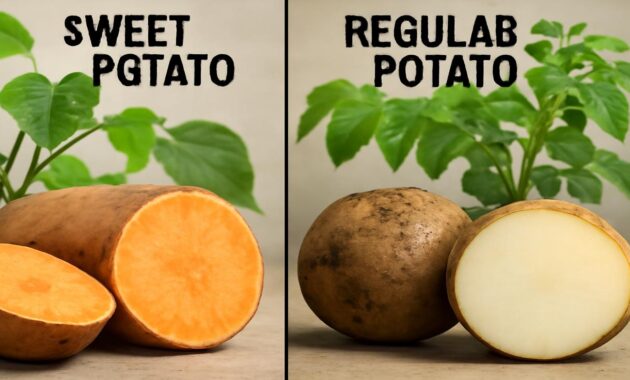
When you slice into a sweet potato, the sweet, creamy flesh that oozes out can seem almost indistinguishable from a regular baked potato. However, despite their similar appearances and uses in the kitchen, sweet potatoes and regular potatoes are not even remotely related. In fact, they come from completely different plant families that evolved on opposite sides of the globe.
The humble spud that graces so many dinner tables is a tuber – an underground storage organ that develops from the stems of a plant. Sweet potatoes, on the other hand, are not tubers at all, but rather storage roots that grow from the vines of a different plant species. This fundamental botanical distinction has shaped the evolution and global spread of these two starchy superstars in fascinating ways.
The Underground Architecture: Tuber vs. Storage Root
Potatoes, the tubers we know and love, develop from the stems of the Solanum tuberosum plant, a member of the nightshade or Solanaceae family. These underground stems, called stolons, grow outward from the base of the plant and swell into the edible tubers we harvest.

Sweet potatoes, in contrast, are not stems at all, but rather storage roots that sprout from the vines of the Ipomoea batatas plant, which is part of the morning glory or Convolvulaceae family. These fleshy, elongated roots are an adaptation that helps the plant store energy and nutrients underground.
The key difference is that tubers like potatoes form from modified stems, while storage roots like sweet potatoes develop directly from the plant’s root system. This fundamental architectural distinction has profound implications for how these two crops evolved and spread across the globe.
When DNA and Flowers Tell the Real Story
Genetic analysis reveals that sweet potatoes and regular potatoes are not even distant cousins – they come from completely unrelated plant families that evolved on opposite sides of the world. Potatoes originated in the Andes mountains of South America, while sweet potatoes have their ancestral roots in tropical Central America and the Caribbean.
Even the flowers of these two plants look nothing alike. Potato blossoms have a classic five-pointed star shape, while sweet potato flowers are large, funnel-shaped, and can come in a rainbow of colors from white to purple. This floral divergence is just one more testament to the vast evolutionary distance between these two iconic root vegetables.
Despite their culinary similarities, sweet potatoes and potatoes have been on completely separate evolutionary journeys for millions of years. Their shared status as beloved starchy staples is more a testament to the ingenuity of human cooks than any close botanical kinship.
From Andes to Islands: How Geography Split Their Stories
The geographic paths of potatoes and sweet potatoes have been just as distinct as their botanical origins. Potatoes arose in the rugged, mountainous Andes, where the diverse climate and topography allowed for the evolution of thousands of unique potato varieties.

Sweet potatoes, on the other hand, trace their ancestry to the tropical lowlands of Central America and the Caribbean. As these starchy roots spread, they adapted to island and coastal environments, becoming a dietary staple for many Polynesian and Melanesian cultures.
Remarkably, sweet potatoes even made their way to the remote islands of the Pacific long before European contact, likely dispersed by ancient seafaring cultures. This global spread stands in stark contrast to the more regionally confined evolution of the potato, which remained centered in the Andes until the 16th century Spanish conquest of the Americas.
Seeing Your Plate as an Evolutionary Story
The next time you enjoy a baked sweet potato or crispy french fries, take a moment to appreciate the remarkable evolutionary journeys that brought these two starchy superstars to your plate. Though they may seem like culinary cousins, potatoes and sweet potatoes are in fact distant relatives, each shaped by its own unique path through the annals of botanical history.

Tracing the origins and adaptations of our food can give us a deeper appreciation for the astounding diversity of life on our planet. These humble root vegetables are just the tip of the iceberg – every item on our plates has its own evolutionary story to tell.
So the next time you’re shopping for produce, try to imagine the millions of years of adaptation and migration that have led to the abundance we enjoy today. In a world that often feels increasingly disconnected from nature, these ancient tales of botanical triumph can be a powerful reminder of our enduring connections to the natural world.
Frequently Asked Questions
What are the main differences between sweet potatoes and regular potatoes?
The main differences are that sweet potatoes are storage roots that grow from vines, while regular potatoes are tubers that develop from underground stems. Sweet potatoes and potatoes also come from completely unrelated plant families that evolved on opposite sides of the globe.

Are sweet potatoes and yams the same thing?
No, sweet potatoes and yams are not the same. Yams are a different type of starchy root vegetable that originated in Africa and Asia, while sweet potatoes are native to the Americas. True yams are rarely found in North American grocery stores, where the “yams” you see are usually just a type of sweet potato.
Why do sweet potatoes and regular potatoes have such different flavors and textures?
The differences in flavor and texture largely come down to the unique chemical compositions of tubers versus storage roots. Potatoes contain more starch, while sweet potatoes are higher in natural sugars that caramelize when cooked, giving them a sweeter, creamier texture.
How did sweet potatoes spread around the world?
Sweet potatoes originated in tropical Central America, but spread to the Pacific islands and other regions through ancient trade and migration routes long before European contact. They became an important staple food for many Polynesian and Melanesian cultures, in contrast to the more regionally confined evolution of the potato in the Andes.

Can you substitute sweet potatoes for regular potatoes in recipes?
You can often substitute sweet potatoes for regular potatoes in many recipes, but the results may vary due to their different chemical properties. Sweet potatoes generally work best in recipes that embrace their natural sweetness, like casseroles, fries, or baked goods. They may not work as well in savory dishes that rely on the starchier, more neutral flavor of regular potatoes.
Are sweet potatoes healthier than regular potatoes?
Both sweet potatoes and regular potatoes can be part of a healthy diet, but sweet potatoes tend to have a slight nutritional edge. They are higher in vitamins A and C, as well as fiber. However, the healthfulness of any potato or root vegetable depends heavily on how it is prepared and consumed as part of an overall balanced diet.
What are some unique ways to cook and prepare sweet potatoes?
Beyond classic baked or mashed preparations, sweet potatoes can be used in a wide variety of creative dishes. They make excellent fries, hash browns, or latkes. Sweet potato puree can be used in soups, pies, and even savory dishes like gnocchi. The vibrant color and natural sweetness of sweet potatoes also lend themselves well to roasting, grilling, or adding to salads and grain bowls.

How do the growing requirements of sweet potatoes and regular potatoes differ?
Sweet potatoes thrive in warm, humid climates and well-drained, sandy soils. They are sensitive to cold temperatures and require a longer growing season than regular potatoes. Potatoes, on the other hand, can tolerate cooler conditions and a wider range of soil types, which has allowed them to be cultivated in diverse regions like the Andes mountains.