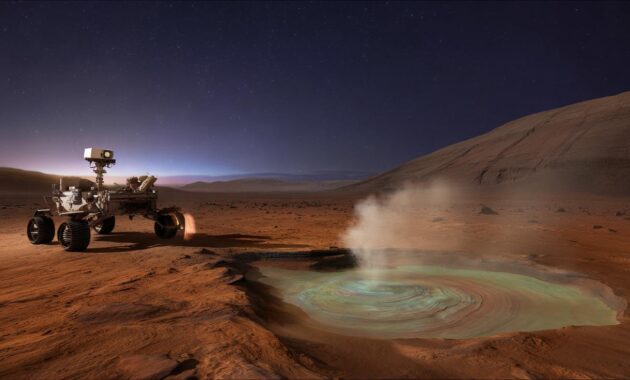
The Martian surface has always been a realm of mystery and intrigue, its desolate landscape seemingly void of any significant biological activity. However, a recent announcement from NASA has sent the scientific community into a frenzy, as the space agency has detected unexpected methane spikes on the red planet, hinting at the possibility of extraterrestrial life.
Methane, a gas commonly associated with biological processes on Earth, has long been observed on Mars, but its presence has generally been attributed to geological or atmospheric processes. These new spikes, however, are proving to be far more enigmatic, appearing and disappearing in a matter of nights, defying the planet’s typically slow-moving geochemical cycles.
This unexpected phenomenon has opened up a realm of possibilities, with scientists and researchers around the world eager to unravel the mystery and determine the true source of these methane bursts. Could they be the result of microbial life thriving beneath the Martian surface, or are there alternative explanations yet to be discovered?

Deciphering the Methane Signals
The detection of these methane spikes on Mars has sparked a flurry of scientific activity, as researchers work to piece together the clues and unravel the underlying mechanisms at play. The data gathered by NASA’s Curiosity rover and other orbital instruments have revealed that the methane levels can fluctuate drastically over short periods of time, leaving scientists perplexed.
One of the key challenges lies in understanding the complex interplay between Martian geology, atmospheric processes, and potential biological activity. Methane, while often associated with life, can also be produced through geological processes, such as the breakdown of organic matter or the reaction of water with certain minerals.
To make sense of these findings, researchers are employing a multifaceted approach, combining data from various sources, including satellite imagery, ground-based observations, and laboratory experiments. By studying the patterns and distribution of the methane spikes, scientists hope to gain insights into their origins and the implications for the potential existence of life on Mars.

Exploring the Possibility of Martian Life
The discovery of these methane spikes has reignited the longstanding debate surrounding the possibility of life on Mars. While the scientific community remains cautious in drawing definitive conclusions, the new data has opened the door to a range of intriguing hypotheses.
One of the leading theories suggests that the methane could be produced by methanogenic microbes, a type of extremophile organism capable of surviving in the harsh Martian environment. These microbes, if present, would likely be adapted to the planet’s low temperatures, limited water availability, and high levels of radiation.
However, the intermittent nature of the methane spikes poses a challenge to this hypothesis, as the biological production of methane is typically a more consistent process. Researchers are now exploring alternative explanations, such as the possibility of methane being trapped beneath the Martian surface and periodically released through geological processes.

Navigating the Complexities of Martian Exploration
Unraveling the mystery of the Martian methane spikes is no easy task, and it will require a concerted effort from the global scientific community. The challenges of exploring the red planet, with its vast distances and inhospitable conditions, have long been a significant barrier to our understanding of its potential for life.
Despite these hurdles, the determination and ingenuity of scientists and space agencies around the world have continued to push the boundaries of our knowledge. The data gathered by the Curiosity rover and other Martian exploration missions have provided invaluable insights, but the latest methane findings have once again highlighted the need for further investigation.
As the scientific community works to decipher the origins of these methane spikes, the world watches with bated breath, eager to witness the unfolding of a story that could potentially rewrite our understanding of the universe and the search for extraterrestrial life.

Implications and the Path Forward
The discovery of unexpected methane spikes on Mars has far-reaching implications, both for our understanding of the red planet and for the broader search for life beyond Earth. If these methane bursts are indeed linked to biological activity, it would represent a significant breakthrough in our exploration of the solar system and could pave the way for future missions focused on the detection and study of Martian life.
However, the complex and multifaceted nature of this phenomenon means that researchers must approach the findings with a cautious and methodical approach. Verifying the source of the methane and ruling out alternative explanations will be crucial in order to establish a strong scientific consensus.
As the scientific community continues to grapple with these new discoveries, the world eagerly awaits the next chapter in the ongoing exploration of Mars. The potential for life on the red planet has long captured the imagination of humanity, and these latest findings have only served to reignite that fascination, promising a future filled with breathtaking discoveries and a deeper understanding of our place in the cosmos.

Navigating the Challenges of Martian Research
The study of Mars and its potential for supporting life is a complex and multifaceted endeavor, fraught with a range of challenges that researchers must overcome. From the extreme environmental conditions on the planet’s surface to the logistical hurdles of conducting research across vast distances, the path to unraveling the mysteries of the red planet is paved with obstacles.
One of the primary challenges lies in the limited access to Martian data and samples. While the Curiosity rover and other robotic missions have provided valuable insights, the ability to conduct in-depth, on-site analysis is severely restricted. Overcoming these limitations will require the development of more advanced exploration technologies, as well as the coordination of international space agencies and research teams.
Additionally, the interpretation of the data gathered from Mars poses its own set of challenges. The complex interplay between geological, atmospheric, and potential biological processes on the planet can lead to ambiguous findings, requiring researchers to exercise a high degree of rigor and critical thinking. Integrating data from multiple sources and reconciling conflicting evidence is a crucial aspect of Martian research.

| Key Challenges in Martian Research | Potential Solutions |
|---|---|
| Limited access to Martian data and samples | Develop more advanced exploration technologies, improve international collaboration |
| Interpreting complex, ambiguous data | Employ rigorous analytical methods, integrate multiple data sources, maintain critical thinking |
| Extreme environmental conditions on Mars | Design robust, resilient exploration systems, improve mission planning and risk mitigation |
| Logistical challenges of long-distance operations | Leverage advanced communication technologies, optimize mission timelines and resource management |
Despite these challenges, the scientific community remains steadfast in its pursuit of understanding the Martian environment and the potential for life on the planet. With continued innovation, collaboration, and a relentless spirit of exploration, researchers are poised to unlock the secrets of Mars and uncover the mysteries that have captivated humanity for generations.
The Road Ahead: Next Steps in Martian Exploration
As the scientific community grapples with the implications of the unexpected methane spikes detected on Mars, the path forward for further exploration and investigation is becoming increasingly clear. With the wealth of data gathered by the Curiosity rover and other Martian missions, researchers are now poised to embark on a new phase of exploration, one that promises to shed light on the fundamental questions surrounding the potential for life on the red planet.
One of the key next steps will be the deployment of more advanced instrumentation and technology, capable of providing more detailed and precise measurements of the Martian atmosphere and surface. This may include the development of specialized sensors and rovers designed to target specific areas of interest, such as the regions where the methane spikes have been observed.

Additionally, the scientific community is exploring the possibility of future sample-return missions, where Martian soil and rock samples could be brought back to Earth for in-depth analysis. This would allow researchers to conduct more comprehensive studies using the full range of scientific equipment and techniques available in terrestrial laboratories, potentially providing the definitive answers that have so far eluded them.
| Next Steps in Martian Exploration | Potential Impact |
|---|---|
| Deployment of advanced instrumentation and technology | Improved data quality and precision, ability to target specific areas of interest |
| Sample-return missions | Opportunity for comprehensive, in-depth analysis of Martian materials in terrestrial labs |
| Increased international collaboration and coordination | Leveraging of diverse expertise and resources, more robust and comprehensive exploration efforts |
| Continued refinement of theoretical models and analytical techniques | Improved understanding of Martian processes and potential for life, more accurate interpretation of data |
As the global scientific community works to unravel the mystery of the Martian methane spikes, the road ahead promises to be filled with both challenges and opportunities. With a renewed focus on innovation, collaboration, and a steadfast commitment to exploration, researchers are poised to unlock the secrets of the red planet and potentially rewrite our understanding of the universe and the search for extraterrestrial life.
FAQ
What is the significance of the methane spikes detected on Mars?
The detection of unexpected methane spikes on Mars is significant because methane is often associated with biological processes on Earth. These spikes suggest the possibility of active, and potentially microbial, life on the red planet, which would be a groundbreaking discovery in the search for extraterrestrial life.

How do the methane spikes challenge our understanding of Mars?
The methane spikes challenge our understanding of Mars because the planet’s atmospheric and geological processes are typically slow-moving, yet these spikes appear and disappear rapidly, within a matter of nights. This intermittent nature of the methane production is not easily explained by known Martian processes, suggesting the possibility of a more dynamic and complex environment on the planet.
What are some of the potential explanations for the methane spikes?
There are several potential explanations for the methane spikes, including the possibility of methanogenic microbes living beneath the Martian surface, the periodic release of trapped methane through geological processes, or even unknown atmospheric or chemical reactions. Researchers are exploring these and other hypotheses to determine the true source of the methane emissions.
What are the challenges in studying the methane spikes and investigating the potential for life on Mars?
The key challenges in studying the methane spikes and investigating the potential for life on Mars include the limited access to Martian data and samples, the complex and ambiguous nature of the data, the extreme environmental conditions on the planet, and the logistical challenges of conducting long-distance operations. Overcoming these obstacles will require the development of advanced technologies, international collaboration, and a rigorous, multidisciplinary approach to research.
What are the next steps in Martian exploration to further investigate the methane spikes?
The next steps in Martian exploration to further investigate the methane spikes include the deployment of more advanced instrumentation and technology, the pursuit of sample-return missions to bring Martian materials back to Earth for in-depth analysis, increased international collaboration and coordination, and the continued refinement of theoretical models and analytical techniques. These efforts will aim to provide more definitive answers about the origin and implications of the methane spikes.
How might the discovery of life on Mars impact our understanding of the universe and the search for extraterrestrial life?
If the methane spikes on Mars are indeed linked to biological activity, it would represent a significant breakthrough in our understanding of the universe and the search for extraterrestrial life. Such a discovery would challenge our existing models of planetary formation and evolution, and could potentially open new avenues of exploration and research, ultimately expanding our knowledge of the cosmos and our place within it.
What are the ethical and societal implications of discovering life on Mars?
The discovery of life on Mars would have profound ethical and societal implications, from the need to establish international protocols for the responsible exploration and study of extraterrestrial life, to the potential impact on religious and philosophical beliefs about the uniqueness of life on Earth. Careful consideration of these implications will be crucial as the scientific community continues to investigate the possibility of Martian life.
How can the public stay informed and engaged with the latest developments in Martian exploration and the search for life?
The public can stay informed and engaged with the latest developments in Martian exploration and the search for life through a variety of channels, including following the official communications of space agencies like NASA, subscribing to science news outlets, and engaging with the scientific community through social media and public events. By staying informed and involved, the public can contribute to the ongoing discussion and support the crucial work of researchers in this field.