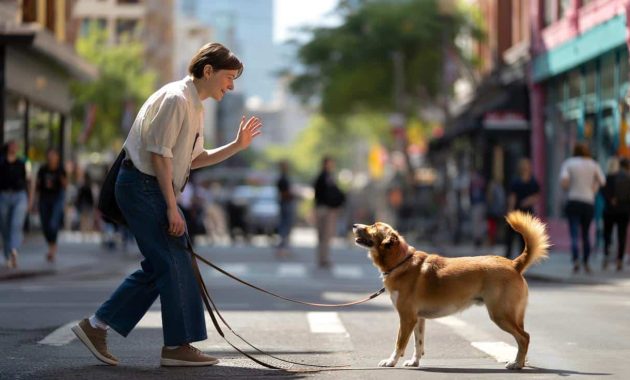
You’re walking down the street, late for something you don’t really want to go to, when a dog appears on the sidewalk. Not your dog. Not anyone you know. Just a golden snout, bright eyes, tail giving that hopeful helicopter wiggle.
And without thinking, your hand lifts in a small wave and your mouth says, almost softly, “Hey there, buddy.”
The owner barely notices, but your brain does. There’s a strange flicker of warmth, a tiny reset of the day.
Some people never do this. Some people do it every single time.
Psychologists say that little wave is not random at all.
The “dog wave” and what it quietly reveals about you
If you’re the kind of person who instinctively waves at dogs you don’t know, you’re probably scoring high on something called “agreeableness”.
That trait bundles together warmth, empathy, and a tendency to look for connection instead of conflict.
For many of us, acknowledging a dog in the street is like sending a micro-postcard of kindness into the world.
There’s no social obligation, no reward, nobody grading you.
You just greet a creature that can’t even answer in your language, and something about that reveals where your emotional compass points.
Walk through any city for ten minutes and you can almost map personalities by how people react to dogs.
One person stiffens, eyes down, zips past. Another smiles only at the owner. Then there’s the person who locks eyes with the dog, lifts their hand, and says “Hello!” like they’ve bumped into an old friend.
A 2020 study from the University of Copenhagen suggested that people who engage with unknown dogs in public spaces tend to report higher levels of social trust and perceived social support.
They’re not just friendlier to animals; they often describe the world as a place where small, positive interactions still matter.
Micro-moments with dogs become tiny proofs that friendliness is safe.
Psychologists link these street gestures to what’s called “social approach behavior”.
Some brains are wired to lean forward toward contact, even low-stakes contact with a dog on a leash. Others lean back, staying protected.
That one-second wave is like a personality reflex.
It quietly signals that your radar isn’t just scanning for threats or tasks, but also for chances to share a soft moment.
*If you find yourself doing it without thinking, that habit says you’re willing to be seen as gentle in public — even a little silly — and you’re surprisingly okay with that.*
What your dog-greeting style says about your emotional world
Psychologists who study human–animal bonds often talk about “emotional openness”.
Waving at a strange dog is a low-risk way of expressing it.
➡️ Two long-lost predators from 325 million years ago resurface from the world’s longest cave
➡️ Behemoth star,’ previously thought to be dying, is ‘rising from the ashes’ like a phoenix
➡️ With these 3 patents, France grabs the reins of “tomorrow’s” €57 billion energy bet: e‑methanol
➡️ The overlooked bathroom vent setting experts say reduces mold by more than 40%
➡️ A polar vortex disruption is on the way, and its magnitude is almost unheard of in March
➡️ Turning off Wi‑Fi at night, a quiet habit that improves sleep
You’re admitting, with your body language, that this moment matters enough to mark it.
No one is filming, you’re not curating content, and life won’t radically change because you acknowledged a spaniel on a Tuesday morning.
You still choose to open the door a crack, emotionally speaking.
The way you do it also carries clues.
Some people crouch slightly, soften their voice, and check in with the owner: “Can I say hi?” Others just flash a quick smile and a silent wave from a distance, like a neighbour across the street.
That second group is interesting to researchers.
They often show what’s called “parasocial warmth”: a tendency to extend friendly energy even when no real relationship will form.
Think chatting with baristas, complimenting strangers’ shoes, or nodding at a toddler in a stroller.
The dog wave sits in the same family — a gentle willingness to invest emotionally in micro-interactions.
Behind all this, something deeper is going on around control and vulnerability.
Dogs don’t judge your outfit, your job, or your relationship status. They just register tone, body, and energy.
Greeting them strips communication down to something very simple and very honest.
Many psychologists say that people who like these stripped-down moments are often more comfortable with vulnerability than they realize.
They don’t need polished scripts to feel connected.
Let’s be honest: nobody really does this every single day. But the people who do it often are sending themselves a quiet message — that softness has a place in their daily life.
How to wave at strange dogs without being “that” person
If you’ve always wanted to be the person who greets dogs in the street, there’s a respectful way to do it.
The first rule is simple: your wave is for the dog, but your permission comes from the human.
Start by catching the owner’s eye, not the dog’s.
Give a half-smile, a tiny hand lift, almost like you’re saying, “Is this okay?”
If their body relaxes or they smile back, you’re usually safe to lean a bit closer, lower your voice, and offer a soft “Hi, gorgeous” or “Hello, friend.”
The dog reads your tone far more than your words.
Many shy people worry they’ll look weird or childish.
There’s a quiet fear of overstepping, of being seen as intrusive in a tense city sidewalk.
That’s where smallness is your ally.
Keep your gesture light and brief. If the dog or the owner seems unsure, you just let the moment pass and keep walking.
No drama, no awkward apology tour.
The mistake most people regret isn’t waving at dogs.
It’s touching without asking, rushing in with high-pitched noise, or assuming every wagging tail wants to be hugged.
Empathy here means remembering a simple thing: not all dogs — or owners — had an easy past.
Some therapists even use a question in session that sounds like a joke: “Do you talk to dogs in the street?”
The answer, they say, often opens a door to how comfortable a person feels showing tenderness where other people might see them.
- Look at the owner firstThink of them as the dog’s personal security guard. A quick glance and smile asks for non-verbal consent.
- Read the dog’s body languageLoose tail, relaxed mouth, wiggly body? Green light. Stiff posture, tucked tail, intense stare? Time to keep walking.
- Use a soft, grounded voiceDogs respond better to calm warmth than squealing excitement, especially in busy streets.
- Keep your hands low, not hovering aboveA low wave or palm sideways feels less threatening than a hand reaching down from above their head.
- Accept the “no” with graceIf the dog backs away or the owner seems tense, just smile and move on. Your kindness still counts.
Why this tiny habit lingers in your mind all day
Once you start noticing it, the dog wave becomes a kind of emotional mirror.
On days you feel heavy and closed, you may keep your eyes glued to the pavement.
On lighter days, your hand rises almost by itself and a stranger’s dog lights up, just for you.
Psychologists would say that this is your attachment style, your social trust, your nervous system, all briefly peeking out into daylight.
But on the ground, in real life, it just feels like a stolen pocket of uncomplicated good.
You give a little warmth, an animal receives it, the owner smiles, and for a beat the city feels less hostile.
| Key point | Detail | Value for the reader |
|---|---|---|
| Dog greeting reflects personality traits | Linked to agreeableness, emotional openness, and social trust | Helps you understand what your instinctive reactions say about you |
| Gestures can be done respectfully | Focus on owner consent, body language, and calm signals | Allows you to express warmth without crossing boundaries |
| Small interactions shape your day | Micro-moments with animals can regulate mood and reduce stress | Encourages you to use brief dog encounters as real emotional resources |
FAQ:
- Question 1Does waving at dogs really say anything serious about my personality?
- Answer 1It’s not a clinical test, of course, but studies on human–animal interaction suggest that people who greet unknown dogs tend to sit higher on traits like empathy, agreeableness, and social approach behavior. It’s one small but telling clue among many.
- Question 2Is it rude to wave at someone else’s dog?
- Answer 2Not if you treat the owner as the first point of contact. A brief smile and eye contact before you wave or speak to the dog keeps the power with them and usually feels respectful rather than invasive.
- Question 3What if I’m scared of dogs but wish I wasn’t?
- Answer 3You can start from a distance. A tiny nod or quiet “hi” from a few meters away still counts as contact. Over time, repeated safe exposures — always with calm, controlled dogs — can slowly retrain your nervous system.
- Question 4Do people who ignore dogs seem “less kind” to psychologists?
- Answer 4No. Some people grew up with fear, allergies, or cultural distance from pets. Psychologists look at patterns across many situations, not just one behavior on the sidewalk.
- Question 5Can saying hello to dogs actually improve my mood?
- Answer 5Yes, for many people. Brief, positive contact with animals has been linked to lower stress and a quick bump in positive emotions. That tiny wave can work like a small, free mood reset in the middle of your day.