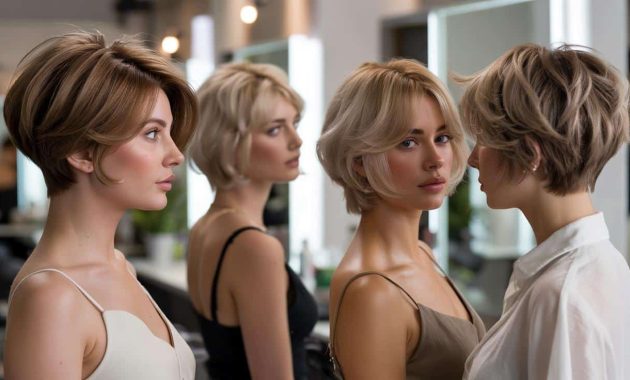
The woman in front of the salon mirror doesn’t look unhappy, just… unconvinced. Her hair is freshly washed, cut to the chin, technically “styled”. Yet as the hairdresser fluffs the ends one last time, the same thought flickers across her face that so many of us know: why does it still look so flat? The cut is cute, yes. But her fine hair lies close to the head like silk paper, swallowing light instead of reflecting it.
Out in the street, other women pass by with bouncy lobs and dense pixies, and you can almost hear the silent calculation: is it my hair, or is it the haircut?
The answer is often simpler – and more hopeful – than we think.
Short hair, fine strands: when the “trendy cut” just falls flat
There’s a specific kind of disappointment that belongs only to people with fine hair. You bring an inspiration photo of a stunning bob, sit in the chair for an hour, then walk out with something that looks… smaller. From the side, your hair hugs your skull instead of floating away from it. From the back, the nape collapses by midday.
The cut might be technically perfect, but on fine hair, perfection can look painfully thin. What you actually need is structure, not just style.
One Paris-based stylist described a client who came in every six weeks with the same complaint: “My hair looks like three lonely feathers.” Her previous salon had given her the trending blunt bob each time, pin-straight and minimal. On her friend’s thick hair, that shape looked architectural and chic. On her? It read as narrow and flat, exposing the neck in a way that made the whole head look smaller.
The stylist switched her to a **softly layered French bob**, opening up the back and tucking a hidden stack of layers at the crown. Two months later, the client came back with photos of herself from all angles, grinning. The hair wasn’t thicker. The shape just finally matched the texture.
Fine hair behaves like fabric on a body: drapey cuts cling, structured cuts lift. When all the weight of a short cut sits at one length, that weight pulls the hair down, erasing any natural movement. A few millimeters of layering, a slightly shorter nape, a fringe placed at the right height – these small decisions change how the eye reads volume.
That’s why some short cuts seem to “inflate” fine hair, while others betray it. The trick is choosing silhouettes that create shadows and air pockets, not sleek curtains. Once you understand that, every salon visit becomes less of a gamble and more of a strategy.
The 4 short cuts that fake thicker hair (without high effort)
The first shortcut to visible thickness is the stacked nape pixie. This is not the spiky boy cut of the 2000s, but a modern version where the back is tapered snug to the neck and then gently stacked with short layers. The top is left slightly longer and softer, falling forward or to the side.
➡️ Cash machine keeps your card: the quick move and the button you need to know
➡️ Goodbye private rentals as new housing rules pit landlords against struggling tenants
➡️ Banana peels in the garden: effective for plants only if you put them in this exact spot
On fine hair, that graduated back creates a little “shelf” of fullness. Your hair no longer lies flat against the scalp – it builds a curve. From profile, the head suddenly has shape. The best part: this cut looks intentional even when you’ve just woken up and run your fingers through it.
The second powerhouse for fine hair is the French bob, just skimming the jaw or slightly above, often with a fringe. Think messy ends, tiny bend in the strands, zero razor-sharp geometry. One London colorist told me about a client who spent years straightening her fine hair into a blunt chin-length cut, then complaining it “refused to stay big”.
When she finally tried a French bob with a soft, broken line and airy bangs, her hair instantly looked twice as dense. The micro-wave at the ends stopped the eye from seeing where the hair started and ended. Even on a no-blow-dry day, the shape held a kind of lived-in puffiness that no volumizing mousse had ever achieved for her.
Third on the list: the layered shaggy crop — a short, collarbone-or-above cut with invisible layers threaded through the length. Not a rockstar shag, more a gentle halo of movement. By scattering layers instead of hiding them only at the back, you create a cloud effect around the head.
The fourth option is the grown-out pixie, sometimes called the “bixie” between a bob and a pixie. The nape stays neat and short, the sides hug the cheekbones, and the top is allowed to be longer and swingy. This contrast in lengths tricks the eye into reading volume at the crown and temples. *Fine hair loves contrast far more than it loves symmetry.*
How to talk to your hairdresser (and style it at home) so volume actually lasts
Walk into your appointment with more than a screenshot. Use words that describe what your fine hair does, not only what you want it to look like. Say things like: “My hair collapses at the crown by lunchtime,” or “I get gaps at the back of my head.” Then ask explicitly for a cut that builds support: stacked nape, crown layers, softness around the hairline instead of heavy blocks.
When your stylist shows you the back with a mirror, look for a roundness at the occipital bone, not a flat line. That roundness is your built-in volume. Ask them to show you a super simple styling move you can copy in 3 minutes at home.
At home, rough-drying is your best friend. Flip your head upside down and dry the roots in different directions with your fingers, not a brush. Once the roots are dry, then shape the lengths. If you start perfecting the ends too early, you freeze the hair in a flat position.
Skip heavy serums and rich creams on short fine hair, especially near the root. They kill lift instantly. A light mousse or foam at the root, a spritz of texturizing spray through the mid-lengths, and that’s usually enough. Let’s be honest: nobody really does this every single day. So your cut has to do most of the heavy lifting.
“People think they need ‘more hair’,” says a Berlin stylist who works almost exclusively with fine textures. “They don’t. They need the right architecture. A tiny change at the nape can add more apparent volume than any expensive product.”
- Stacked nape pixie – Best for those who don’t mind short backs and love a defined profile. It gives instant fullness at the back of the head.
- Soft French bob – Ideal if you want to keep some length near the face and maybe tuck hair behind the ear without it looking stringy.
- Layered shaggy crop – Great if your fine hair is also slightly wavy and you like a relaxed, “I woke up like this” finish.
- Grown-out bixie – A sweet spot if you fear going too short but crave more lift at the crown than a classic bob can offer.
Choosing the cut that fits your face, your life, and your patience
Each of these four cuts can transform fine hair from “flat” to “full”, but they don’t suit the same lifestyle. If you hate going to the salon, the shaggy crop or French bob will grow out more gracefully than a tight pixie. If you love a strong silhouette and don’t mind trims every six weeks, the stacked nape pixie can become part of your personal signature.
Face shape plays a role too. Round faces often benefit from the vertical lift of a bixie or pixie, while longer faces soften beautifully under the gentle width of a French bob with bangs. None of these are strict rules, just starting points for a real conversation with your stylist.
There’s also the emotional side: cutting fine hair short can feel risky, like giving up the little length you have. Yet many women describe an unexpected relief once their hair is no longer pretending to be something it isn’t. We’ve all been there, that moment when you finally see your reflection and think, “Ah. So that’s what my hair wanted all along.”
If you’re still hesitating, save photos of these four cuts on your phone, then look honestly at your daily routine, at your morning energy, at the clothes you feel most yourself in. Somewhere between those images and that reality, there’s a haircut that won’t just look fuller – it will feel like less effort and more you.
| Key point | Detail | Value for the reader |
|---|---|---|
| Choose structural cuts | Stacked napes, crown layers, and soft lines create shadow and lift on fine hair | Helps you pick a cut that visually thickens hair instead of flattening it |
| Use real-life language at the salon | Describe how your hair behaves (“collapses”, “separates”) rather than only showing photos | Increases the chance you and your stylist design a cut that solves your actual problems |
| Simple daily styling habits | Rough-dry roots upside down, avoid heavy products, rely on the cut’s built-in shape | Makes volume achievable on busy mornings without complicated routines |
FAQ:
- What is the most flattering short cut for very fine, straight hair?The stacked nape pixie or a softly graduated French bob work best. They both add structure at the back and create a rounder silhouette so the hair appears denser from every angle.
- Will layers make my fine short hair look thinner?Too many visible layers can, but invisible or “internal” layers actually add lift. Ask for subtle layering at the crown and nape, not choppy, obvious steps around the face.
- How often should I trim a short cut to keep the volume?Every 5–7 weeks is ideal for pixies and bixies, while French bobs and shaggy crops can stretch to 8–10 weeks if the shape is well designed from the start.
- Can I wear bangs if my hair is fine?Yes, as long as the fringe is airy and slightly textured, not heavy and blunt. Wispy curtain bangs or a soft French fringe blend better and avoid exposing the scalp.
- Do I need special products for volume on short fine hair?A light root-lifting mousse or spray and a dry texturizing spray are usually enough. Focus on product at the roots and mid-lengths, and keep the ends almost bare to avoid weighing everything down.