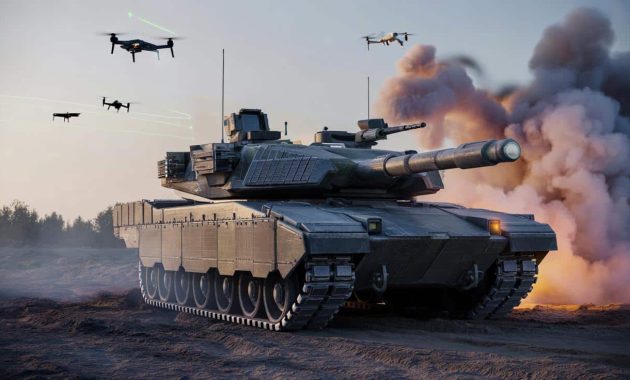
The US Army is quietly preparing a radical makeover for its armoured forces, betting on thermal stealth, anti-drone shielding and smarter warning systems to keep heavy vehicles alive under constant digital surveillance.
A war where being seen means being hit
For decades, tanks were designed to survive artillery, rockets and other tanks. Now they must survive algorithms. Drones, loitering munitions and cheap thermal cameras have turned large armoured vehicles into glowing targets, easily spotted from the sky or by troops with off-the-shelf optics.
The US Army’s answer is ambitious: turn Abrams tanks, Bradleys and other tracked vehicles into “digital ghosts” that blend into the background of a sensor-saturated battlefield. The shift is not cosmetic. It changes how vehicles are painted, how they are protected from above, and how they react the moment a hostile laser locks onto them.
The new goal is not just to withstand a hit, but to avoid ever becoming a clean, obvious target in a drone’s camera feed.
A new skin: the GM1912 thermal signature coating
At the heart of the plan lies an unusual upgrade: paint. The US Army has earmarked funding for a specialist coating known as GM1912 Signature Management Coating. This is more than camouflage in the traditional sense.
GM1912 is designed to distort a vehicle’s thermal signature, the heat pattern that infrared cameras detect. Instead of a bright, tank-shaped blob on a drone’s screen, a coated vehicle should appear as a less defined shape that blends into the ground or surrounding infrastructure.
According to budget documents, more than 380 vehicles are due to receive this coating from 2026. That figure likely includes front-line platforms such as M1A2 Abrams tanks and other tracked combat vehicles slated for extended service.
Thermal stealth does not make a tank invisible, but it can slow down an enemy operator’s ability to recognise and prioritise it as a target.
How thermal camouflage frustrates smart weapons
Modern guided munitions often rely on a mix of sensors: GPS, radar, imaging infrared and sometimes laser designation. Cheap commercial drones commonly use basic thermal cameras, while more advanced loitering munitions can lock onto a distinct heat signature.
➡️ A centenarian reveals the daily habits behind her long life, saying “I refuse to end up in care”
➡️ Spraying vinegar on the front door : why people recommend it and what it’s really for
➡️ Psychologists say people who intellectualize emotions do so to stay emotionally safe
➡️ Everyone with bread in the freezer needs to read this
By blurring that signature, GM1912 aims to:
- Shorten the detection range of infrared sensors
- Force human operators to take longer to classify the object
- Confuse automated target-recognition software trained on clear images of vehicles
- Increase the chance that munitions mis-prioritise or lose their lock
In a battlefield where seconds decide whether a tank survives a drone swarm, forcing the enemy to hesitate even briefly can keep crews alive.
Reinforcing the roof: GM1914 anti-top-attack kits
Stealth alone does not solve the biggest vulnerability exposed in Ukraine and elsewhere: the top of armoured vehicles. Drones dropping munitions, and missiles designed to dive onto their targets from above, routinely exploit the relatively thin armour on roofs, engine decks and hatches.
The US Army plans to counter that with GM1914 protection kits, a set of add-on, mostly passive armour modules mounted on the upper surfaces of vehicles. With an allocated budget of €91.7 million, the programme is expected to equip four full armoured brigades.
While technical details remain classified, these kits are likely to combine additional armour plating, structural spacing to absorb blasts and possibly sacrificial panels that disrupt the jet formed by shaped-charge warheads.
The message is clear: the days when the front glacis was the only critical armour surface are over. The roof now matters just as much.
Budget snapshot: what gets funded in 2026
| Component | Budget (2026) | Planned coverage |
| GM1912 stealth coating | €15.3 million | 380 vehicles |
| GM1914 anti-top-attack kit | €91.7 million | 4 armoured brigades |
| Laser warning systems | Not publicly detailed | Phased deployment |
The sharp jump in funding stands out. No money was set aside for these specific items in 2024 or 2025. Their entry in the 2026 “Weapons and Tracked Combat Vehicles Procurement” line signals that senior commanders now view anti-drone and signature management measures as urgent, not optional extras.
Laser warning: a few seconds that change everything
Alongside stealth and armour, the army plans to mount laser warning systems on its vehicles. These systems detect when an enemy uses a laser designator to mark the tank for a guided strike, typically from a drone or a ground observer.
Once the sensors pick up this “paint”, they can trigger audible alerts in the crew compartment and, in some configurations, automatically cue smoke launchers or other countermeasures.
Laser warning turns a silent, invisible threat into something the crew can actually react to, even if only for a brief window.
Those extra seconds let the driver reposition behind terrain, angle the armour, or pop obscurants that block both visual and infrared views. In some setups, the warning could also be fed into active protection systems that shoot down incoming projectiles, creating a layered defence against top-attack weapons.
Industrial race to build the “ghost brigades”
The budget documents do not list specific contractors, yet the main US land-systems heavyweight, General Dynamics Land Systems, looks well placed to integrate the changes. The firm already leads upgrades on the Abrams tank and the Stryker family of vehicles.
Smaller companies specialised in advanced coatings, composites and passive sensors are expected to supply key technologies. The integration challenge lies in fitting these new layers of survivability onto legacy hulls without overloading weight limits or eroding mobility.
Beyond foreign wars: homeland roles
Although the focus is clearly on contested regions such as Eastern Europe, the Middle East and the Indo-Pacific, the US Army also frames these upgrades as dual-use for domestic operations. Stealthier, better-protected vehicles could support civil authorities during crises on US soil.
In a mass-casualty terrorist attack, for example, armoured vehicles may need to operate near hostile drones targeting convoys or critical infrastructure. Lower signatures and laser warning could help them move safely in densely populated, sensor-rich environments.
Swarm threat: why heavy armour must adapt or fade
The deeper driver behind this shift is the rise of drone saturation. Conflicts from Nagorno-Karabakh to Ukraine have showcased autonomous and semi-autonomous drones hunting armour in large numbers. Many are cheap, expendable and easy to modify.
Against a swarm, traditional protection concepts struggle. There are simply too many threats approaching from too many angles, often guided by thermal and optical feeds shared across networks in real time.
Instead of trying to shoot down every drone, the US approach is starting to look more like digital camouflage and deception at scale.
A tank that is harder to detect, harder to classify and harder to kill from above is more likely to survive long enough to contribute meaningful firepower. That matters not only tactically, but politically, as public tolerance for heavy combat losses drops in many democracies.
What “thermal signature” really means
Behind the jargon sits a simple idea: everything emits heat. Infrared cameras convert that radiation into an image, where hotter areas look brighter or different in colour. A running tank, with a hot engine, exhaust, turret electronics and friction-heated tracks, stands out strongly against cooler terrain.
Signature management coatings try to smooth that contrast. Some redistribute heat, others absorb and re-radiate it differently, and some use patterned emissivity so that the vehicle mimics nearby surfaces. None of this makes the tank cold. It just makes it less obvious at a glance.
Future scenario: an armoured company under drone attack
Picture an armoured company advancing through rolling terrain under constant drone surveillance. Enemy operators sit kilometres away, watching a thermal feed. Tanks without signature management appear as crisp, tank-shaped lights, easy to tag with software or human eyes.
Now imagine the same scene with GM1912 coating and roof armour installed. Vehicles look fuzzier, less distinct. The enemy still sees activity, but identifying which shapes are high-value, and lining up precise top-attack strikes on each, becomes slower and less certain.
When a laser designator tries to mark one of the lead tanks, its warning system chirps and a curtain of smoke erupts, masking the formation. Some drones still get through. Yet instead of a clean, systematic destruction of the column, the attack turns messy and less efficient. Survivability rises not through invincibility, but through friction added to the enemy’s kill chain.
Risks and trade-offs of “invisible” armour
These upgrades come with questions. Additional armour adds weight, which can strain engines, transmissions and bridges. Coatings require maintenance and may degrade under harsh conditions. Laser warning systems must avoid false alarms while still catching fleeting threats.
There is also a risk that adversaries adapt quickly. As Western militaries field better thermal camouflage, sensor makers will try to tune algorithms to spot “fuzzy” signatures or look for movement patterns instead of clear outlines.
Still, the combination of thermal stealth, anti-top-attack armour and early-warning sensors marks a significant shift. Tanks are no longer treated only as steel fortresses. They are becoming nodes in a wider contest of signatures, data and timing, where leaving as little trace as possible can matter just as much as the thickness of the steel plate.