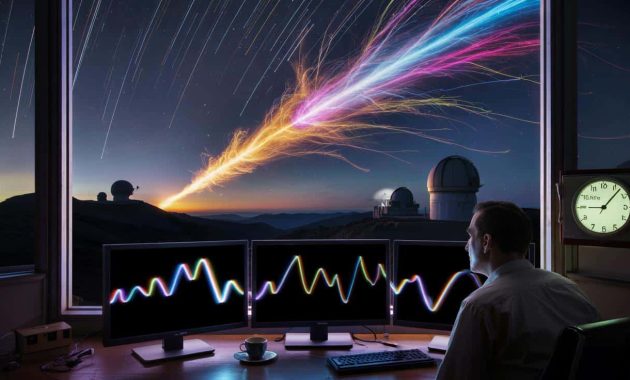
Under the night’s quiet face, space did something it almost never does. A cosmic outburst that should have blinked out in minutes kept roaring for hours, as if some invisible engine had jammed open and the sky forgot where the off switch was.
Screens snapped awake, numbers skittered, and the graph that should have calmed after a bright spike simply kept climbing and breaking and surging again. Coffee cooled untouched while the clock rolled on and the feed refused to die.
It felt like the universe had leaned on the doorbell. We’re used to fireworks — a quick, violent flare and then the long afterglow that astronomers nurse for days. This was different. Minute 12 became minute 40, then an hour, then two. The team stopped talking in complete sentences. Someone laughed, not from joy but disbelief. And it refused to end.
The night the sky wouldn’t stop screaming
Gamma-ray bursts are the universe’s most dramatic one-act plays. Most last seconds, the “long” ones stretch to a handful of minutes, and then they’re done, leaving a fading afterglow like embers in the dark. That night, the script tore itself up. The prompt emission — the bit that usually blazes and fades — droned on, hour after hour, a saw-toothed roar across our sensors.
There’s a name for this rare breed: ultra-long gamma-ray bursts. One famous case, GRB 111209A, stayed bright for roughly seven hours, first flagged by the Swift satellite and chased by telescopes across the world. Light took billions of years to reach us, and yet the story felt present tense, almost indecently close. Later, a peculiar supernova — SN 2011kl — was linked to it, hinting the dying star behind the fireworks had been anything but ordinary.
Why so long? Imagine a massive star with an oversized, wispy envelope, collapsing into a black hole or an ultramagnetised neutron star. Material keeps falling in, feeding jets that drill through the star and out into space. As long as the fuel rains down, the engine sputters and surges. The timescale stops being seconds and starts being hours, set by how long that fragile outer shell takes to fall and by how the jet stutters against it. **This wasn’t a blip; it was a new chapter in a very old story.**
How to read an ultra-long burst without losing the plot
Start with the light curve, not your assumptions. Split the long growl into phases — early spikes, plateaus, late-time flares — and compare energy bands rather than one big lump of counts. Cross-match the gamma-ray data with X-ray and optical follow-up to catch the switch from prompt emission to afterglow. Look at T90, the time covering most of the energy, but also the parts the metric hides.
Common traps wait in a night like this. People chase every micro-flare as if it’s a new engine, when some of it is the jet flickering through clumpy debris. We’ve all had that moment when a noisy graph looks like a coded message. Let’s be honest: nobody cleans raw telemetry in real time perfectly or watches every calibration plot every night. Step back, breathe, and anchor each claim to more than one wavelength.
There’s also the lure of overfitting. A tidy model is nice; a faithful model is better.
“An ultra-long burst is the cosmos telling you to be patient. It’s not a longer version of the usual story — it’s a different story told slowly,” said one weary observer at 03:17, half whisper, half grin.
➡️ Heavy snow expected starting late tonight
➡️ The trick to remove label glue from jars and bottles without losing your mind
➡️ Daily horoscope: A message from Esperanza Gracia for Aries, Taurus, Gemini, Cancer, Leo and Virgo
➡️ Greenland’s climate isn’t what you think: the clichés are wrong
➡️ What it means when someone looks away while talking, according to psychology
➡️ The homemade gravy recipe that instantly upgrades any roast dinner
➡️ This rearview mirror scam is wreaking havoc in England, here’s how it works and how to avoid it
**If you need a pocket checklist, here’s the version we wish we’d had taped to the monitor that night.**
- Phase the light: identify prompt, plateau, and late flares cleanly.
- Track spectra over time, not just totals.
- Coordinate across bands within minutes, not hours.
- Test both central-engine options: magnetar and black hole accretion.
- Document every “boring” calibration step — it saves you later.
Why this outlier matters for the rest of us
The hours-long tantrum rewrites the comfortable categories we like to teach. Long versus short never told the whole tale; ultra-long adds a new shelf to the library and asks awkward questions about how massive stars die. If some stars carry bloated envelopes that drip-feed a central engine, then our census of distant explosions, and of how often they seed galaxies with heavy elements, needs a fresh look.
It also nudges at our sense of scale. Human time fights cosmic time, and here the universe met us halfway, drawing out the blast to match our attention span. **A burst that keeps going is a rare, almost generous teacher.** It lets us watch a jet mature, cool, and cough in real time, instead of piecing it together from fragments. The lesson isn’t that the cosmos is louder than we thought. It’s that it holds a note far longer than our usual instruments expect.
| Point clé | Détail | Intérêt pour le lecteur |
|---|---|---|
| Ultra-long GRB | Prompt emission lasting hours, not seconds | Reframes what a “normal” cosmic blast can be |
| Possible origins | Blue supergiant collapse, extended envelope, sustained accretion | Clues to how massive stars die and feed jets |
| How to read it | Phase the light curve, track spectra, coordinate across bands | Practical way to follow breaking space news without getting lost |
FAQ :
- Do gamma-ray bursts usually last for hours?No. Most last seconds, and the “long” class often runs to a few minutes. Hour-long prompt emission marks an ultra-long burst, a rare outlier.
- What made this one keep going?The best bet is a dying massive star with an extended envelope, feeding the central engine for longer. A magnetar or black hole can be sustained by slow, ongoing fallback of material.
- Was it the brightest ever?Not necessarily. Some shorter bursts can be brighter at peak. This one stands out for duration, structure, and what it reveals about the engine’s stamina.
- Could it be a tidal disruption event instead?In some cases the data can mimic a star shredded by a black hole. Multi-wavelength follow-up and late-time spectra help separate the two stories.
- What should I watch for when the next alert pings?Look for sustained prompt emission beyond the first few hundred seconds, coordinated X-ray and optical activity, and a light curve that refuses the neat rise-and-fall template.