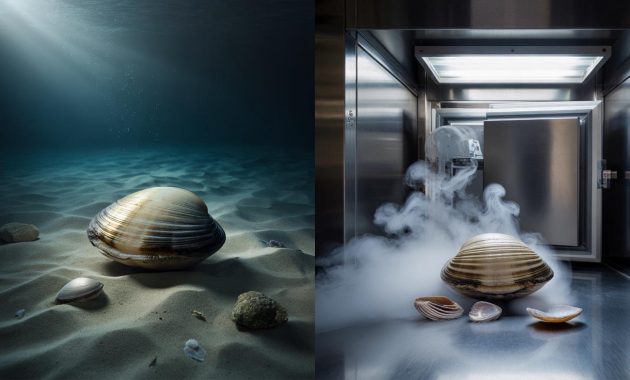
The shell fit in a human hand. That was the first surprise. You expect a creature that’s survived shipwrecks, revolutions and the dawn of the internet to be huge, almost mythological. Instead, it looked a bit like any other clam you might step on at low tide, its ridged shell dulled by five centuries of sand and time.
On a winter day in 2006, on a research ship off Iceland, a marine biologist slid that clam into a tray with dozens of others. Same routine, same motions. Nobody on deck knew they were holding an animal that had already been alive when Leonardo da Vinci was still drawing machines that couldn’t yet exist.
By nightfall, that animal’s story would be over.
Its name, later, would be Ming.
A 507-year-old life, ended in a few minutes
The clam was dredged from the cold, dark seabed in the North Atlantic, about 80 meters down. Down there, light doesn’t travel far. Time moves thick and slow. Creatures live a kind of quiet life that doesn’t care about human calendars or headlines.
Scientists were gathering clams to study ocean temperatures over centuries. The method was simple: collect, freeze, count growth rings on the shells. They wanted data, not drama.
Nobody expected to fish up an animal that had already survived four pandemics and the entire Age of Exploration.
Back in the lab, the clams went into a freezer, like grocery store seafood. A standard scientific step, done thousands of times around the world. The animal that would later be named Ming was among them. When researchers thawed and opened the shell to count the layers, they realised something was off.
There were far more rings than usual. Not 80. Not 120. Not 200. When they double-checked with more precise techniques, the number climbed to 507.
This little bivalve had started its life in 1499. The year before the first Portuguese ships reached Brazil. The year maps still had blank oceans.
➡️ Cucumber with aloe vera: why this simple combination is so often recommended for skin
➡️ Hair professionals say this cut is ideal if your hair volume changes with humidity
➡️ A simple behavior many people overlook can influence long-term well-being
The reason it could live that long is almost insultingly simple: it did almost nothing. Ocean quahogs, the species Ming belonged to, bury themselves in the seabed and barely move. They filter water, grow slowly, keep their metabolism low. Less stress, fewer errors in their cells, less damage from the environment.
That lethargic lifestyle seems to be a golden ticket for longevity. Scientists measured the clam’s growth bands, like tree rings, and found that as it aged, it almost stopped growing. Energy went into maintenance, not speed.
There’s a quiet logic to that: rush through life, burn fast. Or stretch time out, one patient heartbeat at a time.
What Ming’s frozen death reveals about us
For longevity researchers, Ming was a jackpot wrapped in a tragedy. Here was a natural experiment that had run for more than five centuries. Inside those tissues and shells might be clues about how some animals resist aging, cancer, and cellular breakdown far better than humans.
The labs went back to the frozen remains, looked at proteins, membranes, DNA repair systems. They compared Ming’s species with shorter-lived clams. They tried to map what, exactly, was so resilient.
The irony was sharp: the very act of collecting this data had killed the most extraordinary data point they’d ever find.
Many people felt a jolt of discomfort when the story broke. An animal that had cruised through history like a living timeline died because of a routine experiment, carried out by well-meaning scientists. The researchers were stunned too. They hadn’t “killed a legend” on purpose. To them, it had been one shell among many, not a 507-year-old survivor.
We’ve all been there, that moment when you realise only after the fact that what you treated as ordinary was actually irreplaceable. A house sold, a photo thrown away, an elder’s story never recorded.
Ming became a symbol of that sinking, late awareness.
The plain truth is: science is often messy and imperfect. Data usually comes from repetition and routine, not grand epiphanies. On that ship, the protocol was to freeze the animals, not to scan them for world records first.
The case sparked discussions about how we handle rare specimens, especially those that might be old or unique. Some argued for non-lethal methods, like scanning shells or using tiny biopsies. Others pointed out that you only know something is extraordinary after you’ve done the ordinary thing.
It’s a uncomfortable reminder that curiosity can collide with care, and the line only becomes clear in hindsight.
How a clam’s quiet life is reshaping the way we think about aging
What makes a clam live five centuries while many mammals barely pass 70? Researchers looking at Ming’s species, Arctica islandica, focused on the basics: cell membranes, stress resistance, and metabolism. They found that these clams have unusually stable cell membranes that don’t stiffen and crack as quickly over time. Their bodies are also better at cleaning up damaged proteins, like a house that never lets clutter pile too high.
They seem to run on a “low and slow” setting. Less energy wasted, less internal chaos. For scientists studying human aging, that’s gold.
The hope is that by decoding those molecular strategies, we might find ways to extend healthy years in our own lives, even if we never touch 507.
The emotional catch: stories like Ming’s are easy to romanticize and easy to oversimplify. It’s tempting to think, “Ah, so we just need to slow down and we’ll live forever.” Biology doesn’t work like that. Humans have different bodies, different pressures, different trade-offs.
But there are echoes we can borrow. Low chronic stress. Fewer extreme spikes in energy use. Systems in our lives that prevent accumulation of “junk”, whether that’s in our arteries or in our calendars.
Let’s be honest: nobody really does this every single day. We sprint, crash, then promise we’ll be gentler with ourselves tomorrow.
Ming’s story keeps coming back because it compresses a deep truth into one image: an ancient animal, unbothered by human drama, accidentally destroyed by human curiosity.
The clam forces awkward questions into the room:
- How much are we willing to risk in the name of knowledge?
- What counts as “acceptable loss” when the subject can’t consent?
- Which lives do we notice only once they’re gone?
- Could we design research that’s both ambitious and gentler?
- And what does “respect” really mean when we study non-human lives?
*The answers don’t fit neatly in a graph or a grant proposal, and maybe that’s the point.*
A five-century life, a few seconds of decision, and the way we tell the story
Ming’s lifespan covers the fall of empires, the birth of electricity, the first phone call, the launch of Sputnik, the rise of smartphones. While we rushed from invention to invention, this clam stayed mostly in one spot, pulling plankton from the water, laying down one more faint line in its shell each year. There’s something almost rude about how indifferent that life was to ours.
When people read about Ming, they often react with a mix of awe and guilt. Awe at the sheer age. Guilt that the ending came from a freezer rather than a quiet death under the sediment. That discomfort can be useful if we let it linger instead of scrolling past.
Stories like this tug us toward bigger questions, the ones that don’t fit easily in daily life. What does a “good life” even mean for a creature that doesn’t seek adventure or progress? Is longevity a blessing, or just a long, cold routine? And for us, so obsessed with speed and upgrades, what do we really envy in that five-century calm?
Maybe the most honest thing we can do is hold both truths at once: the value of the science Ming enabled, and the quiet sadness of its unnecessary death. That tension is real, and it doesn’t cancel itself out.
If anything, it asks us to pay more attention the next time we pick something up and think, “Just another shell.”
| Key point | Detail | Value for the reader |
|---|---|---|
| World’s oldest known animal | Ming the clam was dated to 507 years, born around 1499 on the North Atlantic seabed | Gives a concrete sense of deep time and how different lifespans can be across species |
| Accidental death in research | The clam was frozen and opened as part of routine scientific sampling before its age was known | Raises ethical questions about how we treat “ordinary” specimens and what we call a necessary sacrifice |
| Clues to longevity | Slow metabolism, stable cell membranes, and robust cellular cleanup systems in this species | Offers insights that may inspire future approaches to healthier human aging and lifestyle choices |
FAQ:
- Question 1Was Ming definitely the oldest animal ever discovered?
- Question 2How did scientists figure out that Ming was 507 years old?
- Question 3Did the researchers break any rules by killing the clam?
- Question 4Are there other animals that can live almost as long?
- Question 5What can Ming’s story realistically change about our own lives?