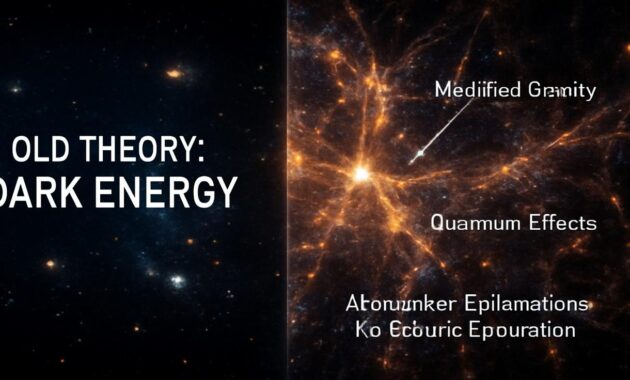
The night sky may appear serene, but deep within the cosmic tapestry, a fundamental shift is underway. Whispers of a radical new theory are rippling through the scientific community, challenging the very foundations of our understanding of the universe’s expansion. What if the force we’ve long attributed to “dark energy” simply doesn’t exist?
This bold proposition has the potential to rewrite the cosmic narrative, forcing us to reevaluate everything from the origins of galaxies to the fate of the universe itself. As researchers grapple with this intriguing possibility, the implications of a universe without dark energy loom large, promising to reshape our view of the cosmos in ways we’ve yet to fully comprehend.
Rethinking the Cosmic Accelerator
For decades, the prevailing model of the universe’s expansion has been predicated on the existence of dark energy, a mysterious force that appears to be driving galaxies apart at an ever-increasing rate. This invisible component, which is said to make up approximately 68% of the universe, has long been a cornerstone of modern cosmology.

However, a growing number of scientists are now questioning the validity of this model, proposing alternative explanations that could upend our understanding of the cosmos. At the heart of this debate is the idea that the observed acceleration of the universe may not be due to dark energy at all, but rather a consequence of our incomplete knowledge of gravity and the fundamental laws that govern the universe.
As researchers delve deeper into this theory, they are exploring the possibility that the expansion of the universe could be driven by a more nuanced interplay of forces, one that does not require the existence of a mysterious and as-yet-undetected dark energy.
Challenging the Consensus
The notion of a universe without dark energy is not entirely new, but it has gained traction in recent years as advances in observation and data analysis have challenged the established paradigm. One of the leading proponents of this alternative view is Erik Verlinde, a theoretical physicist at the University of Amsterdam, who has developed a novel theory of gravity that could potentially account for the observed cosmic acceleration without the need for dark energy.

Verlinde’s theory, known as “emergent gravity,” posits that gravity is not a fundamental force, but rather an emergent phenomenon that arises from the underlying fabric of spacetime. In this framework, the apparent acceleration of the universe could be explained by the way matter interacts with this spacetime fabric, rather than the presence of a mysterious dark energy component.
By rethinking the nature of gravity and the fundamental forces that shape the cosmos, Verlinde and other researchers are challenging the prevailing models of cosmology and offering a tantalizing alternative that could lead to a more comprehensive understanding of the universe.
Measuring Up to Dark Energy
Replacing the dark energy paradigm with a new theory is no easy feat, as any alternative must be able to account for the wealth of observational data that has been used to support the current model. This includes the precise measurements of the cosmic microwave background, the distribution of galaxies, and the behavior of supernova explosions – all of which have been instrumental in shaping our understanding of the universe’s expansion.

Verlinde’s emergent gravity theory, for example, must be able to replicate these observations and make accurate predictions that align with the available data. This is a tall order, as the dark energy model has been refined and tested over decades, and any new theory must be able to match or exceed its explanatory power.
Nevertheless, the proponents of a dark energy-free universe remain undaunted, confident that their alternative models can stand up to scrutiny and offer a more complete and satisfying explanation of the cosmos.
A Walk Through a No-Dark-Energy Universe
Imagining a universe without dark energy requires a radical shift in perspective, one that challenges our most fundamental assumptions about the nature of the cosmos. In this alternative scenario, the observed acceleration of the universe would not be driven by a mysterious and elusive dark energy, but rather by the interplay of known forces and the intricate structure of spacetime itself.

Without dark energy, the expansion of the universe would not be driven by a repulsive force, but rather by the inherent curvature and dynamics of spacetime. This could have profound implications for the evolution of galaxies, the formation of black holes, and even the ultimate fate of the universe.
Moreover, the absence of dark energy would necessitate a rethinking of our understanding of gravity, potentially leading to new insights into the underlying principles that govern the cosmos. This could pave the way for a more unified and comprehensive theory of the universe, one that seamlessly integrates our knowledge of the smallest subatomic particles with the grandest structures of the cosmos.
Implications and Consequences
The potential implications of a universe without dark energy are far-reaching and complex. If this radical theory were to be proven correct, it would force us to reevaluate not only our understanding of the cosmos, but also our place within it.

Without the driving force of dark energy, the future of the universe could look vastly different. The accelerating expansion that has been a cornerstone of our cosmological models may slow or even reverse, leading to a very different fate for the cosmos and the galaxies, stars, and planets that it contains.
Moreover, the absence of dark energy could have profound implications for the development of life in the universe. The balance of forces that has allowed for the formation of complex structures and the emergence of intelligent life may need to be recalibrated, potentially altering the conditions necessary for the existence of beings like ourselves.
Experts Weigh In
“If dark energy doesn’t exist, it would completely upend our understanding of the universe and how it got to be the way it is. We’d have to go back to the drawing board and rethink everything from the ground up.” – Dr. Sarah Bridle, Cosmologist at the University of Manchester

“This is a bold and intriguing proposition, but it’s going to take a lot of work to demonstrate that it can truly account for all the observational evidence we have accumulated over the years. The dark energy model has held up remarkably well, so any alternative will have to be exceptionally robust.” – Dr. John Peacock, Astronomer at the University of Edinburgh
“The idea of a universe without dark energy is both exciting and a little unsettling. It would mean rethinking the very foundations of our cosmological models, but it also opens up new avenues of exploration and the possibility of discovering something truly transformative about the nature of the universe.” – Dr. Claudia de Rham, Theoretical Physicist at Imperial College London
As the scientific community continues to grapple with the implications of a universe without dark energy, one thing is certain: the cosmos is full of surprises, and our understanding of its workings is far from complete. The pursuit of this radical theory could lead to a new era of discovery, where the very fabric of the universe is laid bare, and the secrets of its origins and evolution are finally revealed.

FAQ
What is dark energy, and why is it important in cosmology?
Dark energy is a mysterious force that is said to make up approximately 68% of the universe. It is believed to be driving the accelerating expansion of the universe, and it is a crucial component of the standard cosmological model known as the Lambda-CDM (Lambda Cold Dark Matter) model.
How does the alternative theory of a universe without dark energy work?
The alternative theory, such as Erik Verlinde’s “emergent gravity” theory, proposes that the observed acceleration of the universe can be explained without the need for a dark energy component. Instead, it suggests that the expansion of the universe is driven by the inherent properties and interactions of spacetime itself, rather than a repulsive dark energy force.
What are the key challenges in replacing the dark energy model?
The key challenge in replacing the dark energy model is that the current model has been extensively tested and has been able to accurately explain a wealth of observational data, from the cosmic microwave background to the distribution of galaxies. Any alternative theory must be able to match or exceed the explanatory power of the dark energy model, which is a significant hurdle to overcome.

What would a universe without dark energy look like?
In a universe without dark energy, the expansion of the cosmos would not be driven by a repulsive force, but rather by the inherent properties and dynamics of spacetime. This could lead to a very different evolution of galaxies, the formation of black holes, and even the ultimate fate of the universe, potentially altering the conditions necessary for the emergence of life as we know it.
How would the absence of dark energy impact our understanding of gravity and the fundamental laws of the universe?
The absence of dark energy would necessitate a rethinking of our understanding of gravity and the underlying principles that govern the cosmos. This could lead to the development of a more unified and comprehensive theory of the universe, one that seamlessly integrates our knowledge of the smallest subatomic particles with the grandest structures of the cosmos.
What are the potential implications of a universe without dark energy?
The potential implications of a universe without dark energy are far-reaching and complex. It could change our understanding of the future evolution of the cosmos, the conditions necessary for the development of life, and even our place within the universe. The absence of dark energy could also lead to a fundamental shift in our understanding of the laws of physics and the nature of reality itself.
How likely is it that the dark energy model will be replaced?
The dark energy model has been extensively tested and has held up remarkably well, so the likelihood of it being replaced is still relatively low. However, the emergence of alternative theories, such as Verlinde’s “emergent gravity” model, has sparked renewed interest and debate within the scientific community. Ultimately, it will take a significant amount of observational and theoretical evidence to overturn the well-established dark energy model.
What are the next steps in investigating a universe without dark energy?
The next steps in investigating a universe without dark energy will likely involve further refinement and testing of alternative theories, such as Verlinde’s “emergent gravity” model. This will involve comparing the predictions of these models to the wealth of observational data that has been used to support the dark energy model, as well as exploring new avenues of research and observation that could provide additional insights into the nature of the cosmos.