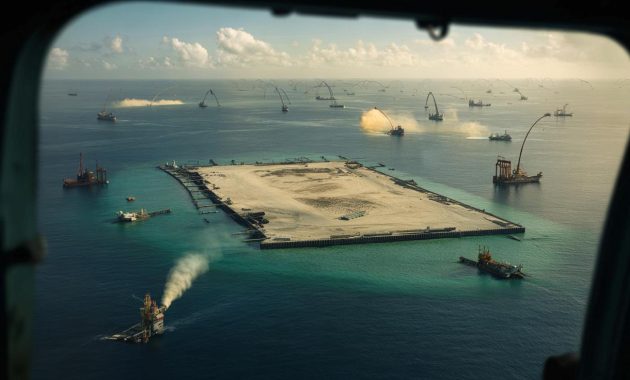
The first thing you notice is the color of the water.
From the window of a surveillance plane over the South China Sea, the blue suddenly turns a cloudy beige, thick like spilled cement. Below, dozens of dredging ships crawl in slow motion, sucking sand from the seafloor and coughing it back out in long pale plumes. Around them, new patches of land are rising where, a few years ago, there was only open ocean.
The pilots don’t speak much. They just circle, watching an entire geography being rewritten in real time.
It feels less like watching construction and more like watching someone edit the map itself.
How China turned empty sea into solid ground
From the outside, “land reclamation” sounds boring, like an accountant’s task. The reality in the South China Sea is closer to a science‑fiction experiment. Over the past decade, China has poured millions of tonnes of sand and crushed coral into shallow reefs and shoals, slowly forcing the ocean to retreat a few meters at a time.
What begins as a ring of waves breaking on hidden rocks becomes, after months of dredging, a beige oval shimmering above the waterline. Then the trucks arrive, the concrete mixers, the cranes.
Soon there are roads, radar domes, fuel tanks. Flags.
One of the most striking examples is Fiery Cross Reef, once just a speck on nautical charts, known only to fishermen and naval officers. Around 2014, satellite images started catching strange streaks in the water: dredging ships, working nonstop.
By 2016, the reef had swollen into a 3,000‑meter airstrip with deep‑water harbor, hangars, and barracks. What was once nearly invisible at high tide had become an island with its own lights, its own postal code, its own permanent presence.
Similar transformations appeared at Subi Reef, Mischief Reef, and several more scattered like stepping stones across disputed waters.
➡️ Hygiene after 65 : not once a day, not once a week, shower frequency that keeps you thriving
➡️ If you want a happier life after 60 admit you are the problem and quit these 6 habits
➡️ How to safely whiten teeth that have yellowed with age, according to dental experts
This isn’t magic. It’s engineering stacked on top of political will. Dredgers suck up sand from the seafloor and blast it over the reef, layer after layer, until the structure rises above high tide. Sea walls are poured to stop the waves from clawing it back. Concrete frames lock the new land in place.
The process is brutally efficient and brutally simple. No coastal ecosystem is delicate enough to survive that kind of violence.
*You don’t “build” these islands gently; you win them from the sea in a hard, one‑way fight.*
The method behind the manufactured islands
If you zoom in on the method, it starts with a survey ship quietly measuring depths and seabed composition. Engineers then pick spots where shallow reefs sit like submerged scaffolding under the water.
Next come the dredgers: hulking vessels with long arms that vacuum the seabed. They work in shifts, day and night, guided by GPS, pushing the sand through floating pipelines that arch across the surface like sleeping snakes.
Bit by bit, a mound grows, breaking the waves, then standing clear of the tide. The moment soil dries in the sun, construction crews move in, almost impatient.
On the ground, the work looks like any hectic construction site, just framed by endless horizon instead of city blocks. Cement trucks roll past stacks of rebar. Workers in faded hard hats shout over the roar of generators. Cargo ships arrive with prefabricated slabs, fuel, even soil trucked from the mainland to sustain patches of imported greenery.
We’ve all been there, that moment when a bare plot of land in your neighborhood suddenly sprouts a building and you feel the scale of change in your gut. Multiply that by an entire ocean.
Let’s be honest: nobody really thinks of coral reefs as “neighborhoods” for fish, turtles, and seabirds until the bulldozers—real or underwater—show up.
Behind the cement and sandbags lies a tight logic. By transforming reefs into islands, Beijing gains more than just runway space. An island can host radar that sees farther, missiles that reach deeper, ships that can rearm and refuel without returning to the mainland. It can anchor claims to “territorial waters” and “exclusive zones” that wouldn’t exist around a mere reef.
The newly raised land turns into a legal and military argument, poured in concrete.
This is why other coastal states watch every new strip of tarmac and seawall photo with a knot in their stomach: land made from sand isn’t just geography, it’s strategy.
What this massive reshaping really changes
For engineers, the first “tip” for making a permanent island is simple: fight erosion from day one. The ocean is a patient enemy. Sea walls are built thick and high, with sloping faces to deflect the waves. Layers of rock, concrete blocks, and sometimes massive “tetrapods” grip the new shoreline.
Drainage channels snake under the surface so the island doesn’t become a sponge that collapses with each storm. The sand is compacted again and again to stop it from sinking.
Without all that, these new outposts would slowly slump back into the water like sandcastles left after sunset.
From an environmental perspective, the “don’ts” are almost endless, and that’s exactly what stings. Dredging smothers coral reefs that took centuries to grow. Fish nurseries vanish in weeks. Sediment clouds drift for kilometers, blocking the light and choking fragile ecosystems.
People who depend on those waters—Filipino fishermen, Vietnamese crews, small coastal communities—see their traditional grounds fenced off by patrol boats or degraded beyond use. The map changes, and then the daily routine changes with it.
For anyone following from afar, it’s tempting to reduce all this to a tidy headline. On the water, it feels more like living next to a construction site you never agreed to.
“From a distance, these artificial islands look like symbols of power,” a regional security analyst told me. “Up close, they’re scars—on the seabed, on diplomacy, and on trust.”
- Environmental costCoral destruction, sediment plumes, disappearing fishing grounds.
- Strategic leapRunways, radars, and deep‑water ports pushed hundreds of kilometers from the mainland.
- Legal gray zoneReefs turned into “islands” to bolster competing maritime claims.
- Daily disruptionFishermen facing new patrols, exclusion zones, and shrinking catches.
- Escalation riskMore ships, more planes, more chances for an incident nobody really wants.
What these rising islands say about us
Step back from the satellite imagery and it’s hard not to see something uncomfortably familiar. A powerful country, pressed by security fears and economic ambitions, leans on engineering to answer political problems. When a map feels constraining, the instinct is to redraw the coastline. When the sea feels too far, you drag the shore toward it.
Other nations have “reclaimed” land before—Dubai’s palm‑shaped islands, Singapore’s expanding coast, the Netherlands keeping the North Sea at bay—but the scale and contested location of China’s projects hit differently. These are not tourist resorts or flood defenses. These are forward bases and bargaining chips.
The unsettling part is how normal the images are becoming. A decade ago, a new airstrip materializing in open water would have dominated front pages for days. Now it often slips into the feed as just another satellite graphic, wedged between celebrity gossip and sports highlights.
Some readers scroll past, thinking, “That’s far away, it won’t touch me.” Yet the sea lanes that pass near these islands carry the products on our desks, the fuel in our cars, the phones in our hands. The stakes are woven quietly into our routines.
There’s no neat moral here, no easy villain‑hero script that survives contact with history, economics, and local fears. What’s left is a set of uneasy questions.
How far should human engineering go in rewriting nature for advantage? When does “reclamation” become occupation? And what happens when other countries start thinking, “If they can build new land from scratch in disputed waters, why can’t we?”
The sand has already been dumped. The islands are already lit up at night. What comes next is less about concrete, and more about what the world decides to tolerate when the map itself becomes negotiable.
| Key point | Detail | Value for the reader |
|---|---|---|
| Scale of construction | Millions of tonnes of sand and coral used to raise reefs into full‑fledged islands | Gives context to headlines about “artificial islands” that can feel abstract |
| Strategic function | Runways, radars, and harbors extend military and political reach deep into disputed waters | Helps explain why other countries react so strongly to distant construction projects |
| Hidden costs | Long‑term damage to coral ecosystems and livelihoods of coastal communities | Connects geopolitics to everyday lives, not just to states and armies |
FAQ:
- Question 1Are China’s artificial islands natural land or purely man‑made?
- Answer 1They sit on natural reefs and shoals, but the visible landmass—runways, bases, buildings—is almost entirely created by dumping and compacting sand, rock, and concrete.
- Question 2Why is China building these islands in the first place?
- Answer 2They serve multiple goals: strengthening territorial claims in the South China Sea, extending military range, supporting coast guard and fishing fleets, and gaining leverage over critical shipping routes.
- Question 3Is this kind of island building legal under international law?
- Answer 3It’s contested. Land reclamation itself isn’t banned, but using new structures to claim extra maritime zones clashes with international rulings that treat many of these features as rocks or low‑tide elevations, not full “islands.”
- Question 4What impact do these projects have on the environment?
- Answer 4Dredging buries coral reefs, stirs up sediment clouds that spread for kilometers, and disrupts habitats for fish, turtles, and seabirds, with knock‑on effects for local fishing communities.
- Question 5Could other countries start building their own artificial islands in disputed seas?
- Answer 5Some already use smaller‑scale reclamation, and China’s example may tempt others to follow. That raises the risk of a “build‑up race” where concrete, not diplomacy, sets the boundaries.