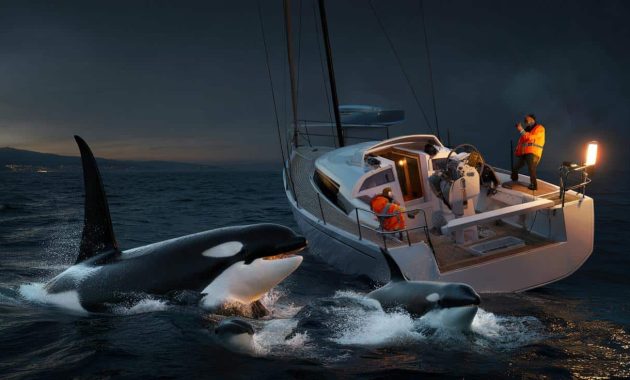
The first crack sounded like someone had hit the hull with a sledgehammer.
On the night sea off Gibraltar, the sky was flat black, the only light a trembling strip from the stern. Then came the second blow, harder, followed by the sickening screech of fiberglass giving way. The skipper grabbed the tiller, but the wheel spun uselessly. Under the surface, white flashes moved with eerie precision. Orcas. The “cute” black‑and‑white stars of wildlife documentaries, now ramming a 12‑meter sailboat like a toy.
On the VHF, another boat was already calling Mayday.
The orcas kept circling.
When the ocean’s darlings turn into a nightmare for sailors
Ask any cruising sailor in 2024 what scares them most, and many won’t say storms. They’ll say orcas.
The same animals we grew up admiring on posters and in aquariums have quietly become the most unpredictable hazard for small boats in parts of the Atlantic. What started as a strange curiosity off Spain in 2020 has turned into a pattern: deliberate, repeated attacks on sailboats, focused on rudders and keels.
On social media, you see the same images again and again.
Men and women in life jackets, voices shaking, filming those black fins as if they were a slow, intelligent storm.
Take the busy stretch between the Strait of Gibraltar and Galicia, along the Spanish and Portuguese coasts. Since 2020, researchers estimate there have been hundreds of “interactions” between orcas and boats, with at least several dozen vessels seriously damaged or sunk. One popular tracking map, shared in sailing groups, is now dotted with red warning icons like a spreading rash.
Ask skippers coming into port in Cádiz or Lagos and you’ll hear the same kind of story.
The boat suddenly shudders. The wheel goes slack. The rudder is gone.
A French couple told local media they had less than 10 minutes from the first hit to abandoning their boat. They watched from the life raft as the orcas stayed with the wreck, as if inspecting their work.
Marine biologists resist calling this “aggression”. They talk about play, social learning, maybe trauma passed through a pod after a bad encounter with a fishing boat. The fact remains: a specific group of Iberian orcas has developed a very specific behavior, and it’s spreading among younger animals like a dark trend on an underwater TikTok.
For sailors, the nuance doesn’t change much. A playful 6‑tonne predator smashing your steering in open water is still a crisis.
**The contradiction is brutal**. These orcas belong to an endangered population protected by European law, and yet they’re now directly endangering human lives and livelihoods. Spanish and Portuguese authorities are torn between two missions: save a species or protect people on fragile hulls passing through its hunting ground.
Between flares, fear, and fines: how people are actually reacting at sea
On paper, the guidelines are simple: slow down, disconnect the autopilot, keep hands and feet out of the water, avoid loud noises, do not throw anything or try to harm the animals, and radio for help if the rudder is damaged. On the water, in the dark, with a family on board and a 3‑meter dorsal fin coming straight at your stern, those nice bullet points evaporate.
So new rituals appear.
Some crews now cross high‑risk zones at dawn, in convoy, sharing live position updates in WhatsApp groups. Others hug the coast, even if it means rougher seas. There are skippers who hang fenders off the stern like jellyfish, hoping to confuse the orcas. Nobody really knows what works, and everyone pretends they do.
➡️ Day turns to night as the longest total solar eclipse of the century sweeps across multiple regions
➡️ “I saved $650 in four months by reducing decision fatigue”
➡️ 10 hobbies to adopt that help prevent loneliness in old age, according to psychology
The gray zone gets darker when panic meets the law. Firing flares at orcas is illegal. So is using homemade “pingers” or trying to shock them with metal bars. Yet there are quiet confessions on docks and in bars. A British skipper in Lisbon admits he “banged like crazy” on the hull with a crowbar to scare them off, then deleted the GoPro footage. A Spanish fisherman shows photos of sliced tuna left as “tribute”, hoping the orcas will take the bait instead of his rudder.
Let’s be honest: nobody really follows the rulebook to the letter when the boat starts to flood.
*Survival instinct doesn’t read conservation protocols.* And **that’s exactly where the current policy is failing** — it assumes rational compliance in a moment that is anything but rational.
Officially, Spanish and Portuguese authorities repeat the same line: protect the orcas, report the incidents, adapt routes. Unofficially, you can sense the fatigue. Coast guard crews are spending more time escorting damaged yachts. Insurance claims are rising. Passenger confidence in charter companies is sliding. And on Facebook and sailing forums, a new, more hostile narrative is emerging: “If they’re attacking us, we should be allowed to defend ourselves.”
Inside ministries and marine institutes, the discussion is getting sharper. Do you move shipping lanes? Close zones to small boats in peak season? Authorize non‑lethal deterrents that might still stress an already fragile population?
The choice is no longer abstract. **Each new attack pushes public opinion one notch closer to a demand for force.**
Forced to take sides: science, law, and the raw politics of fear
Behind closed doors, the “pick a side” moment has already started. Marine authorities are quietly reviewing charts, looking at where incidents cluster, calculating which corridors could be reserved for commercial ships and which could be avoided by leisure craft. It’s not exactly a ban, not yet. More like squeezing sailors into narrower paths, hoping the orcas will lose interest.
One practical method that’s gaining traction is route timing. Cross certain hot spots only in daylight, with two people on watch at the stern, engine ready, radio checks done. If you can, sail in loose flotillas. Boats that talk to each other react faster. The sea remains wild, but you’re not alone in the wild.
There’s also quiet coaching going on in yacht clubs and sailing schools. Old‑timers warn younger skippers against macho reflexes. Don’t try to “outrun” a predator that can hit 50 km/h. Don’t freeze in denial while your rudder is hanging by a thread. The smarter reaction now is almost counterintuitive: slow down, observe, protect the crew, and start planning for the worst‑case scenario — towing, a drogue, maybe even abandonment.
We’ve all been there, that moment when theory and reality split apart and you have to improvise. The trick is not to improvise from zero. Have a grab‑bag ready. Talk in advance about who does what if the rudder fails. And accept that sometimes the bravest thing is to turn back to port instead of insisting on a dangerous route just because the forecast looks fine on paper.
Marine biologist Alfredo López, who has been tracking the Iberian orcas for years, put it bluntly in a Spanish interview: “We are facing a clash between empathy. Empathy for an intelligent, endangered predator, and empathy for people who feel trapped in a game they never agreed to play.”
- Before departure
Check the latest orca interaction maps, talk to local harbor masters, update your emergency contacts, and review insurance coverage for wildlife damage. - On board equipment
Prepare a dedicated “orca kit”: extra fenders, a sharp knife for cutting lines, waterproof phone with tracking apps, printed mayday script, and a backup steering system if your boat allows it. - After an incident
Document everything once safe: time, GPS position, behavior of the animals, type of damage. Report to national authorities and research programs; your bad night can become useful data for everyone else.
An uncomfortable mirror: what these attacks really say about us
Strip away the drama and this story is less about “killer whales” and more about how we react when nature stops playing by our script. For years, orcas were the perfect symbol: wild but photogenic, fierce yet trainable, a kind of ocean superhero we could project onto without feeling threatened. Now they’re scratching our boats and our certainties at the same time.
The easy reaction is anger. The harder one is to accept that we’ve pushed wildlife into tighter corners, packed shipping lanes over feeding grounds, overfished their prey, then acted shocked when their behavior shifts. None of that excuses a broken hull in a cold Atlantic night. It does change how we frame the question “Who is attacking whom?”
What happens next will say a lot about our priorities. If public pressure wins, we might see aggressive deterrents, chased pods, maybe even “problem” orcas quietly removed. If science and long‑term thinking hold, we’ll likely have to redraw routes, slow down in certain areas, and accept that some stretches of sea are no‑go zones for fragile recreational boats, at least for a while.
On the docks from La Rochelle to Lagos, people are already choosing their camp, sometimes without admitting it. There are those who say, “We’re entering their house, we adapt.” And those who answer, “No animal is worth a human life.” Between those two sentences sits a messy, uncomfortable middle ground where most of us actually live — sailing, scrolling, arguing, and secretly wondering what we would do if a black fin appeared just off our stern.
| Key point | Detail | Value for the reader |
|---|---|---|
| Rising orca–boat incidents | Hundreds of interactions and dozens of serious damages reported since 2020, especially off Iberia | Helps sailors and ocean lovers understand that this is no longer a rare anomaly but a real risk to plan around |
| Conflicting missions for authorities | Need to protect an endangered predator while also safeguarding human life and maritime activity | Clarifies why official responses feel slow or contradictory, and where future regulations might go |
| Practical adaptation strategies | Route timing, convoys, on‑board preparation, and post‑incident reporting to researchers | Gives concrete steps readers can use or share, turning anxiety into informed action |
FAQ:
- Are orcas really trying to sink boats on purpose?Current research suggests a learned behavior focused on rudders, possibly play, curiosity, or a response to past trauma, not a coordinated plan to kill humans. Yet the damage can still be severe enough to sink a vessel.
- Which areas are most affected by orca attacks on sailboats?Most reported incidents involve the Iberian orca population, especially along the Spanish and Portuguese Atlantic coasts, including the Strait of Gibraltar and up toward Galicia.
- Can sailors legally defend themselves against attacking orcas?In Spain and Portugal, these orcas are strictly protected. Intentional harm, harassment, or use of aggressive deterrents can lead to serious fines or prosecution, even after a frightening incident.
- Do engines or certain boat types attract orcas more?Reports show a clear focus on sailing yachts, especially medium‑sized monohulls with deep rudders. Motorboats and catamarans appear less frequently in incident logs, though they are not completely exempt.
- What’s the most realistic way this conflict could be resolved?Experts talk about a mix of better routing, temporary exclusion zones for small craft, improved data sharing, cautious deterrent testing, and long‑term recovery of orca prey species so boats become less “interesting” targets.