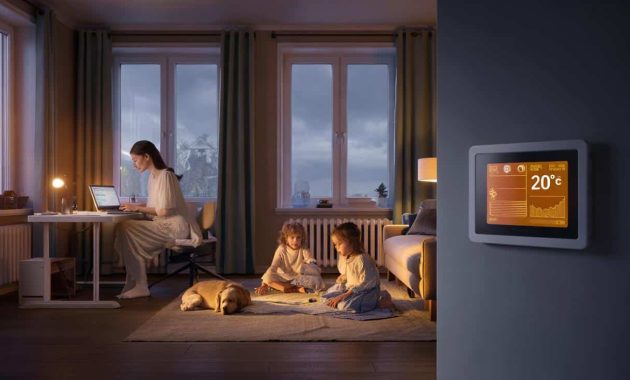
On a grey November morning, Jeanne walks barefoot across her living room and jumps back like she’s stepped on ice. The thermostat flashes 19 °C, proud and stubborn, like a badge of virtue from the 1970s. She pulls on a sweater, then another, then wraps herself in a throw she bought on sale. Still, she’s cold. She sighs, thinking of the endless advice to “heat to 19 °C, not one degree more” if you care about the planet and your bill.
But her kids are sniffling again, her partner works from home shivering in video calls, and the dog refuses to leave his blanket. At what point does “recommended” turn into “unlivable”?
The truth is, the famous 19 °C rule no longer fits the way we live today.
Why the 19 °C rule no longer matches our real lives
The 19 °C standard was born in a different world. Smaller homes, fewer screens, no remote work marathons, tighter family budgets, and a huge focus on saving oil during the energy crises. That number became a kind of moral temperature: heat more and you’re selfish, less and you’re heroic.
Fast forward to 2025. We spend more time at home, we work, exercise, cook, even attend school between four walls. A so‑called “correct” temperature that was fine when you only sat in your living room for two hours at night doesn’t always work when you’re there ten hours straight. Our routines have changed. The rule hasn’t.
Take Paul, 38, graphic designer, remote since the pandemic. He tried to stick to the strict 19 °C recommendation all winter last year. Third day in, he noticed his shoulders were constantly tense. By the end of the week, he had headaches and he was typing with frozen fingers.
He ended up buying a small electric heater to put by his feet. His gas consumption went down a bit, but his electricity bill exploded. Result: he spent more, felt worse, and still thought he was “doing it wrong”. That guilty feeling around heating is shared in a lot of households. We lower the dial, we suffer in silence, and we tell ourselves we’ll get used to it.
Energy experts and doctors are increasingly saying the same thing: the conversation needs to shift from “one magic number” to a range that fits both health and usage. They talk about “thermal comfort” rather than a rigid figure. Your ideal temperature depends on several factors: how insulated your home is, your age, your activity, your health, and even humidity levels.
*One person can feel fine at 19 °C while another will need 21 °C to stop shivering at their desk.* The new recommended temperatures are more nuanced, room by room, hour by hour. Less moralising, more realistic.
The new expert benchmark: a flexible range, not a single number
So what do specialists recommend now? Most recent guidelines converge on a simple idea: aim between 19 °C and 21 °C in main living spaces during the day, with 20 °C as a **practical new reference point** for modern lifestyles. That half degree or one degree extra compared to the old dogma can radically change how you feel from morning to night.
➡️ Experts claim that strict parents raise more successful children but also more anxious adults
➡️ I learned it at 61 : few people know the difference between white eggs and brown eggs
➡️ If the ATM keeps your card, this fast technique instantly retrieves it before help arrives
For bedrooms, many doctors still suggest 16–18 °C for good sleep, but they insist that children, elderly people, and those with chronic illnesses may need 18–20 °C. The famous “one size fits all at 19 °C” fades, replaced by a spectrum that takes the human body into account. Temperature becomes an adjustment, not a moral exam.
The tricky part comes when this flexible range meets your bank account. We all know the rule: 1 °C less can save 5 to 7% on your heating bill. This figure is true… on paper. In real life, it depends on the energy source, the insulation, and whether you’re constantly turning the heating off and on.
Let’s be honest: nobody really does this every single day. We lower the thermostat too sharply, then crank it up when we’re freezing, creating temperature roller coasters that waste energy without bringing real comfort. Experts now argue that a stable 20 °C in the living room, with good insulation and smart programming, can be both comfortable and economical.
Behind this shift is a clearer understanding of health outcomes. Prolonged exposure to indoor temperatures below 18 °C increases respiratory risks, complicates cardiovascular issues, and tires the body. People who work from home and sit still for hours are even more sensitive to cold than those who move all day. It’s not just a matter of comfort.
This is why more and more doctors publicly support the idea of a **“healthy comfort threshold”** around 20 °C for most adults in living spaces, with some flexibility depending on vulnerability. The message is subtle but strong: saving energy shouldn’t mean enduring cold at home. Balance beats sacrifice.
How to heat smarter: the right gestures for 20 °C without blowing your budget
The simplest method endorsed by many energy advisors goes like this: choose a target, often 20 °C for your living room, and keep it stable during your active hours. Program your thermostat rather than adjusting it manually ten times a day. Lower by 2–3 °C at night or when you’re out for more than three hours, not more.
In bedrooms, test 17–18 °C with a slightly warmer duvet, then adapt if someone in the family is sensitive to the cold. In the bathroom, 21–22 °C just during showers is reasonable. You’re not looking for uniform heat everywhere, all day, but a **smart map of temperatures**, tailored to how you use each room.
Where many households stumble is in the small “energy leaks” that sabotage every effort. Radiators hidden behind sofas, thick curtains covering heaters, windows never aired for fear of “wasting heat”, doors left open between rooms with very different temperatures. These habits nudge the thermostat upwards without you noticing.
You’re not alone if you feel a bit lost between guilt, comfort, and bills. We’ve all been there, that moment when you hesitate between a hot shower and three extra degrees in the bedroom. The goal isn’t to become a heating control freak. It’s to find a routine that feels bearable in January and still acceptable once the bill lands.
Experts insist on two pillars: insulation and regular maintenance. Poor insulation makes any temperature feel wrong, too cold near windows, too hot by the radiators. A quick tune‑up of your boiler, bleeding radiators at the start of the season, installing thermostatic valves: these are simple moves with visible impact.
“People often think they have a heating problem, when they actually have a distribution and regulation problem,” explains an energy efficiency consultant. “Once radiators are balanced and rooms are correctly programmed, 20 °C suddenly feels a lot more comfortable.”
- Seal air leaks around windows and doors: small cost, big comfort gain.
- Free radiators from furniture and heavy curtains: let the heat circulate.
- Use a programmable thermostat: stable temperature, fewer spikes on the bill.
- Distinguish living, sleeping, and passage areas: each with its own setpoint.
- Layer clothing moderately instead of piling on coats indoors: comfort, not survival mode.
A new relationship with indoor heat, between comfort and responsibility
Behind this quiet revolution from 19 °C to around 20 °C lies a broader question: what kind of comfort do we accept, and at what cost, both personal and collective? Some will keep to 19 °C by conviction, wrapped in thick sweaters, and feel fine. Others will finally dare switch to 20–21 °C in their living room, breathe easier, and still pay attention to insulation and habits.
The real shift is not just the number on the thermostat. It’s the permission to adapt, to listen to your body, your family, your home. To admit that energy sobriety can coexist with health and warmth. That we can talk about degrees without judgment, experiment from one winter to the next, and share tricks rather than guilt.
Maybe the right question this year is not “Am I at 19 °C?” but “Do I feel well at home without wasting energy?” The answer will rarely be exactly the same for everyone on the street. And that might be good news.
| Key point | Detail | Value for the reader |
|---|---|---|
| From fixed 19 °C to flexible 19–21 °C | Experts now recommend a comfort range with ~20 °C as a central benchmark for living spaces | Helps adjust heating without guilt while staying within health and budget limits |
| Room‑by‑room temperature map | Cooler bedrooms (16–18 °C), warmer bathrooms (21–22 °C), stable living areas | Gives a concrete plan to fine‑tune each room instead of applying one rigid rule |
| Smart habits over sacrifice | Insulation, regulation, and stable settings beat extreme “turn it down” gestures | Improves comfort and reduces bills without feeling like you’re freezing for nothing |
FAQ:
- What is the new recommended temperature for living rooms?Most experts now suggest a range between 19 °C and 21 °C, with around 20 °C as a realistic reference for current lifestyles, especially if you spend long hours at home.
- Is 19 °C too cold for working from home?For some people, yes. If you sit still for many hours, you may feel better at 20–21 °C, combined with light layers of clothing and a properly adjusted chair and desk.
- What temperature should I choose for bedrooms?For healthy adults, 16–18 °C usually supports good sleep. Children, older adults, and people with certain conditions may need 18–20 °C, plus appropriate bedding.
- Does increasing by 1 °C always explode the bill?Not necessarily. The classic 5–7% figure depends on your insulation, heating system, and patterns. A stable, slightly higher setting can sometimes cost less than big daily ups and downs.
- How can I feel warmer without pushing the thermostat too high?Improve insulation, free your radiators, use a programmable thermostat, close doors between heated and unheated areas, and use rugs and curtains to reduce cold surfaces.